Definition:
A + spread in betting means the team or player is the underdog and is given extra points. If you bet on the + spread, your pick can either win the game outright or lose by fewer points than the spread and still win the bet.
If you’ve ever looked at a sportsbook line and seen something like Team A +7.5, you might wonder what that plus sign actually means. It’s one of the most common symbols in sports betting, yet it confuses beginners all the time. The good news: once you understand the idea of the underdog getting a scoring advantage, everything clicks into place.
This guide explains the + spread in simple terms, shows how it works with real examples, compares it with the minus spread, and gives practical tips for interpreting betting lines correctly.
What Is a + Spread in Betting?
A + spread indicates that a team is the underdog and receives extra points before the game starts for betting purposes.
Core Idea
• The + team starts with a point advantage
• You win if they win OR lose within the spread
• The number shows how many points they are given
Simple Example
If a team is listed as +5, they can:
• Win the game → bet wins
• Lose by 1–4 points → bet wins
• Lose by exactly 5 → usually a push (tie bet)
• Lose by 6 or more → bet loses
Origin and Purpose of Point Spreads
Point spreads were created to balance betting on uneven matchups. Instead of everyone betting on the stronger team, sportsbooks give the weaker team extra points to make both sides attractive.
This system is widely used in major sports leagues such as the NFL, NBA, and NCAA.
The spread doesn’t predict the exact score. It reflects the expected margin of victory.
Why the Plus Sign Matters
The + symbol tells you instantly which side is expected to be weaker.
What the + Symbol Signals
• Underdog status
• Extra points added to final score
• Greater margin for winning the bet
Think of it as a head start before the game begins.
How a + Spread Works Step by Step
Step 1: Identify the Spread
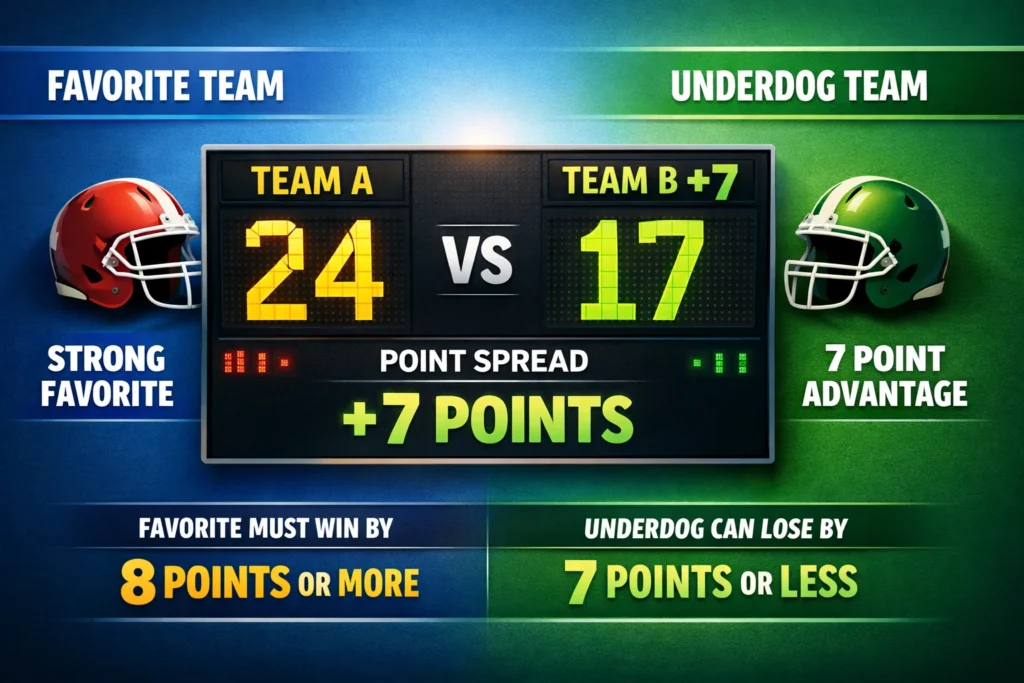
Example: Team B +7
Step 2: Apply the Points
Add 7 points to Team B’s final score.
Step 3: Determine Outcome
If adjusted score beats opponent → bet wins.
Real-World Betting Examples
Example 1: Football Game
Spread: Underdog +3.5
Final Score: Favorite 24, Underdog 21
Adjusted Score: 24 vs 24.5
Result: Underdog covers → bet wins
Example 2: Basketball Game
Spread: Underdog +8
Final Score: Favorite 110, Underdog 103
Adjusted Score: 110 vs 111
Result: Bet wins
Example 3: When the Bet Loses
Spread: Underdog +6
Final Score: Favorite 30, Underdog 20
Adjusted Score: 30 vs 26
Result: Bet loses
Tone and Meaning in Betting Language
The + spread carries a clear implication about expectations.
Neutral Meaning
The team is expected to lose but remain competitive.
Positive Interpretation 🙂
The underdog has a cushion that improves your chances.
Dismissive or Analytical Context
Oddsmakers believe the team is weaker.
The tone depends on perspective. Bettors often see + spreads as opportunity.
+ Spread vs – Spread
This is the most important comparison for understanding betting lines.
Key Difference
• + Spread = Underdog gets points
• – Spread = Favorite gives points
Comparison Table
| Spread Type | Team Status | What Must Happen to Win Bet |
|---|---|---|
| + Spread | Underdog | Win or lose by fewer points than spread |
| – Spread | Favorite | Win by more points than spread |
Memory Tip
Plus = Protection
Minus = Pressure
Example Betting Line Breakdown
| Team | Spread | Meaning |
|---|---|---|
| Team A -6.5 | Favorite | Must win by 7+ |
| Team B +6.5 | Underdog | Can lose by 6 or less |
Both bets relate to the same expected margin.
When Bettors Choose the + Spread
Many bettors prefer underdogs for strategic reasons.
Common Reasons
• Higher margin for error
• Value in close matchups
• Upset potential
• Psychological bias toward favorites
The + spread can be appealing when games are expected to be tight.
Alternate Meanings of “+” in Betting
The plus sign can appear in other betting contexts, but the meaning changes slightly.
Moneyline Betting
+150 means potential profit on a winning bet
It does NOT involve point spreads
Spread Betting
- always refers to extra points
Context determines the meaning.
Usage Tips for Reading Betting Lines
When you see a + spread, follow this simple checklist:
- Identify the underdog
- Note how many points they receive
- Add points to their final score
- Compare adjusted result
This method removes confusion instantly.
FAQs
1. What does + spread mean in betting?
A + spread means the underdog receives extra points and can win the bet by winning outright or losing within the spread.
2. Does + mean the team is expected to lose?
Yes. The + team is considered the underdog.
3. Can you win a bet if the + team loses?
Yes, if they lose by fewer points than the spread.
4. What happens if the score equals the spread?
The bet is usually a push and your stake is refunded.
5. Is + spread safer than – spread?
It can be, because the underdog gets a scoring advantage.
6. What does +7.5 mean?
The team gets 7.5 points added to its final score.
7. Is + spread the same as moneyline?
No. Spread betting uses points, moneyline betting uses odds.
8. Why do sportsbooks use spreads?
To balance betting action between teams.
Conclusion
Understanding a + spread is essential for anyone interested in sports betting. A + spread indicates that a team is the underdog and is given extra points, giving bettors a better chance to win even if the team does not win outright. By knowing how to read and interpret the + spread, you can make smarter betting decisions and better evaluate game matchups.
Remember, a + spread doesn’t guarantee a win it simply gives the underdog a points cushion. When combined with careful analysis of the teams and game conditions, using the + spread can be a powerful tool to improve your betting strategy.
Discover More Related Articles:
- PFP Mean in Text: Complete Guide for Social Media Users (2026)
- Shabbat Shalom Mean in English: Usage, and Significance in 2026

Amanda Lewis is a professional content writer and word-meaning researcher who specializes in explaining definitions, slang, abbreviations, and modern language terms. She writes for WordNexy.com, where she creates clear, accurate, and reader-friendly articles to help users understand word meanings and proper usage. Her work is especially useful for students, writers, and online readers seeking quick and reliable explanations.