Definition:
A spread in sports betting is a number set by oddsmakers that represents the expected margin of victory in a game. Bettors wager on whether a team will win by more than the spread or lose by less than the spread.
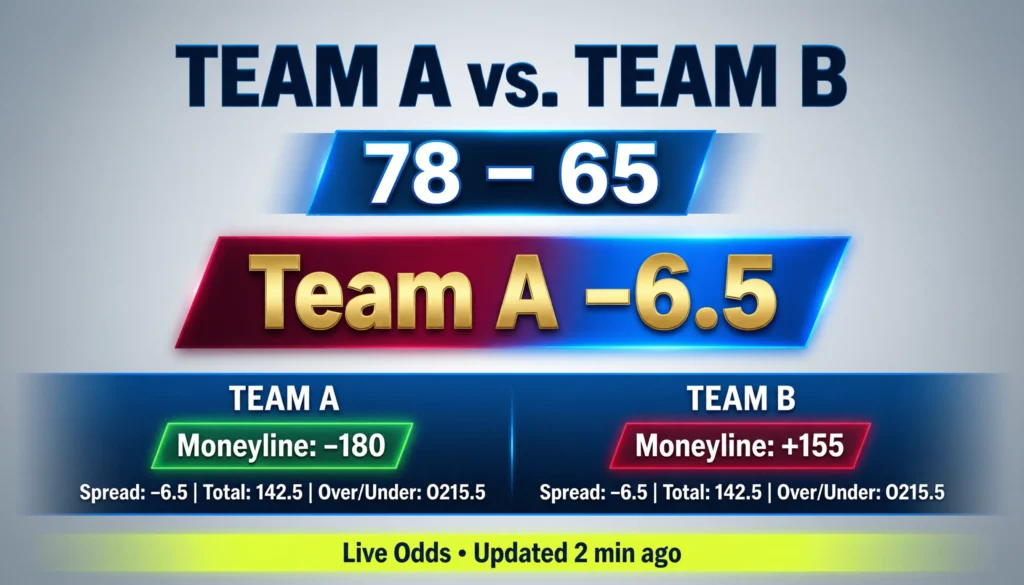
If you have ever looked at a betting line and seen something like “Team A -6.5,” you have already encountered a point spread. It is one of the most common and widely used concepts in sports wagering, designed to balance uneven matchups and create fair betting opportunities on both sides.
This guide explains what a spread means in sports betting, how it works, why it exists, and how to read and use it with confidence.
What a Spread Means in Plain English
The spread levels the playing field between two teams.
- The favorite must win by more than the spread
- The underdog can either win outright or lose by less than the spread
- The spread reflects how much better one team is expected to be
Example:
If the spread is Team A -7, Team A must win by 8 or more points for a bet on them to win.
If you bet on Team B +7, they win the bet if they:
- Win the game, or
- Lose by 6 or fewer points
It is not about who wins the game. It is about margin of victory.
Why Sportsbooks Use Point Spreads
Sportsbooks use spreads to make betting more competitive and balanced. Without spreads, most people would simply bet on the stronger team.
Spreads help:
- Balance betting action on both teams
- Reflect perceived team strength
- Increase engagement for mismatched games
- Create strategic betting decisions
Point spreads are especially common in major leagues like the National Football League and the National Basketball Association, where scoring margins are predictable enough to set meaningful lines.
How to Read a Betting Spread
A typical spread looks like this:
Team A -6.5
Team B +6.5
Here is what each number means:
- Minus sign (-) indicates the favorite
- Plus sign (+) indicates the underdog
- The number represents expected margin
Key Rule
Favorites must win by MORE than the number.
Underdogs must lose by LESS than the number or win.
Step-by-Step Example
Game: Miami vs Dallas
Spread: Dallas -4
Betting outcomes:
- Dallas wins by 5 or more → Dallas spread bet wins
- Dallas wins by 1 to 3 → Dallas spread bet loses
- Miami wins → Miami spread bet wins
- Dallas wins by exactly 4 → Push (bet refunded)
Half-point spreads like -4.5 exist to avoid ties.
Tone and Context Examples
While this is a technical term, it appears in everyday sports conversation.
Friendly tone
“I took the underdog with the spread. They did not win, but they covered.”
Neutral tone
“The team failed to cover the spread despite winning the game.”
Dismissive tone
“They only care about the spread, not who actually wins.”
Spread Betting Outcomes Table
| Spread | Favorite Result | Underdog Result | Betting Outcome |
|---|---|---|---|
| -7 | Wins by 10 | Loses by 10 | Favorite covers |
| -7 | Wins by 3 | Loses by 3 | Underdog covers |
| -3 | Wins by 3 | Loses by 3 | Push |
| +5 | Loses by 4 | Loses by 4 | Underdog covers |
| -6.5 | Wins by 6 | Loses by 6 | Underdog covers |
Origin and Popularity of the Point Spread
The modern point spread system became popular in the mid-20th century as sportsbooks sought more balanced betting markets. It transformed sports wagering from simple winner prediction into a strategy-driven activity focused on performance margins.
Today, spreads are the standard format for betting on football and basketball and are widely used across global sports markets.
Common Variations of the Spread
1. Point Spread
Most common format. Based on score difference.
2. Run Line (Baseball)
A fixed spread, typically 1.5 runs.
3. Puck Line (Hockey)
Usually set at 1.5 goals.
4. Live Spread
Adjusted during the game based on performance.
Spread vs Other Betting Types
Understanding how spreads compare to other wagers helps clarify their role.
| Bet Type | What You Predict | Risk Level | Typical Use |
|---|---|---|---|
| Spread | Margin of victory | Medium | Most common |
| Moneyline | Who wins | Low to high | Simple outcome |
| Over/Under | Total score | Medium | Score prediction |
| Parlay | Multiple bets combined | High | Higher payout |
Professional Alternatives and Related Terms
In formal or betting contexts, you may see:
- Point spread
- Betting line
- Handicap
- Margin line
- Cover the spread
“Covering the spread” means a team performed well enough relative to expectations.
Alternate Meanings of “Spread”
Outside sports betting, “spread” can refer to:
- Financial market difference between prices
- Food arrangement
- Statistical distribution
In sports betting, it specifically refers to expected scoring margin.
When Bettors Use the Spread Strategically
Experienced bettors often consider:
- Team injuries
- Recent performance trends
- Home-field advantage
- Public betting patterns
- Weather conditions
The spread reflects expectations, not guarantees.
Practical Tips for Understanding Spreads
- Focus on margin, not winner
- Check half-point differences
- Understand push scenarios
- Compare spreads across sportsbooks
- Avoid betting based solely on favorites
FAQs:
1. What does -7 mean in sports betting?
The favorite must win by more than 7 points.
2. What does +7 mean in betting?
The underdog can lose by up to 6 points or win outright.
3. What does it mean to cover the spread?
A team performs well enough relative to the spread to win the bet.
4. What happens if the margin equals the spread?
It is a push and the bet is refunded.
5. Why are spreads sometimes decimals?
Half-points prevent ties.
6. Is betting the favorite safer?
Not necessarily. The spread already accounts for team strength.
7. Are spreads used in all sports?
Most common in football and basketball.
8. Can spreads change after they are set?
Yes. Lines adjust based on betting activity and new information.
Conclusion
A spread in sports betting represents the expected margin of victory and creates balanced wagering opportunities. It shifts focus from simply predicting winners to evaluating performance relative to expectations.
Understanding how spreads work helps bettors read odds correctly, interpret game predictions, and make more informed wagering decisions.
Discover More Related Articles:
- PFP Mean in Text: Complete Guide for Social Media Users (2026)
- Shabbat Shalom Mean in English: Usage, and Significance in 2026

James Anderson is an experienced content writer and language researcher who focuses on explaining word meanings, definitions, slang terms, and modern expressions. He writes for WordNexy.com, where his articles are designed to provide accurate meanings, practical usage examples, and easy-to-understand explanations for readers worldwide.