
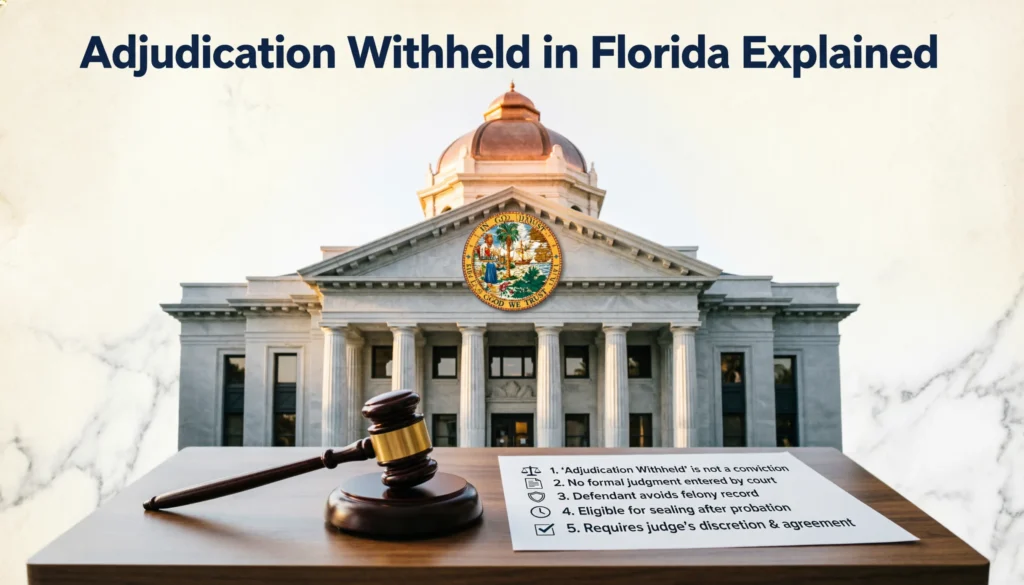
Adjudication withheld in Florida means a judge decides not to formally convict a defendant even after a guilty plea or verdict, allowing the person to avoid a formal conviction on their record if they complete court-ordered conditions.
If you have reviewed a Florida court record and seen the phrase “adjudication withheld,” you might wonder whether the person was found guilty or not. The answer is nuanced and very important for employment, housing, licensing, and future legal consequences.
This guide explains what adjudication withheld means in Florida, why judges use it, how it affects your record, and how it compares to related legal outcomes. Everything is explained in clear, practical terms.
What “Adjudication Withheld” Means in Plain English
When a court withholds adjudication:
- The defendant admits guilt or is found guilty
- The judge does not enter a formal conviction
- The defendant must comply with conditions such as probation, fines, or classes
- If conditions are completed, the person avoids a conviction on record
It is a legal middle ground between conviction and dismissal.
You are not found innocent.
You are also not formally convicted.
That distinction can significantly affect your future.
Why Florida Uses Adjudication Withheld
Florida courts use this outcome to balance accountability with rehabilitation. Judges often grant it when:
- The offense is nonviolent
- The defendant has little or no prior criminal history
- The court believes the person can reform
- A conviction would create disproportionate long-term harm
It functions as a structured second chance rather than automatic forgiveness.
Legal Origin and System Context
Adjudication withheld exists within Florida’s discretionary sentencing framework. State law allows judges to impose penalties without entering a formal conviction when appropriate.
This approach became widely used as courts sought alternatives to permanent criminal records, especially for first-time offenders.
How the Process Works
- A criminal charge is filed
- The defendant pleads guilty or no contest, or is found guilty
- The judge evaluates eligibility
- The court orders adjudication withheld
- The defendant completes required conditions
- The case closes without formal conviction
If conditions are not completed, the court may enter a conviction.
Real-World Usage and Courtroom Context
Adjudication withheld commonly appears in cases involving:
- First-time drug possession
- Minor theft offenses
- Driving-related offenses
- Certain nonviolent misdemeanors and some felonies
In court records it usually appears as:
“Adjudication: Withheld”
Though short, the phrase carries long-term legal significance.
Tone and Context Examples
This is a legal term, but it can be discussed in different tones depending on context.
Friendly or reassuring tone
“Good news. You received adjudication withheld. If you complete everything, you avoid a conviction.”
Neutral informational tone
“The court withheld adjudication and imposed twelve months of probation.”
Negative or dismissive tone
“The case was not dismissed. The court simply withheld adjudication.”
Example Scenarios Table
| Scenario | Charge | Court Outcome | Long-Term Impact |
|---|---|---|---|
| First-time shoplifting | Petit theft | Adjudication withheld and probation | No conviction if completed |
| College student with marijuana | Possession under 20g | Adjudication withheld and education program | Avoids formal conviction |
| Repeat offender | Theft second offense | Adjudicated guilty | Permanent conviction |
| DUI case | DUI first offense | Usually adjudicated guilty | Conviction entered |
What Happens to Your Criminal Record
With adjudication withheld:
- There is no formal conviction
- The case still appears on criminal history records
- You may qualify to seal the record in some situations
- It is not the same as expungement
- Disclosure may still be required in certain applications
Can Adjudication Withheld Be Sealed or Expunged
It may be possible, but it is not automatic.
You may qualify to seal a record if:
- You have no prior convictions
- The offense qualifies under state law
- You meet eligibility requirements
Expungement eligibility is more limited than sealing.
Benefits of Adjudication Withheld
Legal Benefits
- Avoids a formal conviction
- May preserve certain civil rights
- Can reduce future sentencing consequences
Practical Benefits
- Improved employment opportunities
- Reduced stigma in background checks
- Greater licensing flexibility
- Potentially fewer immigration consequences depending on the case
Limitations and Misconceptions
Common misunderstandings include:
- It does not mean the case was dismissed
- It does not automatically disappear from records
- It does not erase the charge
- It still has legal consequences
It is a recorded legal disposition with real impact.
Comparison With Related Legal Terms
| Term | Was Guilt Established | Conviction Entered | Record Impact |
|---|---|---|---|
| Adjudication Withheld | Yes | No | Appears but not a conviction |
| Adjudicated Guilty | Yes | Yes | Permanent conviction |
| Case Dismissed | No | No | May be removable |
| Not Guilty Verdict | No | No | No conviction |
| Deferred Adjudication | Yes | Delayed | Similar concept |
Professional Ways to Describe This Outcome
In formal or professional contexts, you may see:
- Disposition without formal conviction
- Court withheld adjudication
- Non-conviction outcome
- Guilty plea without adjudication
Alternate Meanings
The phrase “adjudication withheld” has no common meaning outside Florida’s legal system. Other jurisdictions may use different terminology for similar outcomes, such as deferred judgment or conditional discharge.
When Judges Usually Grant Adjudication Withheld
Judges typically consider:
- Severity of the offense
- Criminal history
- Impact on victims
- Evidence of rehabilitation
- Compliance during proceedings
The decision is discretionary.
Practical Tips If You Received Adjudication Withheld
- Complete all court conditions promptly
- Keep documentation of compliance
- Ask about record sealing eligibility
- Understand disclosure rules for employment
- Seek legal advice about long-term effects
FAQs
1. Is adjudication withheld the same as not guilty?
No. Guilt is established, but a conviction is not entered.
2. Does adjudication withheld appear on background checks?
Yes. The case appears, but not as a conviction.
3. Can employers see adjudication withheld?
Often yes, depending on the type of background check.
4. Is adjudication withheld available for felonies?
Sometimes, but not for all felony offenses.
5. Does adjudication withheld mean dismissal?
No. The case is resolved without a conviction.
6. Can it become a conviction later?
Yes, if court conditions are violated.
7. How long does it stay on record?
Indefinitely unless sealed or expunged.
8. Is adjudication withheld a favorable outcome?
In many cases, yes, because it avoids a formal conviction.
Conclusion
Adjudication withheld in Florida is a significant legal outcome that allows accountability without a formal criminal conviction. It appears on records, requires compliance with court conditions, and may offer opportunities for sealing in eligible cases.
Understanding this disposition helps individuals interpret court records, evaluate legal consequences, and make informed decisions about employment, licensing, and disclosure. When handled responsibly, it can serve as a meaningful second chance within Florida’s legal system.
Discover More Related Articles:
- RSVP Meaning in English: Complete Guide with Origin and Examples (2026)
- What Does LOI Stand For in Business Transactions? (2026)

James Anderson is an experienced content writer and language researcher who focuses on explaining word meanings, definitions, slang terms, and modern expressions. He writes for WordNexy.com, where his articles are designed to provide accurate meanings, practical usage examples, and easy-to-understand explanations for readers worldwide.

