Definition:
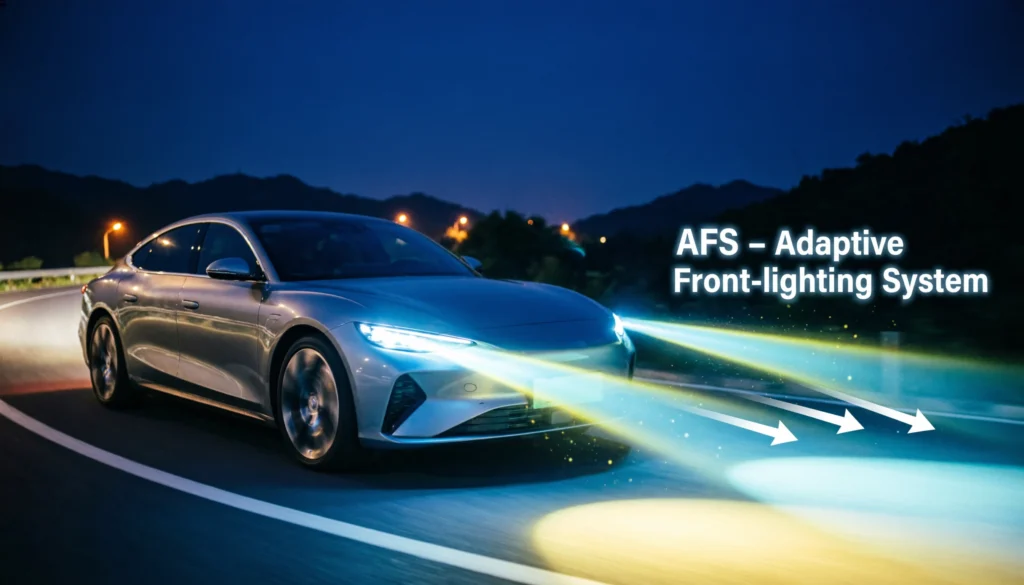
AFS in a car stands for Adaptive Front-lighting System, a technology that automatically adjusts your vehicle’s headlights based on driving conditions, speed, and steering angle to improve visibility and safety during night driving.
Origin of AFS in Cars
History and Development
The concept of adaptive lighting emerged in the late 1990s and early 2000s, primarily in luxury vehicles. Traditional headlights project a fixed beam pattern, which often limits visibility around curves or in poor weather. Automakers sought a solution to enhance night driving safety without blinding other drivers, giving rise to AFS technology.
Early Adoption
- Audi, BMW, and Mercedes-Benz were among the pioneers introducing AFS in their premium models.
- Initially, AFS was marketed as a luxury safety feature but gradually became more common in mid-range cars.
Popularity Today
AFS is now widely recognized in vehicles worldwide. Its growing adoption is linked to increased safety regulations, consumer demand for advanced driving aids, and the development of LED and HID headlight technologies.
How AFS Works in a Car
The Core Mechanism
AFS relies on sensors and motorized headlight units to dynamically adjust the light beam based on:
- Vehicle speed 🚗
- Steering angle 🔄
- Elevation or pitch of the car
- Ambient lighting conditions 🌙
Example: When approaching a sharp curve at night, the headlights swivel slightly in the direction of the turn, illuminating the road ahead without blinding oncoming traffic.
Key Features of AFS
- Cornering lights: Illuminate corners when turning.
- Speed-adaptive lights: Adjust beam height and intensity depending on speed.
- Weather adaptation: Some systems can modify beam patterns in rain or fog.
Real-World Usage of AFS
Friendly Example
Imagine driving on a winding mountain road at night. Traditional headlights illuminate only straight ahead, forcing you to slow down significantly. With AFS, the headlights pivot along the curve, allowing a smoother, safer drive.
Neutral Example
Some drivers may not notice AFS in everyday city driving. It works subtly, improving visibility without dramatic effects, which can make it seem like an “invisible” feature.
Negative/Dismissive Example
Occasionally, AFS may misalign due to sensor issues or headlight motor wear, causing glare or improper illumination. Regular maintenance is essential to avoid this.
Examples Table: AFS Features in Popular Cars
| Vehicle Model | AFS Feature Type | Notes |
|---|---|---|
| BMW 5 Series | Steering-linked AFS | Lights follow steering input |
| Mercedes-Benz E-Class | Adaptive High Beam | Automatically dims for oncoming traffic |
| Audi A6 | Cornering Lights | Lights pivot with low-speed turns |
| Toyota Camry (Luxury Trim) | LED Adaptive Headlights | Affordable mainstream option |
Comparison With Related Terms
Difference AFS vs. DRL
- AFS: Adjusts light direction and intensity at night.
- DRL: Only improves daytime visibility; does not pivot or adapt.
Comparing AFS vs. Cornering Lights
- AFS: Fully adaptive system, automatically integrates multiple sensors.
- Cornering Lights: Static or semi-static lights triggered only when turning.
Using AFS vs. HID/LED Headlights
- HID/LED: Refers to the type of light source.
- AFS: Refers to the functionality of dynamically adjusting light direction, independent of bulb type.
Alternate Meanings of AFS
While in cars, AFS almost always refers to Adaptive Front-lighting System, it can have other less common interpretations:
- Automatic Flight System (aviation)
- Advanced Fire Suppression (industrial)
- American Field Service (organization)
When discussing cars, context makes it clear that AFS = Adaptive Front-lighting System.
Professional and Polite Alternatives
If someone doesn’t understand “AFS,” you can explain it as:
- “Dynamic headlights that adjust with your driving”
- “Intelligent headlight system”
- “Steering-adaptive night lights”
These alternatives make the concept clear without technical jargon.
FAQs
Is AFS worth it in a car?
Yes, AFS improves nighttime visibility and reduces accident risk on curves, hills, and dark roads.
How much does AFS cost to repair?
Repair costs vary: simple sensor recalibration may cost $100–$300, while replacing motors or units can exceed $500–$1,000.
Does AFS work in all weather conditions?
Most AFS systems adjust for rain or fog, but heavy snow or mud may reduce effectiveness.
Can AFS headlight systems fail?
Yes, sensors, motors, or alignment issues can cause AFS to malfunction. Regular inspections help maintain performance.
Which cars commonly have AFS?
Luxury vehicles like BMW, Audi, Mercedes-Benz, and higher trims of mainstream cars like Toyota Camry or Honda Accord.
Does AFS drain more battery?
Minimal impact. Modern cars design AFS to operate efficiently alongside other electronics.
How do I know if my car has AFS?
Check the car’s manual or look for labels like “AFS” or “Adaptive Headlights” on the light assembly or infotainment system.
Can AFS be retrofitted?
It’s possible but expensive. Retrofitting requires compatible headlights, sensors, and wiring, usually costing more than upgrading to a vehicle with factory-installed AFS.
Conclusion:
- AFS (Adaptive Front-lighting System) improves safety by adjusting headlights based on driving conditions.
- It originated in luxury vehicles but is increasingly found in mid-range cars.
- Benefits: Better night visibility, safer turns, and reduced glare for oncoming drivers.
- Maintenance: Ensure sensors and motors are clean and functional.
- Comparison: AFS differs from DRL, cornering lights, and light source types like LED/HID.
- For drivers looking for enhanced night driving safety, AFS is a practical and increasingly common feature.
Discover More Related Articles:
- PFP Mean in Text: Complete Guide for Social Media Users (2026)
- Shabbat Shalom Mean in English: Usage, and Significance in 2026

Sarah Williams is the passionate author behind WordNexy.com, dedicated to creating content that informs, inspires, and sparks curiosity. With a love for words and storytelling, she transforms ideas into meaningful articles that educate, entertain, and leave a lasting impression on every reader.