Definition:
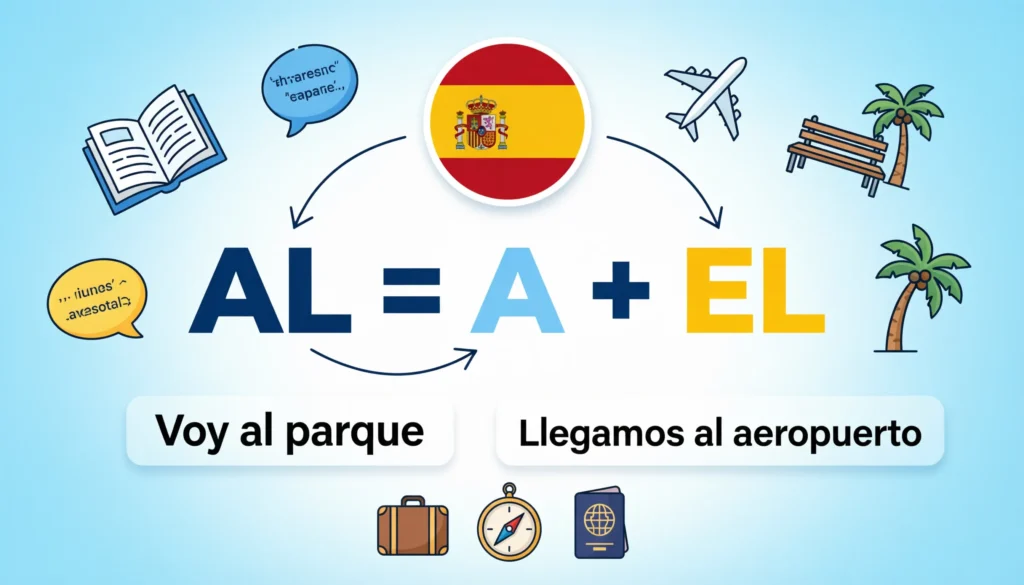
“Al” in Spanish is a contraction of the preposition “a” (to/at) and the masculine definite article “el” (the). It means “to the” or “at the” in English and is used when referring to movement or direction toward a masculine noun.
Example:
Voy al supermercado.
→ I go to the supermarket.
Spanish learners often notice the small word “al” appearing in many sentences al mercado, al trabajo, al llegar. At first glance, it may seem confusing because it looks like a simple word, yet it plays an important grammatical role in Spanish.
Understanding what “al” means in Spanish is essential because it appears in everyday conversations, writing, and even formal contexts. Once you learn how it works, you’ll recognize it everywhere.
In this guide, we’ll explore the definition, origin, grammar rules, examples, tone, comparisons with similar words, and common questions about “al” in Spanish.
Understanding “Al” in Spanish Grammar
The word “al” is known as a grammatical contraction. Spanish uses contractions to simplify speech and writing.
There are only two mandatory contractions in Spanish:
| Contraction | Original Words | Meaning |
|---|---|---|
| al | a + el | to the / at the |
| del | de + el | of the / from the |
So whenever “a” comes before “el”, they must combine into “al.”
Example:
- Incorrect: Voy a el parque.
- Correct: Voy al parque.
Origin of “Al” in Spanish
The contraction “al” comes from the evolution of Latin into Spanish.
Linguistic Background
Spanish developed from Vulgar Latin, where prepositions and articles often merged for easier pronunciation.
Latin roots:
- ad → meaning to or toward
- ille → meaning the
Over centuries, these evolved into:
- a + el → al
The contraction became standardized in Spanish grammar and is now required in both spoken and written Spanish.
Because it simplifies pronunciation, it helps Spanish sound smoother and more natural.
When to Use “Al” in Spanish
You use “al” whenever the sentence requires:
a + el
This usually happens when describing movement, direction, or location involving a masculine noun.
Common Situations Where “Al” Appears
- Movement toward a place
- Going somewhere
- Arriving at a location
- Beginning an action (“upon doing something”)
Example Sentences Using “Al”
| Spanish Sentence | English Translation | Context |
|---|---|---|
| Voy al cine. | I go to the cinema. | Direction |
| Ella llegó al aeropuerto. | She arrived at the airport. | Location |
| Caminamos al parque. | We walk to the park. | Movement |
| Al entrar, saludó a todos. | Upon entering, he greeted everyone. | Time/action |
“Al” Meaning in Different Contexts
Although “al” literally means “to the”, its meaning can change slightly depending on context.
1. Direction or Destination
Most commonly, “al” describes movement toward a place.
Examples:
- Voy al trabajo.
I go to work. - Fuimos al restaurante.
We went to the restaurant.
Tone: Neutral and everyday usage
2. Location or Arrival
It can also indicate arriving somewhere.
Example:
- Llegamos al hotel tarde.
We arrived at the hotel late.
Tone: Neutral
3. Time Expression (“Upon Doing Something”)
Spanish sometimes uses “al + infinitive verb”.
Example:
- Al salir de casa, empezó a llover.
Upon leaving the house, it started raining.
Meaning: when / upon
Tone: Formal or narrative
Real-Life Examples in Conversation
Understanding tone helps learners use the phrase naturally.
Friendly Context 😊
- Vamos al parque esta tarde.
Let’s go to the park this afternoon.
Tone: casual and friendly.
Neutral Everyday Usage
- Voy al banco después del trabajo.
I go to the bank after work.
Tone: neutral.
Narrative or Descriptive
- Al abrir la puerta, vio algo extraño.
Upon opening the door, he saw something strange.
Tone: storytelling or written Spanish.
“Al” vs Similar Spanish Terms
Many learners confuse “al” with similar-looking words.
Here’s a comparison.
| Word | Meaning | Usage |
|---|---|---|
| al | to the / at the | contraction of a + el |
| a | to / toward | preposition |
| el | the | masculine article |
| del | of the / from the | contraction of de + el |
Example comparison:
- Voy al mercado. → I go to the market
- Vengo del mercado. → I come from the market
“Al” vs “A La”
This is another common confusion.
“Al”
Used with masculine nouns
Example:
- Voy al restaurante.
“A La”
Used with feminine nouns
Example:
- Voy a la escuela.
| Phrase | Gender | Meaning |
|---|---|---|
| al | masculine | to the |
| a la | feminine | to the |
Alternate Meanings of “Al”
Although “al” mainly means “to the,” it can appear in other expressions.
1. “Al + infinitive”
Meaning when / upon
Example:
- Al llegar, llamó a su madre.
2. In Idiomatic Expressions
Examples:
- al mismo tiempo → at the same time
- al final → in the end
- al principio → at the beginning
Common Spanish Expressions with “Al”
| Expression | Meaning |
|---|---|
| al final | in the end |
| al principio | at the beginning |
| al mismo tiempo | at the same time |
| al día siguiente | the next day |
| al menos | at least |
These phrases appear often in both spoken and written Spanish.
Usage Tips for Spanish Learners
If you’re learning Spanish, these tips will help you use “al” correctly.
1. Remember the contraction rule
Whenever you see a + el, it must become al.
2. Watch noun gender
“Al” works only with masculine nouns.
Examples:
- al restaurante
- al banco
- al cine
3. Use it in travel and direction sentences
Many beginner sentences use al.
Examples:
- go to the store
- walk to the park
- drive to the airport
4. Practice with daily routines
Example sentences:
- Voy al gimnasio.
- Salgo al trabajo.
Polite or Professional Alternatives
Sometimes Spanish uses other phrases instead of al for formality or clarity.
Examples:
| Informal | Professional Alternative |
|---|---|
| Voy al médico. | Voy a consultar con el médico. |
| Vamos al jefe. | Consultaremos con el jefe. |
However, “al” itself is neutral and perfectly acceptable in professional settings.
Common Mistakes with “Al”
Spanish learners often make these mistakes.
Mistake 1
❌ Voy a el supermercado.
Correct:
✔ Voy al supermercado.
Mistake 2
Using al with feminine nouns
❌ Voy al escuela.
Correct:
✔ Voy a la escuela.
Mistake 3
Forgetting contraction in writing
Even in formal writing, “al” must be used.
FAQs
1. What does “al” mean in Spanish?
“Al” means “to the” or “at the.” It is a contraction formed by combining “a” (to) and “el” (the). Spanish grammar requires these two words to combine into “al.”
2. Why is “a el” changed to “al” in Spanish?
Spanish uses contractions to make speech smoother and easier to pronounce. Because of this rule, “a + el” must always become “al.”
3. Is “al” used with masculine or feminine nouns?
“Al” is used only with masculine nouns because it includes the article “el.” For feminine nouns, Spanish uses “a la.”
4. What is the difference between “al” and “a la”?
The difference is based on gender:
- al → used with masculine nouns
- a la → used with feminine nouns
Example:
- Voy al restaurante.
- Voy a la escuela.
5. Can “al” be used before verbs in Spanish?
Yes. When “al” is followed by an infinitive verb, it often means “when” or “upon.”
Example:
- Al llegar, empezó la reunión.
- Upon arriving, the meeting started.
6. Is “al” formal or informal in Spanish?
“Al” is neutral and can be used in both formal and informal communication, including everyday conversations and professional writing.
7. Is “al” used in all Spanish-speaking countries?
Yes. The contraction “al” is universal in Spanish grammar and is used in Spain, Mexico, Latin America, and other Spanish-speaking regions.
8. What is another Spanish contraction similar to “al”?
Another common contraction is “del,” which comes from “de + el.” It means “of the” or “from the.”
Example:
- Vengo del mercado.
- I come from the market.
Conclusion
The Spanish word “al” may look small, but it plays a major role in everyday Spanish grammar. It is a mandatory contraction of “a + el,” meaning “to the” or “at the.”
You’ll encounter “al” constantly in conversations, travel phrases, directions, and storytelling.
Once you start paying attention, you’ll notice “al” everywhere from everyday conversations to books and movies.
Practice using it in sentences like:
- Voy al parque.
- Llegamos al hotel.
- Al entrar, saludó.
Mastering small grammar points like “al” is a big step toward becoming fluent in Spanish.
Discover More Related Articles:
- Understanding FIP in Baseball: Definition, Formula, and Uses (2026)
- TW in Jewelry Meaning: What It Really Stands For (2026)

Amanda Lewis is a professional content writer and word-meaning researcher who specializes in explaining definitions, slang, abbreviations, and modern language terms. She writes for WordNexy.com, where she creates clear, accurate, and reader-friendly articles to help users understand word meanings and proper usage. Her work is especially useful for students, writers, and online readers seeking quick and reliable explanations.