Definition:
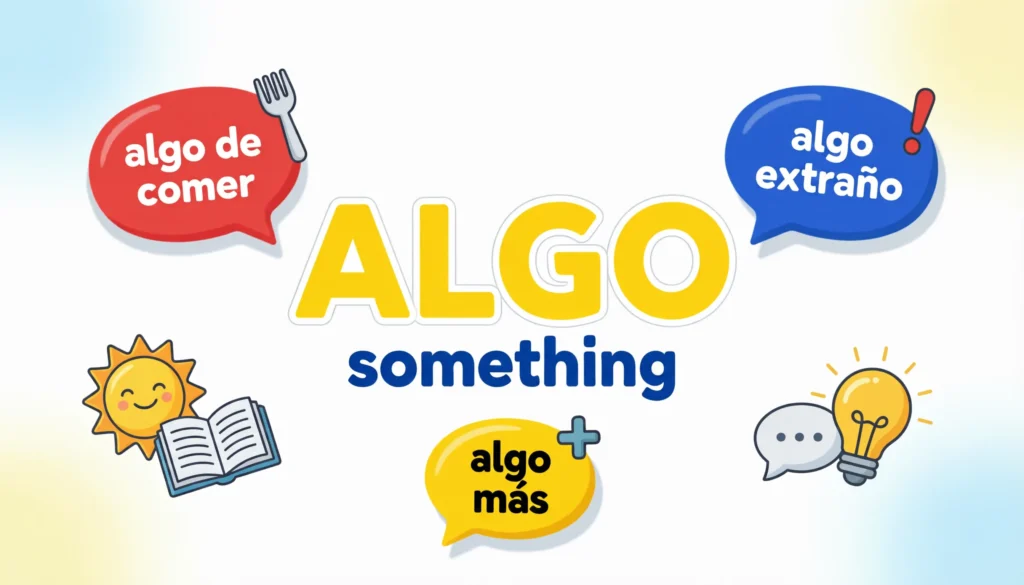
“Algo” in Spanish means “something.” It is an indefinite pronoun used to refer to an unspecified thing, idea, or amount. Spanish speakers use algo when they want to mention something without being specific, similar to the English words “something,” “anything,” or “somewhat,” depending on context.
For example:
Quiero algo de comer. → I want something to eat.
Hay algo extraño aquí. → There is something strange here.
Although the word is small and simple, “algo” is extremely common in everyday Spanish conversation, writing, and media. Understanding how to use it properly will help you sound more natural when speaking Spanish.
What Does Algo Mean in Spanish?
If you’ve ever started learning Spanish, you’ve probably encountered the word “algo.” It appears in conversations, songs, text messages, and everyday speech. But what exactly does it mean?
In simple terms, “algo” means “something.” It refers to an unspecified object, idea, amount, or situation. Instead of naming a specific thing, speakers use algo when they want to keep the reference general or unknown.
For example:
- Necesito algo de agua.
I need some water. - Algo pasó ayer.
Something happened yesterday. - Quiero decirte algo.
I want to tell you something.
The beauty of this small word is that it works in many contexts, making it one of the most useful Spanish vocabulary words for beginners and advanced learners alike.
Origin and Linguistic Background of “Algo”
The Spanish word “algo” has roots in Latin, specifically from the phrase “aliquid,” which also meant “something” or “anything.”
Over time, the word evolved in Old Spanish into “algo”, becoming a widely used indefinite pronoun.
Key linguistic facts about “algo”
- Language family: Romance language (Spanish)
- Part of speech: Indefinite pronoun
- Root language: Latin
- Literal translation: Something
Unlike nouns, “algo” does not change form based on gender or number. It always remains algo, regardless of the sentence.
Example:
- Algo bueno → Something good
- Algo interesante → Something interesting
Why “Algo” Is So Popular in Spanish
One reason algo is used so frequently is because Spanish speakers often prefer flexible, indirect expressions.
Instead of specifying something exactly, they might say “algo” when:
- The thing is unknown
- The detail is unimportant
- They want to speak casually
Situations where people commonly use “algo”
- Asking for food or drinks
- Mentioning a problem
- Expressing curiosity
- Describing a vague feeling
- Introducing a topic
For example:
- ¿Quieres algo?
Do you want something? - Siento algo raro hoy.
I feel something strange today.
How “Algo” Is Used in Everyday Spanish
“Algo” can appear in different sentence structures, but its core meaning stays the same.
Common sentence patterns
1. Algo + adjective
This means “something + description.”
Examples:
- Algo interesante → Something interesting
- Algo importante → Something important
- Algo extraño → Something strange
2. Algo + de + noun
This structure means “some amount of something.”
Examples:
- Algo de comida → Some food
- Algo de dinero → Some money
- Algo de tiempo → Some time
3. Algo que… (something that)
Used when explaining something unknown.
Examples:
- Algo que decir → Something to say
- Algo que aprender → Something to learn
Example Sentences Using “Algo”
Here are practical examples showing how the word appears in real conversations.
| Spanish Sentence | English Translation | Context |
|---|---|---|
| Quiero algo dulce. | I want something sweet. | Talking about food |
| Algo no está bien aquí. | Something is not right here. | Suspicion |
| ¿Tienes algo para beber? | Do you have something to drink? | Asking politely |
| Algo pasó anoche. | Something happened last night. | Storytelling |
| Necesito algo de ayuda. | I need some help. | Requesting assistance |
These examples show how “algo” works naturally in everyday Spanish dialogue.
Tone and Context: How “Algo” Can Change Meaning
Although algo literally means “something,” the tone can change depending on context.
Friendly tone 😊
Used when offering help or asking casually.
Example:
- ¿Quieres algo de comer?
Do you want something to eat?
Curious tone 🤔
Used when wondering about something unknown.
Example:
- Creo que escuché algo.
I think I heard something.
Suspicious or mysterious tone 😶
Example:
- Algo extraño está pasando.
Something strange is happening.
“Algo” Compared With Similar Spanish Words
Many learners confuse algo with similar indefinite words. Here is a helpful comparison.
| Word | Meaning | Example |
|---|---|---|
| Algo | Something | Quiero algo de comer |
| Nada | Nothing | No quiero nada |
| Alguien | Someone | Alguien está aquí |
| Todo | Everything | Todo está bien |
| Cualquier cosa | Anything | Puedes elegir cualquier cosa |
Quick explanation
- Algo = something (unspecified object or idea)
- Nada = nothing
- Alguien = someone
- Todo = everything
Understanding these differences helps prevent common Spanish learning mistakes.
Expressions and Phrases With “Algo”
Spanish speakers often combine algo with other words to create useful phrases.
Common phrases
Algo así
Meaning: Something like that
Example:
- Quiero algo así para mi casa.
I want something like that for my house.
Algo más
Meaning: Anything else / Something more
Example:
- ¿Algo más, señor?
Anything else, sir?
Algo mejor
Meaning: Something better
Example:
- Necesitamos algo mejor.
We need something better.
Polite or Professional Alternatives
Sometimes you may want to sound more polite or formal instead of using algo.
Alternatives
| Expression | Meaning | Tone |
|---|---|---|
| Alguna cosa | Some thing | Neutral |
| Algo de… | Some amount of | Neutral |
| Un poco de | A little bit of | Polite |
| Algún asunto | Some matter | Formal |
Example:
- Necesito algo de ayuda. (casual)
- Necesito un poco de ayuda. (more polite)
Alternate Meanings of “Algo”
Although algo primarily means “something,” it can sometimes imply “somewhat” or “a little.”
Example:
- Estoy algo cansado.
I am somewhat tired.
Here, algo modifies the adjective, meaning “a bit” or “somewhat.”
Common Mistakes With “Algo”
Spanish learners sometimes misuse this word.
Mistake 1: Using gender
❌ Algo bueno/a (incorrect if gender is applied)
✔ Algo bueno (correct)
Algo is neutral, so adjectives following it usually stay masculine singular.
Mistake 2: Confusing “algo” with “alguien”
❌ Algo está en la puerta (if referring to a person)
✔ Alguien está en la puerta
Because:
- Algo = something
- Alguien = someone
Practical Tips for Using “Algo”
To sound natural when speaking Spanish:
- Use algo when the thing is unknown or unspecified.
- Pair it with adjectives to describe vague ideas.
- Use algo de when referring to quantities.
- Avoid adding gender endings.
The more you listen to Spanish conversations, the more you’ll notice how frequently this small word appears.
FAQs
1. What does algo mean in Spanish slang?
In slang or casual speech, algo still means “something.” However, the tone can make it sound mysterious, suspicious, or casual depending on the situation.
Example:
Algo raro está pasando.
Something weird is happening.
2. Does algo mean anything or something?
Usually, algo means “something,” but in some contexts it can feel like “anything.”
Example:
¿Quieres algo?
This could mean “Do you want something?” or “Do you want anything?”
3. Is algo masculine or feminine?
Algo is neutral. Adjectives that follow it usually appear in the masculine singular form.
Examples:
- Algo bueno
- Algo interesante
4. How do you pronounce algo?
Pronunciation: AHL-go
Phonetic breakdown:
al-go
The “g” is pronounced like the g in “go.”
5. What is the difference between algo and alguien?
| Word | Meaning |
|---|---|
| Algo | Something |
| Alguien | Someone |
Use algo for things and alguien for people.
6. Can algo mean “a little”?
Yes. When used with adjectives, it can mean “somewhat” or “a little.”
Example:
Estoy algo preocupado.
I am somewhat worried.
7. What does algo de mean in Spanish?
Algo de means “some” or “a bit of.”
Examples:
- Algo de dinero → Some money
- Algo de comida → Some food
8. Is algo formal or informal?
Algo works in both formal and informal contexts.
It is neutral vocabulary, so you can use it in:
- conversations
- writing
- professional communication
Conclusion
The Spanish word “algo” may seem small, but it plays a big role in everyday communication. At its core, it simply means “something,” referring to an unspecified object, idea, or amount.
However, its flexibility makes it extremely useful in many situations from casual conversations to formal writing.
If you’re learning Spanish, mastering words like algo will help you sound more natural and conversational.
Discover More Related Articles:
- PFP Mean in Text: Complete Guide for Social Media Users (2026)
- Shabbat Shalom Mean in English: Usage, and Significance in 2026

James Anderson is an experienced content writer and language researcher who focuses on explaining word meanings, definitions, slang terms, and modern expressions. He writes for WordNexy.com, where his articles are designed to provide accurate meanings, practical usage examples, and easy-to-understand explanations for readers worldwide.