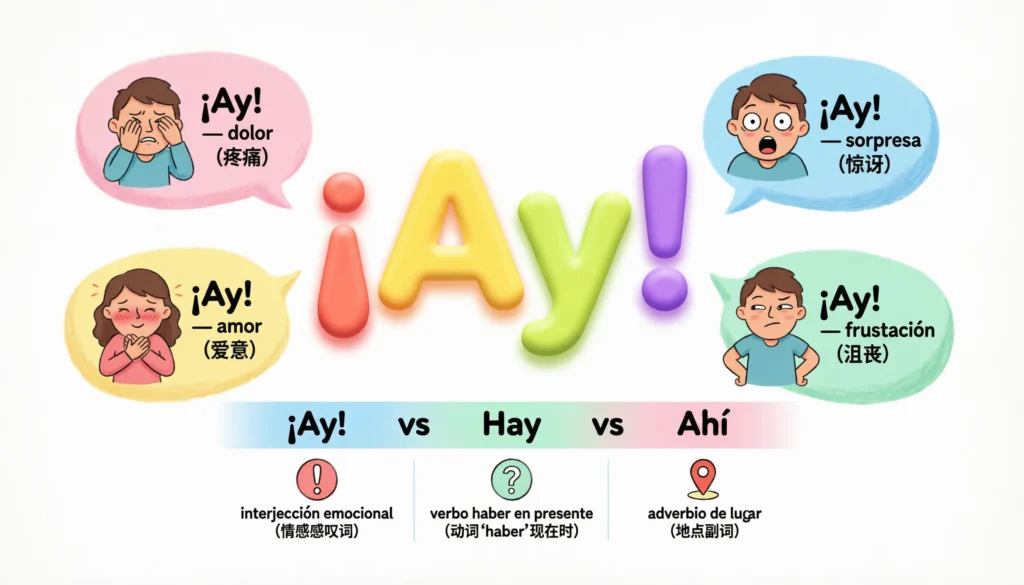
📌 Definition:
“Ay” in Spanish is an interjection used to express emotion, such as pain, surprise, fear, frustration, joy, or affection. Its meaning depends entirely on context and tone of voice. It is similar to “oh!” or “ouch!” in English.
If you’ve ever heard someone say “¡Ay!” in a Spanish conversation, you probably sensed emotion right away but what exactly does it mean?
Is it pain? Surprise? Excitement? Frustration?
The truth is, “ay” is one of the most expressive little words in Spanish, and its meaning changes depending on tone, context, and punctuation.
Let’s break it down clearly and conversationally so you can understand exactly how native speakers use it in real life.
What Does “Ay” Mean in Spanish?
In simple terms:
“Ay” is an emotional expression word.
It doesn’t have a fixed translation like a noun or verb. Instead, it conveys feeling.
Depending on how it’s said, “ay” can mean:
- Ouch!
- Oh!
- Oh no!
- Oh my!
- Ugh!
- Aww!
It’s short, powerful, and incredibly common in everyday Spanish conversation.
Origin of “Ay”
The word “ay” comes from Latin “ai” a natural cry of emotion. Many languages have similar emotional sounds:
- English: Oh! Ouch! Ah!
- French: Aïe!
- Italian: Ahi!
- Portuguese: Ai!
Spanish kept this expressive sound and turned it into the modern “¡Ay!”
Because it’s instinctive and emotional, it has remained popular for centuries in poetry, songs, and everyday speech.
For example, you may recognize it from traditional Latin songs like “Cielito Lindo”, which famously repeats:
🎵 “Ay, ay, ay, ay…”
In music, “ay” often expresses longing, love, or deep emotion.
How “Ay” Is Used in Real Life
The meaning of “ay” depends on:
- Tone of voice
- Facial expression
- Context
- Punctuation (¡Ay! vs. Ay…)
Let’s look at common uses.
1️⃣ Expressing Pain
This is one of the most common meanings.
Examples:
- ¡Ay! Me duele la cabeza.
→ Ouch! My head hurts. - ¡Ay! Me quemé.
→ Ouch! I burned myself.
Tone: Sudden, sharp, loud.
2️⃣ Expressing Surprise
“¡Ay!” can mean “Oh!” when something unexpected happens.
- ¡Ay! No sabía eso.
→ Oh! I didn’t know that. - ¡Ay! Qué sorpresa.
→ Oh! What a surprise.
Tone: Soft, quick, often followed by explanation.
3️⃣ Showing Frustration or Annoyance
Sometimes it expresses mild irritation.
- Ay, ya basta.
→ Ugh, that’s enough. - Ay, qué fastidio.
→ Ugh, how annoying.
Tone: Longer and drawn out.
4️⃣ Expressing Affection or Tenderness
In some contexts, “ay” can sound sweet or caring.
- Ay, qué lindo bebé.
→ Aww, what a cute baby. - Ay, mi amor.
→ Oh, my love.
Tone: Soft and warm ❤️
5️⃣ Dramatic or Emotional Expression
In storytelling, acting, or dramatic speech:
- ¡Ay de mí!
→ Oh, poor me! - Ay, qué tragedia.
→ Oh, what a tragedy.
Often used in theater, poetry, or older-style speech.
Example Table: Meanings of “Ay” in Context
| Spanish Phrase | English Meaning | Tone | Situation Type |
|---|---|---|---|
| ¡Ay! | Ouch! | Sharp | Physical pain |
| ¡Ay, no! | Oh no! | Alarmed | Bad news |
| Ay… | Oh… | Soft | Realization |
| Ay, qué bonito | Aww, how pretty | Sweet | Admiration |
| Ay, por favor | Oh please | Annoyed | Frustration |
This shows how flexible the word is it changes meaning based on how it’s used.
Difference Between “Ay,” “Ahí,” and “Hay”
Many Spanish learners confuse these three words because they sound similar.
Here’s a quick comparison:
| Word | Meaning | Function |
|---|---|---|
| Ay | Emotional expression | Interjection |
| Ahí | There | Adverb of place |
| Hay | There is / There are | Verb (from haber) |
Examples:
- ¡Ay! Me duele. → Ouch!
- El libro está ahí. → The book is there.
- Hay muchas personas aquí. → There are many people here.
Spelling matters a lot in Spanish!
Is “Ay” Formal or Informal?
“Ay” is neutral but emotional.
You can use it in:
- Casual conversations
- Text messages
- Stories
- Songs
- Conversations with friends
However, in professional writing (business emails, academic essays), it’s usually avoided because it’s informal and expressive.
Can “Ay” Be Negative or Dismissive?
Yes depending on tone.
For example:
- Ay, por favor…
→ Oh please… (dismissive) - Ay, qué exagerado.
→ Oh, you’re so dramatic.
Tone determines whether it sounds playful or rude.
If you’re unsure, keep your tone gentle.
“Ay” in Text Messages & Social Media
Online, people use:
- Ay 😭 (sadness)
- Ay 😍 (adoration)
- Ay nooo 😩 (frustration)
- Ay ay ay 😂 (laughing)
In texting, punctuation stretches emotion:
- Ay…
- Ay!!!
- Ayyy
More letters = stronger feeling.
“Ay” in Songs and Pop Culture
You’ll hear “ay” often in Latin music because it carries strong emotional energy.
For example:
- Traditional mariachi songs
- Flamenco music
- Romantic ballads
- Telenovelas
Artists use “ay” to dramatize feelings like love, heartbreak, or longing.
Polite or Professional Alternatives
If you’re in a formal setting and want to avoid emotional interjections, you can say:
Instead of:
- ¡Ay, no!
Say:
- Qué pena.
- Lo siento.
- Qué lástima.
Instead of:
- Ay, qué problema.
Say:
- Entiendo la situación.
- Veo que es complicado.
These sound more professional.
Alternate Meanings of “Ay”
“Ay” generally has only one function: emotional interjection.
However, in English texting culture, “AY” (all caps) can mean:
- Hey!
- Attention grabber
But that is not Spanish.
In Spanish, “ay” is always emotional.
FAQs
What does “ay” mean in Spanish in English?
It means “ouch,” “oh,” “oh no,” or “aww,” depending on context and tone.
Is “ay” a bad word in Spanish?
No, it is not offensive. It’s simply an emotional expression.
What is the difference between “ay” and “ah”?
- “Ah” expresses realization or understanding.
- “Ay” expresses emotion like pain, surprise, or frustration.
Example:
- Ah, ya entiendo. → Oh, I understand.
- ¡Ay! Me duele. → Ouch!
What does “ay no” mean?
It usually means “Oh no!” and expresses concern or disappointment.
Can “ay” mean love?
Indirectly, yes. When said softly, it can show affection:
- Ay, mi vida. → Oh, my dear.
Is “ay” formal?
No, it’s informal and emotional, but not rude.
Why do Spanish songs say “ay ay ay”?
To add emotional intensity, rhythm, or drama.
How do you pronounce “ay”?
It sounds like the English word “eye.”
Phonetic pronunciation: /ai/
Practical Usage Tips
✔ Use “¡Ay!” for sudden emotion.
✔ Stretch it (“Ayyy”) in casual texting.
✔ Avoid it in professional writing.
✔ Pay attention to tone it changes meaning.
✔ Don’t confuse it with “hay” or “ahí.”
Conclusion:
Understanding “ay” is like unlocking a small but powerful piece of Spanish expression. It’s more than just a word it’s an emotional signal that communicates pain, surprise, frustration, affection, or drama depending on context, tone, and punctuation.
By recognizing the nuances of “ay”, you’ll sound more natural in conversations, better understand songs, and even catch subtle emotions in movies and texts. Whether expressing a quick “ouch!” or a tender “aww,” “ay” brings Spanish to life.
Discover More Related Articles:
- PFP Mean in Text: Complete Guide for Social Media Users (2026)
- Shabbat Shalom Mean in English: Usage, and Significance in 2026

Amanda Lewis is a professional content writer and word-meaning researcher who specializes in explaining definitions, slang, abbreviations, and modern language terms. She writes for WordNexy.com, where she creates clear, accurate, and reader-friendly articles to help users understand word meanings and proper usage. Her work is especially useful for students, writers, and online readers seeking quick and reliable explanations.