Definition
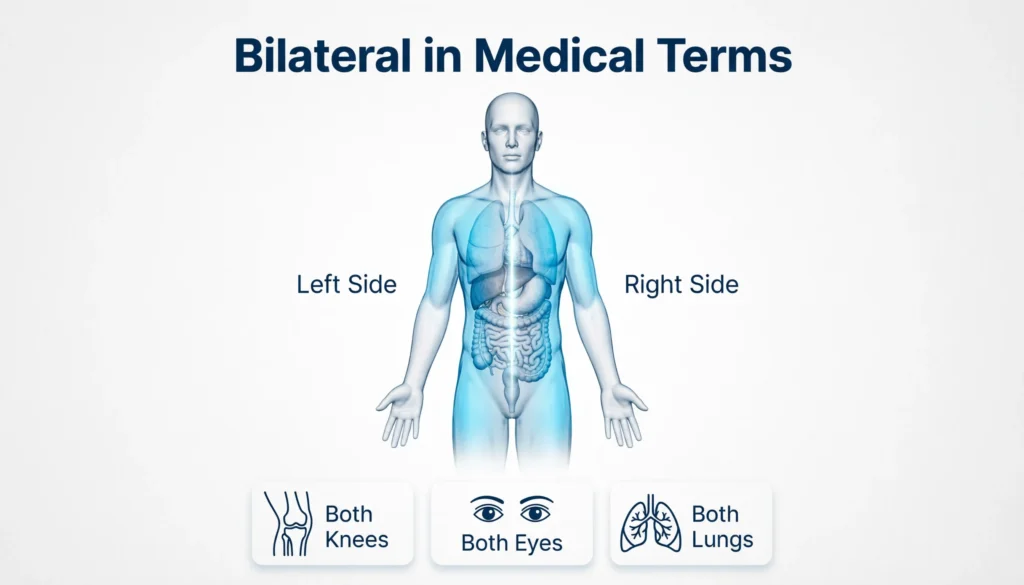
“Bilateral” in medical terms means affecting, involving, or occurring on both sides of the body.
For example, bilateral knee pain means pain in both knees, not just one.
If you’ve ever read a medical report or heard a doctor say something like “bilateral inflammation” or “bilateral hearing loss,” you might have wondered what it really means.
The word sounds technical, but its meaning is actually quite simple and incredibly important in healthcare. Whether it’s diagnosing conditions, interpreting test results, or planning treatment, understanding “bilateral” helps you grasp exactly what part of the body is affected and how serious it might be.
In this guide, you’ll learn everything about the term from its definition and origin to real-life examples, comparisons, and practical usage tips.
Origin and Meaning of “Bilateral”
The term “bilateral” comes from Latin roots:
- “Bi-” = two
- “Latus” (lateralis) = side
👉 So, bilateral literally means “two-sided.”
How It Became Common in Medicine
In medical language, precision is everything. Doctors need to clearly describe where a condition occurs. Instead of saying “on both sides,” professionals use the concise term bilateral.
Over time, it became a standard clinical term used in:
- Radiology reports
- Diagnosis descriptions
- Surgical notes
- Physical examinations
What Does Bilateral Mean in Medical Context?
In healthcare, bilateral indicates that a condition, symptom, or structure involves both sides of the body simultaneously.
Common Body Parts Where “Bilateral” Applies
- Eyes (bilateral vision issues 👀)
- Ears (bilateral hearing loss 👂)
- Lungs (bilateral pneumonia 🫁)
- Kidneys (bilateral kidney disease)
- Arms or legs (bilateral weakness or pain)
Real-Life Medical Examples of “Bilateral”
Understanding examples makes the concept much clearer. Here’s how “bilateral” appears in everyday medical situations:
Common Examples
- Bilateral knee pain → Pain in both knees
- Bilateral hearing loss → Reduced hearing in both ears
- Bilateral pneumonia → Infection in both lungs
- Bilateral swelling (edema) → Swelling on both sides of the body
Example Table: Bilateral vs Meaning
| Medical Term | Meaning | Example Scenario |
|---|---|---|
| Bilateral knee pain | Pain in both knees | Arthritis affecting both knees |
| Bilateral hearing loss | Hearing loss in both ears | Age-related hearing decline |
| Bilateral lung infection | Infection in both lungs | Severe pneumonia case |
| Bilateral eye redness | Redness in both eyes | Allergic reaction |
Tone & Context: How “Bilateral” Is Used
Unlike slang words, “bilateral” is neutral and professional. It doesn’t carry emotional tone it simply describes a condition accurately.
Neutral Usage Examples
- “The patient shows bilateral swelling in the legs.”
- “MRI results indicate bilateral abnormalities.”
Friendly Explanation (Doctor to Patient 😊)
- “This means both sides of your body are affected—not just one.”
Slightly Concerning Context ⚠️
Sometimes, “bilateral” can suggest a more serious condition, because both sides are involved:
- Bilateral lung disease may be more severe than one-sided infection
Bilateral vs Related Medical Terms
Understanding similar terms helps avoid confusion.
Comparison Table
| Term | Meaning | Example |
|---|---|---|
| Bilateral | Both sides | Pain in both legs |
| Unilateral | One side only | Pain in left leg only |
| Symmetrical | Same on both sides | Rash identical on both arms |
| Asymmetrical | Uneven on both sides | One arm more swollen than other |
Key Difference
- Bilateral ≠ Symmetrical
- Bilateral = both sides involved
- Symmetrical = both sides look or behave the same
👉 A condition can be bilateral but not symmetrical.
When Do Doctors Use the Term “Bilateral”?
Doctors commonly use “bilateral” when:
- Diagnosing conditions
- Reading X-rays or MRIs
- Describing symptoms
- Planning treatments
Why It Matters
Knowing whether something is bilateral helps determine:
- Severity of the condition
- Possible causes
- Treatment approach
Common Conditions Described as Bilateral
Here are some frequently diagnosed bilateral conditions:
1. Bilateral Arthritis
- Affects joints on both sides
- Common in knees, hips, and hands
2. Bilateral Pneumonia
- Infection in both lungs
- Can be more serious than one-sided pneumonia
3. Bilateral Hearing Loss
- Hearing impairment in both ears
- Often linked to aging or prolonged noise exposure
4. Bilateral Eye Conditions
- Conjunctivitis (pink eye)
- Dry eye syndrome
Bilateral in Medical Reports: How to Read It
When you see “bilateral” in a report, it usually appears like this:
- “Bilateral pleural effusion”
- “Bilateral renal cysts”
- “Bilateral muscle weakness”
Quick Tip
👉 Replace “bilateral” with “both sides” to understand instantly.
Alternate Meanings of “Bilateral”
While primarily used in medicine, “bilateral” has meanings in other fields:
- Politics/International relations → Agreements between two countries
- General usage → Involving two parties
However, in healthcare, it always refers to both sides of the body.
Polite or Simple Alternatives for Patients
Doctors may simplify the term for better understanding:
- “Both sides”
- “On each side”
- “Affecting both areas”
Example
Instead of:
- “You have bilateral inflammation”
They might say:
- “You have inflammation on both sides.”
Practical Usage Tips
- If you hear “bilateral,” think “both sides immediately”
- Ask your doctor: “Does this mean both sides are affected?”
- Don’t assume it’s always serious context matters
FAQs:
1. What does bilateral mean in simple words?
It means something affects both sides of the body.
2. Is bilateral serious?
Not always. It simply describes location, not severity but it can indicate a broader condition.
3. What is bilateral pain?
Pain occurring on both sides, such as both legs or both shoulders.
4. What is the opposite of bilateral?
Unilateral, which means one side only.
5. What does bilateral mean in a diagnosis?
It means the condition affects both sides of a body part or organ.
6. Is bilateral the same as symmetrical?
No. Bilateral means both sides are involved, while symmetrical means both sides are identical.
7. What is bilateral hearing loss?
Hearing loss that affects both ears.
8. Why do doctors use the term bilateral?
Because it provides a clear, precise description of where a condition occurs.
Conclusion:
“Bilateral” may sound like complex medical jargon, but its meaning is simple and essential. It tells you that a condition affects both sides of the body, helping doctors communicate clearly and accurately.
Understanding what “bilateral” means in medical terms can make a big difference when reading reports or speaking with healthcare professionals. In simple words, it refers to conditions affecting both sides of the body, whether it’s your eyes, ears, lungs, or limbs.
👉 The next time you hear this term, you’ll instantly know what it means and why it matters.
Discover More Related Articles:

James Anderson is an experienced content writer and language researcher who focuses on explaining word meanings, definitions, slang terms, and modern expressions. He writes for WordNexy.com, where his articles are designed to provide accurate meanings, practical usage examples, and easy-to-understand explanations for readers worldwide.