Definition
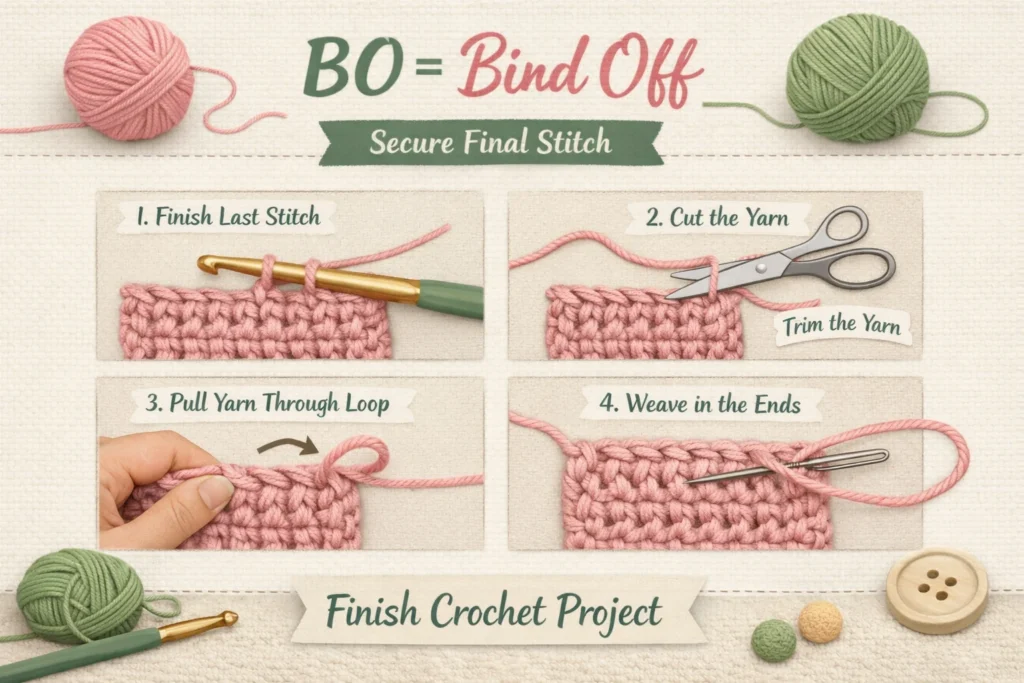
BO in crochet means “Bind Off.”
It is a finishing technique used to secure the last stitch of a crochet project so the yarn does not unravel.
Crochet patterns are full of abbreviations that can feel confusing at first. If you’ve ever followed a pattern and suddenly seen “BO”, you might wonder what it means and what you’re supposed to do next. Don’t worry this is a very common crochet abbreviation, and once you understand it, your crochet projects will become much easier to follow.
Whether you’re making a cozy scarf, a blanket, or a sweater, knowing how to BO in crochet helps you finish your work neatly and professionally. In this guide, you’ll learn exactly what BO means in crochet, how it’s used, where it comes from, and how it compares to similar terms.
What Does BO Mean in Crochet?
In simple terms:
- BO = Bind Off
- It is used to secure the final stitches
- It prevents your crochet work from coming undone
Many crochet patterns especially those inspired by knitting use BO to indicate the final step in completing a piece.
Origin of the Term BO in Crochet
Connection to Knitting Terminology
The abbreviation BO (Bind Off) originally comes from knitting terminology. In knitting patterns, bind off is the standard method for finishing stitches on the needle.
Crochet designers sometimes adopt knitting terms when patterns involve similar finishing techniques. Because crochet and knitting communities often overlap, certain abbreviations like BO appear in both crafts.
How It Entered Crochet Patterns
In crochet, the process of finishing stitches is often called:
- Fasten off (FO)
- Finish off
- Bind off (BO)
While FO is more common, many modern patterns especially hybrid knit-crochet designs use BO interchangeably.
How BO Is Used in Crochet Patterns
When You’ll See BO in a Pattern
The abbreviation BO usually appears near the end of a crochet project or row. It tells you that you’re about to finish the work.
Typical pattern instructions might look like:
- Row 24: Sc in each stitch across. BO.
- Final Round: Sl st to join, BO, weave in ends.
- Finish: BO and cut yarn.
What Happens When You Bind Off
When you bind off in crochet, you typically:
- Complete the last stitch.
- Cut the yarn.
- Pull the yarn through the final loop.
- Tighten gently.
- Weave in the loose yarn end.
This ensures your crochet piece stays secure and neat.
Step-by-Step: How to BO in Crochet
Binding off in crochet is actually very simple. Follow these steps:
Step 1: Finish Your Last Stitch
Complete the final stitch required in your pattern.
Step 2: Cut the Yarn
Leave about 4–6 inches of yarn so you can weave it in later.
Step 3: Pull the Yarn Through the Loop
Use your hook to pull the yarn tail through the loop completely.
Step 4: Tighten the Knot
Pull gently until the loop closes and secures the stitch.
Step 5: Weave in the Ends
Use a yarn needle to hide the yarn tail inside nearby stitches.
This method ensures your crochet project won’t unravel over time.
Example Usage of BO in Crochet Patterns
Understanding real pattern examples helps beginners recognize when and how to use BO.
Common Pattern Instructions
| Pattern Line | What It Means |
|---|---|
| Row 20: Sc across, BO | Finish the row and bind off the yarn |
| Final round: Sl st to join, BO | Close the round and secure the yarn |
| BO and weave in ends | Finish the project and hide loose yarn |
Beginner-Friendly Example
Imagine you’re crocheting a scarf.
Pattern ending might say:
Row 120:
Sc in each stitch across. BO.
This means:
- Complete the row
- Cut the yarn
- Pull through the final loop
- Secure your project
Congratulations you’ve finished the scarf! 🎉
BO vs Other Crochet Abbreviations
Crochet patterns contain many abbreviations, and some are similar to BO.
Comparison Table
| Abbreviation | Meaning | Usage |
|---|---|---|
| BO | Bind Off | Finish stitches securely |
| FO | Fasten Off | Most common crochet finishing term |
| SL ST | Slip Stitch | Join stitches or move across stitches |
| CH | Chain | Create foundation stitches |
| SC | Single Crochet | Basic crochet stitch |
BO vs FO
Both terms are very similar.
BO (Bind Off)
- More common in knitting
- Sometimes used in crochet patterns
FO (Fasten Off)
- Standard crochet finishing term
- Most commonly used by designers
In practice, they often mean the same thing.
Real-World Usage in Crochet Projects
Where You’ll Use BO Most Often
You’ll encounter BO in many crochet projects, including:
- Scarves
- Blankets
- Sweaters
- Hats
- Amigurumi toys
Binding off ensures that the edges of these projects stay stable and durable.
Why It’s Important
Without binding off:
- Stitches can unravel
- Edges may loosen
- The project may fall apart over time
That’s why this step is essential for every crochet project.
Alternate Meanings of BO
Although BO means Bind Off in crochet, the abbreviation can have different meanings in other contexts.
Other Possible Meanings
| Term | Meaning | Context |
|---|---|---|
| BO | Body Odor | Casual slang |
| BO | Back Order | Retail or shipping |
| BO | Box Office | Movies and entertainment |
| BO | Bind Off | Crochet or knitting |
Context usually makes the meaning clear.
For example:
- Crochet pattern: BO = Bind Off
- Retail store: BO = Back Order
Professional or Beginner-Friendly Alternatives
Some crochet patterns avoid abbreviations to help beginners.
Instead of BO, they may write:
- Fasten off
- Finish yarn
- Cut yarn and secure
- Finish off
These alternatives are easier for beginners who are still learning pattern shorthand.
Tips for Beginners Learning Crochet Abbreviations
Understanding crochet abbreviations makes patterns much easier to follow.
Helpful Tips
- Always check the pattern abbreviation guide
- Print a crochet abbreviation chart
- Watch video tutorials for techniques
- Practice finishing small projects first
Popular Crochet Abbreviations to Learn
- CH – Chain
- SC – Single Crochet
- DC – Double Crochet
- SL ST – Slip Stitch
- FO – Fasten Off
- BO – Bind Off
Once you know these basics, most crochet patterns become much easier to understand.
FAQs
What does BO mean in crochet?
BO stands for Bind Off. It is a finishing step used to secure the final stitch of a crochet project so the yarn does not unravel.
Is BO the same as fasten off in crochet?
Yes, in most crochet patterns BO (Bind Off) and FO (Fasten Off) mean nearly the same thing. Both instructions tell you to finish the project by cutting the yarn and securing the last loop.
When should you bind off in crochet?
You usually bind off at the end of a pattern, row, or final round when the instructions indicate that the project is complete.
How do you BO in crochet?
To bind off in crochet:
- Finish the last stitch.
- Cut the yarn, leaving a small tail.
- Pull the yarn through the final loop.
- Tighten the loop.
- Weave in the yarn end using a yarn needle.
Do all crochet patterns use BO?
No, many crochet patterns prefer the term FO (Fasten Off) instead of BO. However, both instructions refer to finishing the project.
Why is binding off important in crochet?
Binding off is important because it prevents the stitches from unraveling and keeps the edges of the project neat and secure.
Is BO more common in knitting or crochet?
The term BO (Bind Off) is more commonly used in knitting patterns, but some crochet patterns also use it, especially in modern or mixed craft designs.
What happens if you forget to bind off in crochet?
If you do not bind off your project, the last stitch may loosen and the crochet work could eventually unravel, which may ruin the finished piece.
Conclusion
Learning crochet abbreviations is an important step in becoming a confident crocheter, and BO is one of the simplest but most essential terms to understand.
To recap:
- BO means Bind Off
- It is used to secure the final stitches of a crochet project
- The technique prevents unraveling and keeps edges neat
- It is similar to fasten off (FO), which is more common in crochet
Once you master binding off, finishing crochet projects becomes quick and satisfying. Whether you’re making scarves, blankets, or detailed handmade gifts, this simple step ensures your work stays beautiful for years.
So the next time you see “BO” in a crochet pattern, you’ll know exactly what to do finish your stitches and proudly complete your creation.
Discover More Related Articles:
- PFP Mean in Text: Complete Guide for Social Media Users (2026)
- Shabbat Shalom Mean in English: Usage, and Significance in 2026
Amanda Lewis is a professional content writer and word-meaning researcher who specializes in explaining definitions, slang, abbreviations, and modern language terms. She writes for WordNexy.com, where she creates clear, accurate, and reader-friendly articles to help users understand word meanings and proper usage. Her work is especially useful for students, writers, and online readers seeking quick and reliable explanations.