Definition
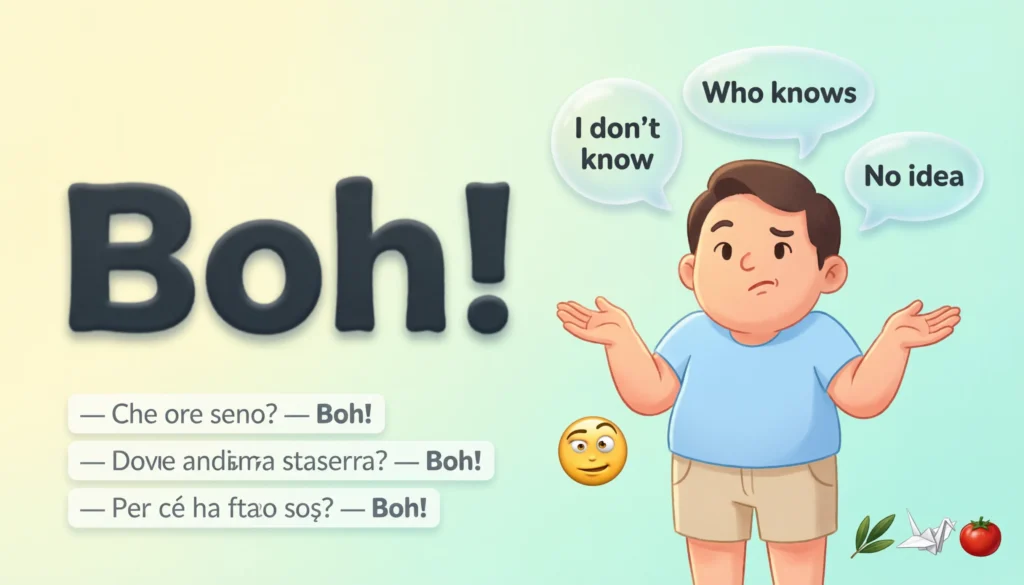
“Boh” in Italian means “I don’t know,” “who knows,” or “I have no idea.”
It is an informal interjection used in casual conversation to express uncertainty, confusion, or indifference. Italians often say it with a shrug to show they don’t have an answer or opinion.
Have you ever watched an Italian movie, heard locals chatting, or seen a comment online where someone simply says “boh”? At first glance, the word might look confusing after all, it’s just three letters and doesn’t translate neatly into English. Yet in everyday Italian conversation, “boh” is incredibly common and expressive.
Whether Italians are unsure about something, expressing indifference, or simply shrugging in conversation, “boh” perfectly captures that feeling of “I don’t know” or “who knows.”
Understanding this small word can instantly make your Italian sound more natural and authentic.
Origin of “Boh” in Italian
The word “boh” is a colloquial interjection in Italian. Unlike many Italian words that come from Latin roots, boh is more of a sound-based expression similar to how English speakers say “uh,” “hmm,” or “meh.”
Key facts about its origin
- Type: Interjection
- Language: Italian
- Meaning: Expression of uncertainty or lack of knowledge
- Usage: Mostly informal conversation
Linguists believe “boh” evolved as a spoken sound representing confusion or uncertainty. Over time, it became a recognized part of everyday Italian speech.
Today, you’ll hear it frequently:
- In casual conversations
- In Italian TV shows and films
- On social media and messaging apps
- Among friends and family
Even though it’s informal, almost every Italian understands and uses it.
Why “Boh” Is So Popular in Italian
One reason “boh” is so widely used is because it perfectly captures a feeling that many languages struggle to express with a single word.
Instead of saying a full sentence like:
“I’m not sure about that.”
Italians can simply say:
“Boh.”
Reasons for its popularity
- Short and expressive
- Communicates uncertainty instantly
- Natural in conversation
- Common in texting and online chats
In many situations, tone and body language like raising shoulders or shrugging add extra meaning to the word.
How Italians Use “Boh” in Everyday Conversation
“Boh” appears in many daily situations. It can respond to a question, express doubt, or show mild indifference.
Below are some typical contexts where Italians use it.
1. When You Don’t Know the Answer
This is the most common use.
Example:
Person A:
“Dove è Marco?”
(Where is Marco?)
Person B:
“Boh.”
(I don’t know.)
Tone: Neutral
2. When Something Is Uncertain
Sometimes it means “who knows.”
Example:
“Forse pioverà domani.”
(Maybe it will rain tomorrow.)
Response:
“Boh, vedremo.”
(Who knows, we’ll see.)
Tone: Thoughtful or uncertain
3. Showing Indifference
Occasionally, boh can sound dismissive.
Example:
“Which movie should we watch?”
Response:
“Boh, scegli tu.”
(I don’t know your choice.)
Tone: Slightly indifferent
4. Expressing Confusion
Example:
“Why did he say that?”
Response:
“Boh… non capisco.”
(I have no idea… I don’t understand.)
Tone: Confused
Example Table: How “Boh” Is Used
| Situation | Italian Example | English Meaning | Tone |
|---|---|---|---|
| Question you can’t answer | “Boh.” | I don’t know | Neutral |
| Unsure about future | “Boh, vedremo.” | Who knows, we’ll see | Casual |
| Indifference | “Boh, fai tu.” | I don’t know, you decide | Slightly dismissive |
| Confusion | “Boh… strano.” | I have no idea… strange | Curious |
| Social media reply | “Boh 🤷♂️” | No idea | Playful |
Tone and Body Language
The meaning of “boh” often depends on tone and gestures.
Italians commonly combine it with:
- 🤷 Shoulder shrug
- 🤔 Thinking expression
- 🙃 Playful tone
Tone variations
| Tone | Meaning |
|---|---|
| Neutral | I don’t know |
| Thoughtful | Who knows |
| Casual | Not sure |
| Dismissive | Don’t care much |
“Boh” in Italian Texting and Online Communication
In modern digital communication, “boh” appears frequently in messages and comments.
Common forms include:
- boh
- boh…
- boh 🤷
- bohhhhh (extra letters for emphasis)
Example chat:
Friend:
“Should we go out tonight?”
Reply:
“Boh… maybe.”
Comparison With Similar Italian Expressions
While “boh” is unique, several other Italian expressions communicate similar ideas.
| Expression | Meaning | Formality |
|---|---|---|
| Boh | I don’t know | Informal |
| Non lo so | I don’t know | Neutral |
| Chi lo sa | Who knows | Casual |
| Non ne ho idea | I have no idea | Slightly stronger |
| Forse | Maybe | Neutral |
Quick comparison
Boh
- Very casual
- Quick response
- Often used alone
Non lo so
- Complete sentence
- More polite or clear
When Not to Use “Boh”
Because boh is informal, it’s not suitable for every situation.
Avoid using it in:
- Formal emails
- Job interviews
- Academic writing
- Professional presentations
Instead, use more polite alternatives.
Polite or Professional Alternatives
If you want to sound more formal in Italian, try these phrases:
| Phrase | Meaning |
|---|---|
| Non lo so. | I don’t know |
| Non sono sicuro. | I’m not sure |
| Non ne sono certo. | I’m not certain |
| Devo controllare. | I need to check |
Example:
Instead of:
“Boh.”
Say:
“Non lo so, devo controllare.”
(I don’t know, I need to check.)
Does “Boh” Have Other Meanings?
The word mostly has one primary meaning: expressing uncertainty.
However, depending on tone, it may imply:
- Confusion
- Indifference
- Mild skepticism
- Casual disagreement
Because it’s an interjection, its interpretation relies heavily on context.
“Boh” in Italian Culture
Italian communication tends to be expressive and conversational.
Small words like boh add personality to everyday speech.
You’ll hear it frequently:
- Among friends
- In family discussions
- In movies and TV
- In Italian comedy
- On social media
It’s a small word that reflects the relaxed, expressive style of Italian conversation.
Tips for Using “Boh” Naturally
If you’re learning Italian, using boh correctly can make you sound more natural.
Helpful tips
• Use it only in casual conversations
• Combine it with tone or gestures
• Avoid it in formal settings
• Add context if needed
Example:
“Boh, non lo so.”
(I really don’t know.)
FAQs
What does “boh” literally mean in Italian?
“Boh” literally means “I don’t know” or “who knows.” It expresses uncertainty or lack of knowledge in a casual way.
Is “boh” rude in Italian?
No, “boh” is not rude, but it can sound slightly dismissive depending on tone. It’s best used with friends or in informal conversation.
Is “boh” formal or informal?
“Boh” is informal slang-like speech used in casual situations, texting, or friendly conversation.
Do Italians use “boh” often?
Yes. Italians use boh very frequently in everyday conversation.
What is the difference between “boh” and “non lo so”?
Boh: casual and quick
Non lo so: complete sentence meaning “I don’t know”
Can “boh” mean “maybe”?
Not exactly, but sometimes it implies uncertainty similar to “maybe” or “who knows.”
How do you pronounce “boh”?
It is pronounced: /bo/
Like the English word “bo” but with a slightly open vowel sound.
Can “boh” be used in writing?
Yes, but mainly in informal writing, such as text messages, social media posts, and chat conversations. It’s rarely used in formal writing.
Conclusion
Although it’s just three letters long, “boh” is one of the most expressive and commonly used interjections in Italian conversation. It captures uncertainty, confusion, or indifference in a way that feels natural and conversational.
If you’re learning Italian, adding boh to your vocabulary can help you sound more natural and authentic in everyday conversations.
Sometimes the simplest words carry the most personality and “boh” is a perfect example of that.
Discover More Related Articles:
- PFP Mean in Text: Complete Guide for Social Media Users (2026)
- Shabbat Shalom Mean in English: Usage, and Significance in 2026

Amanda Lewis is a professional content writer and word-meaning researcher who specializes in explaining definitions, slang, abbreviations, and modern language terms. She writes for WordNexy.com, where she creates clear, accurate, and reader-friendly articles to help users understand word meanings and proper usage. Her work is especially useful for students, writers, and online readers seeking quick and reliable explanations.