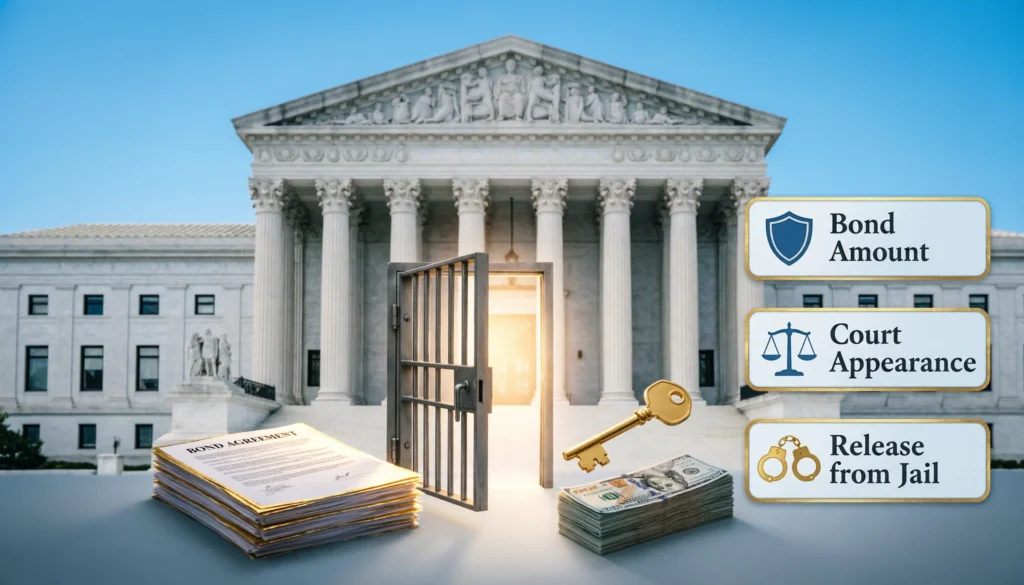
Definition
Bond in jail refers to the amount of money or financial guarantee that a defendant pays to the court in order to be released from jail while waiting for their trial. The purpose of bond is to ensure the person returns to court for future hearings.
If the defendant appears in court as required, the bond may be refunded or released depending on the type of bond used.
Instead of staying behind bars for weeks or months, the court may allow you to leave temporarily if you provide a financial guarantee.
Understanding what bond means in jail is important because it directly affects whether someone can leave custody before their trial. Courts use bonds to balance two goals: allowing individuals their freedom while ensuring they return to court when required.
In simple terms, bond acts like a promise backed by money. The court holds that money—or a guarantee of it—as security. If the person follows all court rules and appears for their hearings, they keep their freedom during the legal process.
In this detailed guide, we will explain:
- The meaning of bond in jail
- Where the concept comes from
- How it works in real life
- Different types of jail bonds
- Examples of bond situations
- Differences between bail and bond
- Common questions people search online
By the end of this article, you will have a clear and practical understanding of how jail bonds work and why they exist.
Origin and History of Jail Bonds
Where the concept of bond comes from
The idea of paying money to secure temporary freedom dates back hundreds of years.
Historically, early legal systems needed a way to ensure that accused individuals returned to court without keeping everyone locked up. The solution was to require a financial pledge.
Some key historical influences include:
- Medieval English law – Courts allowed accused people to remain free if they pledged money or property.
- Magna Carta (1215) – Helped establish the principle that people should not be imprisoned unnecessarily before trial.
- Early American legal system – Adopted similar bail and bond practices from British law.
Over time, the system evolved to include bail schedules, surety bonds, and bail bond agents.
How Bond Works in Jail
The basic process explained
When someone is arrested, the court decides whether they can be released before trial. If the judge allows release, they set a bond amount.
Here is how the process typically works:
- Arrest occurs
A person is taken into police custody. - Booking process
The individual’s information and alleged charges are recorded. - Bond hearing or bail schedule
The judge sets the bond amount. - Bond payment
The defendant or someone on their behalf pays the bond. - Release from jail
The defendant is released while awaiting trial. - Court appearances required
The person must attend all scheduled hearings.
If the defendant fails to appear in court, they forfeit the bond, and a warrant may be issued for their arrest.
Types of Jail Bonds
Common forms of bond used in courts
Not all bonds work the same way. Courts may allow several different types.
| Type of Bond | How It Works | Example Situation |
|---|---|---|
| Cash Bond | Full amount paid in cash directly to court | $2,000 paid to secure release |
| Surety Bond | Bail bond company pays bond for a fee | Defendant pays bondsman 10% |
| Property Bond | Property used as collateral | Home used as guarantee |
| Personal Recognizance (PR) Bond | No money required, promise to appear | First-time offender released |
| Federal Bond | Used in federal court cases | Higher amounts and stricter rules |
Each type has its own requirements and risks.
Real-World Usage of the Term “Bond in Jail”
The phrase “bond in jail” appears frequently in news reports, legal discussions, and everyday conversation.
People often use it when discussing whether someone can leave jail before trial.
Example phrases include:
- “The judge set his bond at $5,000.”
- “She posted bond and was released the same day.”
- “He couldn’t afford the bond, so he stayed in jail.”
In legal contexts, the phrase usually refers to the amount required for release.
Examples of Bond Situations
Realistic scenarios showing how bonds work
| Scenario | Bond Amount | Outcome |
|---|---|---|
| Minor theft charge | $1,000 | Defendant pays and is released |
| DUI arrest | $5,000 | Bail bondsman used |
| Assault charge | $15,000 | Family posts property bond |
| First-time offense | PR bond | No money required |
| Failure to appear | Bond forfeited | Arrest warrant issued |
These examples show how bond amounts vary based on the seriousness of the crime.
Tone and Context in Usage
How the phrase can sound in different contexts
Although bond in jail is mainly a legal term, tone can vary depending on how it’s used.
Friendly or neutral tone
“Don’t worry, he posted bond and is back home.”
Informational tone
“The court set a bond of $10,000 for the defendant.”
Negative or critical tone
“He skipped court and lost his bond.”
These variations depend on the situation and the speaker’s attitude.
Bond vs Bail: What’s the Difference?
A common source of confusion
Many people use bond and bail interchangeably, but they have slightly different meanings.
| Term | Meaning | Key Difference |
|---|---|---|
| Bail | Amount set by court for release | Usually refers to the money amount |
| Bond | Financial guarantee for bail | Often involves a bondsman |
Simple explanation
- Bail = the amount set by the judge
- Bond = the method used to pay or guarantee the bail
Popularity and Media Usage
Why the term appears frequently in news
The term bond in jail appears regularly in:
- Crime news reports
- Legal discussions
- Police reports
- Court coverage
- Television shows
Headlines often include phrases such as:
- “Suspect released after posting bond”
- “Judge denies bond in murder case”
- “Bond set at $50,000”
Because these phrases appear frequently in media coverage, many people search online to understand what bond means in jail.
Alternative Meanings of the Word “Bond”
Other definitions outside the legal context
The word bond has several meanings depending on the field.
| Context | Meaning |
|---|---|
| Finance | Investment loan to government or company |
| Chemistry | Link between atoms |
| Relationships | Emotional connection |
| Construction | Method of joining materials |
However, in the criminal justice system, bond specifically refers to a financial guarantee for court appearance.
Professional or Legal Alternatives
Similar legal terms used in courts
In legal documents, you may also see related terms.
Examples include:
- Bail amount
- Surety
- Recognizance release
- Bond forfeiture
- Bond hearing
These phrases all relate to temporary release before trial.
FAQs
1. What does bond mean when someone is in jail?
Bond means a financial guarantee paid to the court that allows a person to be released from jail while awaiting trial.
2. Is bond the same as bail?
Not exactly. Bail is the amount set by the court, while bond is the payment or guarantee used to secure release.
3. What happens if someone cannot pay bond?
If the defendant cannot afford bond, they may:
- Stay in jail until trial
- Use a bail bondsman
- Request a bond reduction hearing
4. Do you get bond money back?
In many cases, cash bond may be refunded after the case ends, as long as the defendant attends all court appearances.
5. What happens if someone skips court after posting bond?
If the defendant fails to appear:
- The bond is forfeited
- A warrant is issued
- Law enforcement may re-arrest the person
6. Who pays the bond?
The bond may be paid by:
- The defendant
- Family members
- Friends
- A bail bond company
7. Can a judge deny bond?
Yes. Judges may deny bond in serious crimes or if the defendant is considered a flight risk or danger to the community.
8. How long does it take to be released after posting bond?
Release can take a few hours to a full day, depending on jail processing procedures.
Conclusion
Understanding what bond means in jail helps clarify an important part of the criminal justice system. A bond is essentially a financial promise to the court that a defendant will return for their legal proceedings.
While the bond system helps maintain fairness by allowing individuals their freedom before trial, it also ensures accountability through financial guarantees.
By understanding how bonds work, people can better navigate legal situations and make informed decisions when dealing with the justice system.
Discover More Related Articles:
- PFP Mean in Text: Complete Guide for Social Media Users (2026)
- Shabbat Shalom Mean in English: Usage, and Significance in 2026

Amanda Lewis is a professional content writer and word-meaning researcher who specializes in explaining definitions, slang, abbreviations, and modern language terms. She writes for WordNexy.com, where she creates clear, accurate, and reader-friendly articles to help users understand word meanings and proper usage. Her work is especially useful for students, writers, and online readers seeking quick and reliable explanations.