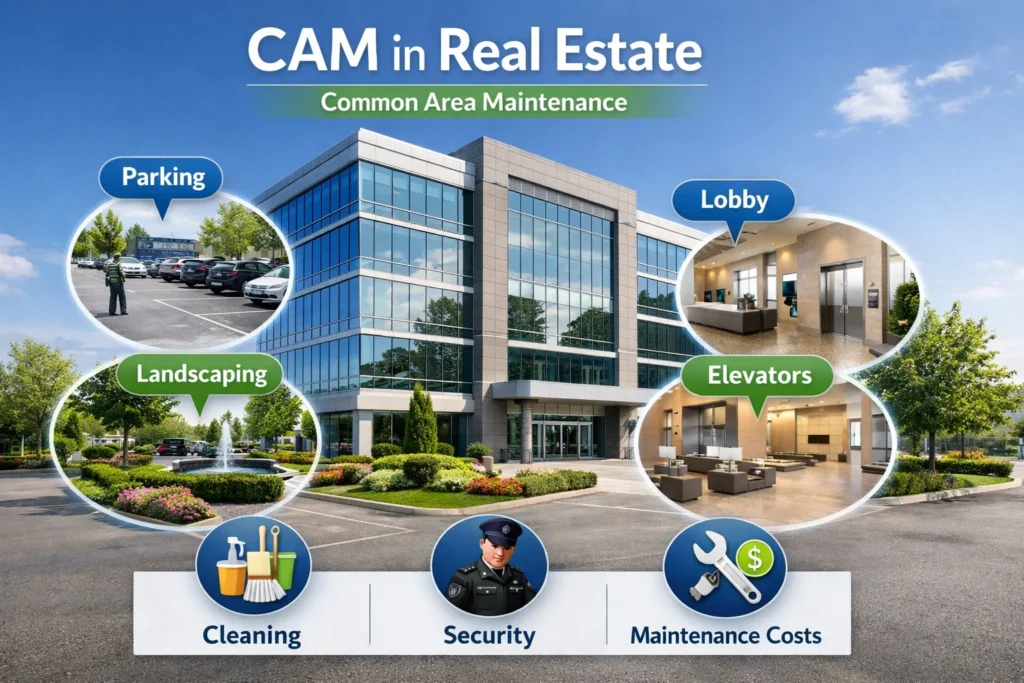
CAM (Common Area Maintenance) refers to the fees that tenants pay to cover the cost of maintaining shared or common areas in a commercial property, such as hallways, parking lots, landscaping, elevators, and lobbies.
When you’re reviewing a lease or exploring commercial property, you might come across the term CAM charges and if you’re not familiar with it, it can feel confusing or even overwhelming. But don’t worry understanding CAM is actually quite simple once you break it down.
What Does CAM Mean in Real Estate?
These charges are typically added to the base rent and are common in shopping centers, office buildings, and multi-tenant properties.
What Is Included in CAM Charges?
CAM fees cover a wide range of shared property expenses. These costs ensure that the property remains clean, safe, and attractive for tenants and visitors.
Common CAM Expenses:
- Cleaning and janitorial services
- Landscaping and lawn care
- Snow removal (in some regions)
- Security services
- Lighting for common areas
- Parking lot repairs and maintenance
- Elevator maintenance
- Trash removal
Optional or Variable CAM Costs:
- Property management fees
- Insurance (sometimes partially included)
- Utilities for shared spaces
💡 Tip: Always review your lease carefully CAM inclusions can vary from property to property.
Origin and Popularity of CAM in Real Estate
The concept of CAM became popular as commercial real estate evolved into shared spaces like malls and office complexes.
Why CAM Exists:
- Properties began housing multiple tenants
- Shared areas required regular maintenance
- Landlords needed a fair way to distribute costs
Instead of one party covering everything, CAM ensures:
- Costs are shared proportionally
- Maintenance remains consistent and high-quality
- Tenants contribute based on their leased space size
Today, CAM is a standard practice in:
- Retail plazas
- Office buildings
- Industrial parks
How CAM Charges Are Calculated
CAM fees are typically calculated based on a tenant’s pro-rata share of the building.
Simple Formula:
Tenant’s CAM Fee = (Tenant’s Square Footage ÷ Total Leasable Area) × Total CAM Costs
Example:
| Detail | Value |
|---|---|
| Total Building Size | 10,000 sq ft |
| Tenant Space | 1,000 sq ft |
| Total CAM Costs | $50,000/year |
| Tenant Share | 10% |
| Annual CAM Fee | $5,000 |
📊 This means the tenant pays $5,000 annually (or monthly installments) for shared maintenance.
Types of CAM Structures in Leases
Different leases handle CAM charges differently. Understanding these structures is essential before signing any agreement.
1. Triple Net Lease (NNN)
- Tenant pays:
- CAM charges
- Property taxes
- Insurance
- Lower base rent, but higher overall responsibility
2. Gross Lease
- CAM is included in rent
- Landlord handles most expenses
- Easier budgeting for tenants
3. Modified Gross Lease
- CAM costs are shared
- Some expenses covered by landlord, others by tenant
Real-World Examples of CAM Usage
Understanding tone and context can help you interpret CAM discussions in leases or negotiations.
Friendly / Neutral Example:
“Your monthly rent is $2,000 plus CAM charges of $300 for shared maintenance.”
✔ Clear and professional, commonly used in leasing agreements.
Detailed Explanation Example:
“CAM charges include landscaping, lighting, and parking maintenance, divided among tenants.”
✔ Transparent and informative tone.
Negative / Cautionary Example:
“Unexpected CAM increases may apply annually.”
⚠️ This signals possible cost fluctuations always clarify caps and limits.
CAM vs Other Real Estate Terms
Here’s how CAM compares with similar or related terms:
| Term | Meaning | Key Difference |
|---|---|---|
| CAM | Maintenance of shared areas | Focuses only on common spaces |
| HOA Fees | Homeowners association fees | Used in residential communities |
| Property Taxes | Government tax on property | Paid to local authorities |
| Operating Expenses | Total cost of running property | Broader than CAM |
| NNN Lease | Lease including CAM, taxes, insurance | CAM is part of this structure |
Alternate Meanings of CAM
While CAM is widely used in real estate, it can mean different things in other contexts:
- Camera (CAM) – Short for camera in tech or media
- Computer-Aided Manufacturing (CAM) – Used in engineering
- Camshaft (CAM) – Automotive component
👉 Always interpret CAM based on the context it’s not always about real estate.
Tips for Tenants: How to Handle CAM Charges
Before Signing a Lease:
- Ask for a CAM breakdown
- Check for caps on increases
- Clarify what’s included/excluded
During Tenancy:
- Review CAM statements annually
- Request expense reports
- Watch for unusual increases
Smart Questions to Ask:
- “Are CAM charges fixed or variable?”
- “Is there a yearly cap?”
- “What expenses are excluded?”
Polite or Professional Alternatives
Instead of just saying “CAM charges,” you might see or use:
- “Common area maintenance fees”
- “Shared property expenses”
- “Building maintenance costs”
These alternatives are often used in formal communication or client-friendly explanations.
Example Table: CAM Cost Breakdown
| Expense Type | Monthly Cost | Included in CAM? |
|---|---|---|
| Cleaning | $500 | Yes |
| Landscaping | $300 | Yes |
| Security | $400 | Yes |
| Property Taxes | $1,200 | No |
| Insurance | $800 | Sometimes |
FAQs
1. What does CAM mean in a lease?
CAM refers to fees tenants pay for maintaining shared areas like hallways, parking lots, and landscaping.
2. Are CAM charges negotiable?
Yes, in many cases you can negotiate caps, inclusions, or limits.
3. Is CAM included in rent?
It depends on the lease type gross leases include it, while NNN leases do not.
4. Why do CAM charges increase?
Costs may rise due to inflation, repairs, or higher service expenses.
5. What is a CAM reconciliation?
It’s an annual adjustment comparing estimated vs actual costs.
6. Can landlords profit from CAM?
Generally, CAM should reflect actual costs, but management fees may be included.
7. What is a CAM cap?
A limit on how much CAM charges can increase annually.
8. Do residential tenants pay CAM?
Not usually CAM is mainly for commercial properties.
Conclusion:
CAM charges might seem like a small detail, but they play a big role in your overall leasing costs. Whether you’re renting retail space or office property, understanding CAM helps you avoid surprises and budget effectively.
👉 In short, CAM ensures shared spaces stay functional and appealing but it’s your responsibility to understand what you’re paying for.
Discover More Related Articles:

Sarah Williams is the passionate author behind WordNexy.com, dedicated to creating content that informs, inspires, and sparks curiosity. With a love for words and storytelling, she transforms ideas into meaningful articles that educate, entertain, and leave a lasting impression on every reader.