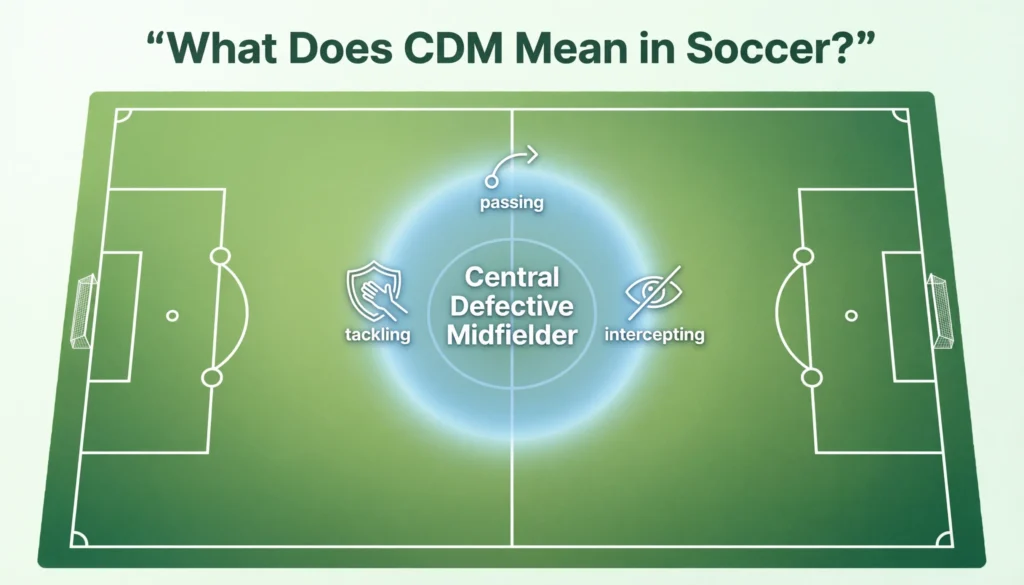
Definition:
CDM in soccer stands for “Central Defensive Midfielder.” It refers to a player positioned just in front of the defense whose main role is to protect the backline, break up opposition attacks, and help transition the ball from defense to offense.
If you’ve ever watched a soccer match and wondered who quietly controls the game without always scoring or assisting, you’re probably looking at the CDM. While strikers get the glory and wingers get the flair, the central defensive midfielder (CDM) is the backbone of a team.
This role is all about balance defending when needed, supporting attacks when possible, and maintaining structure throughout the match. Without a strong CDM, even the best teams can fall apart defensively.
In this guide, you’ll learn everything about what CDM means in soccer, how the role works, why it’s so important, and how it compares to other midfield positions.
What Does CDM Mean in Soccer?
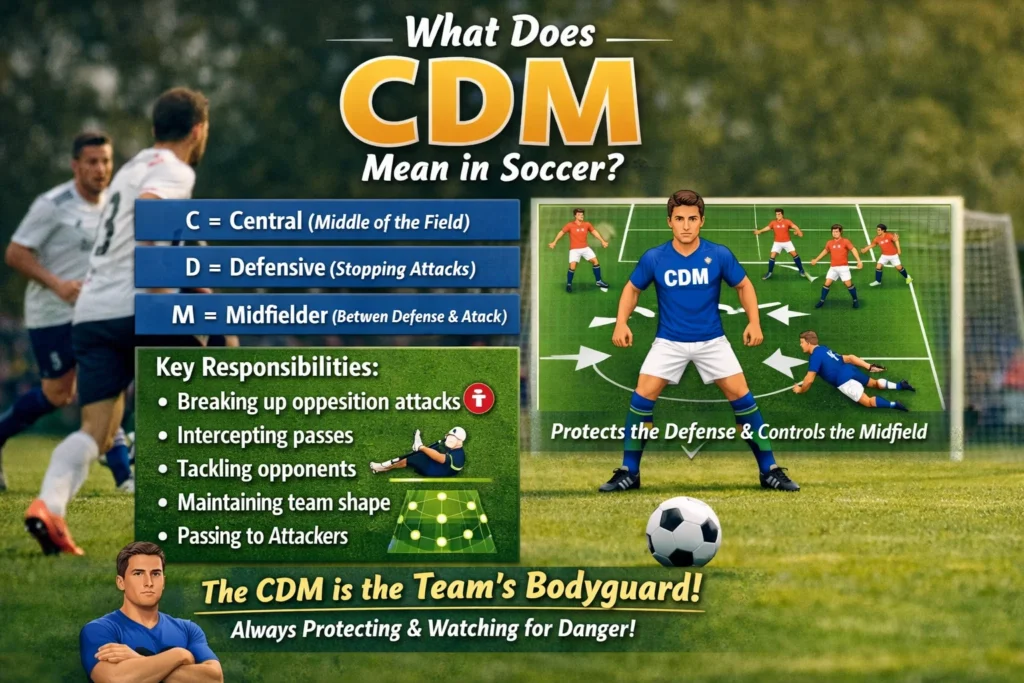
In simple terms:
- C = Central (middle of the field)
- D = Defensive (focused on stopping attacks)
- M = Midfielder (plays between defense and attack)
A CDM plays right in front of the defenders and acts as a shield, preventing opposing players from reaching the goal easily.
Key Responsibilities:
- Breaking up opposition attacks 🛑
- Intercepting passes
- Tackling opponents
- Maintaining team shape
- Passing the ball to more attacking players
Think of the CDM as the team’s bodyguard always protecting and watching for danger.
Origin and Popularity of the CDM Role
The concept of a defensive midfielder has evolved over time. In early soccer formations, roles were less specialized. But as tactics became more advanced, teams realized the need for a player dedicated to defensive midfield duties.
Evolution Highlights:
- 1960s–1980s: Introduction of deeper midfield roles
- 1990s: Rise of specialized defensive midfielders
- Modern Era: CDMs are essential in almost every formation
Famous players like Claude Makélélé revolutionized the role so much that it’s often referred to as the “Makélélé Role.”
Today, every top team relies on a CDM to maintain balance and control.
What Does a CDM Do on the Field?
A CDM is constantly involved in both defense and buildup play. Their role is dynamic but often underappreciated.
Defensive Duties:
- Intercept passes before they reach attackers
- Tackle opponents cleanly
- Block shooting lanes
- Cover defenders when they move out of position
Offensive Support:
- Short, safe passing
- Switching play from one side to another
- Starting counterattacks
- Maintaining possession
Tactical Role:
- Keeps the team compact
- Reads the game and anticipates danger
- Acts as a link between defense and midfield
Key Skills Every CDM Needs
To succeed as a CDM, a player must combine physical, mental, and technical abilities.
Essential Skills:
- 🧠 Game awareness (reading plays early)
- 💪 Strength and stamina
- 🎯 Accurate passing
- ⚡ Quick decision-making
- 🛡️ Defensive discipline
A great CDM doesn’t just react they predict.
Real-World Examples of CDM Players
Some of the best CDMs in soccer history and modern football include:
- N’Golo Kanté – Known for incredible stamina and ball-winning ability
- Casemiro – Strong, aggressive, and tactically disciplined
- Sergio Busquets – Exceptional positioning and intelligence
- Rodri – Modern CDM with passing and control
These players show how diverse the CDM role can be some are destroyers, others are deep playmakers.
Example Table: CDM Responsibilities in Different Situations
| Situation | CDM Action | Purpose |
|---|---|---|
| Opponent attacking | Intercept or tackle | Stop goal-scoring chances |
| Team defending deep | Stay close to defenders | Provide extra protection |
| Team attacking | Pass ball forward | Start offensive moves |
| Counterattack | Win ball and release quickly | Create fast break opportunities |
| Losing possession | Press immediately | Regain control |
How CDM Differs From Other Soccer Positions
Understanding CDM becomes easier when compared to similar roles.
Difference CDM vs CM (Central Midfielder)
| Feature | CDM | CM |
|---|---|---|
| Role | Defensive focus | Balanced role |
| Position | Deeper | More central |
| Responsibilities | Tackling, intercepting | Passing, supporting attack |
CDM vs CAM (Attacking Midfielder)
| Feature | CDM | CAM |
|---|---|---|
| Focus | Defense | Attack |
| Position | Near defenders | Near forwards |
| Key Skills | Tackling, positioning | Creativity, scoring |
CDM vs CB (Center Back)
- CDM plays in midfield
- CB plays in defense
- CDM supports defense, CB is the defense
Usage of “CDM” in Real Conversations
Here’s how “CDM” is commonly used by fans, players, and commentators:
Friendly Tone 😊
- “We need a strong CDM to control the midfield.”
- “He’s an amazing CDM always in the right place!”
Neutral/Analytical Tone ⚖️
- “The CDM played a key role in breaking up attacks.”
- “This formation relies heavily on the CDM.”
Negative/Dismissive Tone 😒
- “Our CDM was too slow today.”
- “Without a proper CDM, the defense looks weak.”
Why the CDM Role Is So Important
A team without a good CDM often struggles with:
- Defensive stability ❌
- Midfield control ❌
- Smooth transitions ❌
Benefits of a Strong CDM:
- Better defensive organization
- More possession control
- Improved team balance
- Reduced pressure on defenders
In modern soccer, the CDM is often considered the engine of the team’s structure.
Alternate Meanings of CDM (Outside Soccer)
While “CDM” is widely used in soccer, it can mean different things in other contexts:
- Cash Deposit Machine (banking)
- Career Development Model (education)
- Content Delivery Manager (tech)
However, in sports especially soccer it almost always refers to Central Defensive Midfielder.
Polite or Professional Alternatives
Instead of using the abbreviation “CDM,” you can say:
- Central Defensive Midfielder (formal)
- Defensive Midfielder (simpler)
- Holding Midfielder (common alternative)
These are especially useful in professional writing or commentary.
FAQs
1. What does CDM stand for in soccer?
CDM stands for Central Defensive Midfielder, a player who protects the defense and controls the midfield.
2. What is the main role of a CDM?
The main role is to stop attacks, intercept passes, and support both defense and midfield play.
3. Is CDM a defensive position?
Yes, it is primarily defensive, but it also supports attacking transitions.
4. Where does a CDM play on the field?
A CDM plays just in front of the defenders, in the central midfield area.
5. Who are the best CDMs in soccer?
Top examples include N’Golo Kanté, Casemiro, Sergio Busquets, and Rodri.
6. What formation uses a CDM?
Formations like 4-3-3, 4-2-3-1, and 4-1-4-1 commonly include a CDM.
7. Is CDM the same as CM?
No, a CM (Central Midfielder) has a more balanced role, while a CDM focuses on defense.
8. Why is a CDM important in soccer?
A CDM provides defensive stability, controls tempo, and links defense with attack.
Conclusion:
The term CDM in soccer might seem simple at first, but it represents one of the most crucial roles on the field. From breaking up attacks to controlling the flow of the game, the central defensive midfielder is the silent hero of any successful team.
If you’re watching a match, pay close attention to the player in front of the defenders you’ll often find the CDM quietly controlling everything.
Discover More Related Articles:

Sarah Williams is the passionate author behind WordNexy.com, dedicated to creating content that informs, inspires, and sparks curiosity. With a love for words and storytelling, she transforms ideas into meaningful articles that educate, entertain, and leave a lasting impression on every reader.