📌Definition
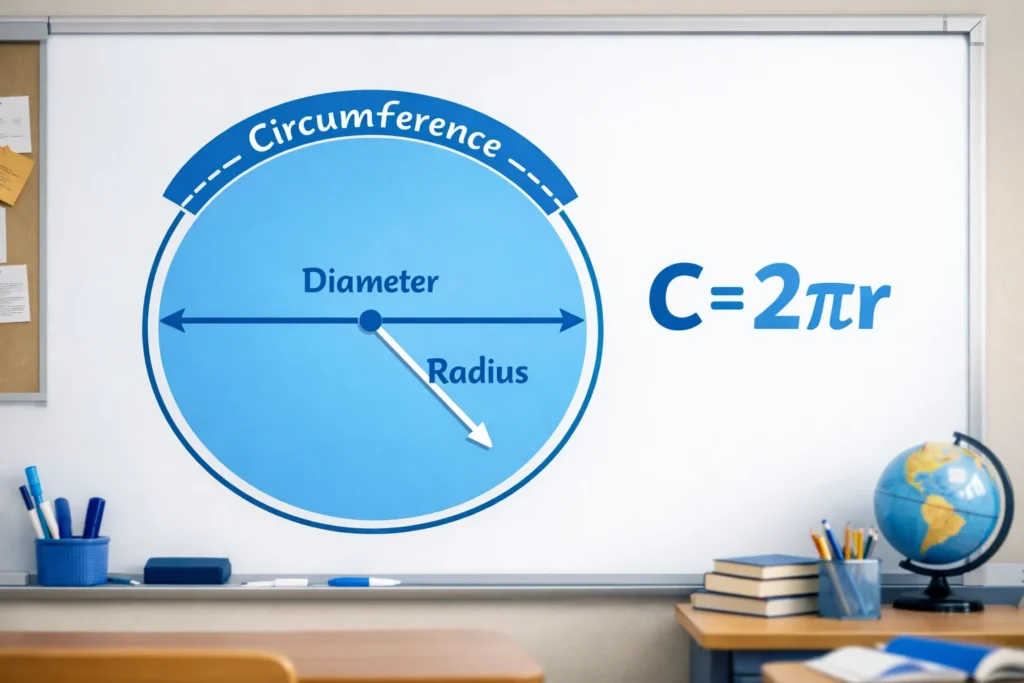
Circumference in math is the total distance around the outside of a circle.
It is calculated using the formula:Circumference = 2πrorC = πd
Where:
r = radius (distance from center to edge)
d = diameter (distance across the circle through the center)
π (pi) ≈ 3.14159
In simple terms, circumference is the perimeter of a circle.
Have you ever wrapped a measuring tape around a round table, a pizza, or even a tree trunk and wondered what that outer distance is called? 🤔 That measurement has a special name in mathematics: circumference.
Understanding circumference isn’t just about passing a math test it helps in real life, from construction and engineering to sports and design. In this complete guide, we’ll break it down in a simple, friendly, and professional way so you can confidently understand and explain it.
Understanding Circumference in Simple Terms
Imagine drawing a circle on paper. Now trace your finger all the way around its edge. The total length your finger travels is the circumference.
Unlike squares or rectangles (which have straight sides), a circle is completely curved — so instead of adding sides together, we use a special formula involving π (pi).
The Origin of the Word “Circumference”
The word circumference comes from Latin:
- “circum” = around
- “ferre” = to carry or bear
So, circumference literally means “to carry around.”
The mathematical concept dates back thousands of years. Ancient civilizations like:
- The Egyptians
- The Babylonians
- The Greeks
…all studied circles carefully.
The famous Greek mathematician Archimedes made major contributions to understanding π and circular measurements around 250 BCE. His work laid the foundation for how we calculate circumference today.
The Formula for Circumference
There are two main formulas:
1️⃣ Using Radius
C=2πr
2️⃣ Using Diameter
C=πd
Because:d=2r
Both formulas give the same result.
📊 Labeled Example Table
| Example | Radius (r) | Diameter (d) | Formula Used | Circumference |
|---|---|---|---|---|
| Small coin | 2 cm | 4 cm | C = 2πr | 12.57 cm |
| Pizza | 7 in | 14 in | C = πd | 43.98 in |
| Circular garden | 5 m | 10 m | C = 2πr | 31.42 m |
| Bicycle wheel | 14 in | 28 in | C = πd | 87.96 in |
(Using π ≈ 3.14)
Step-by-Step Example 😊
Let’s say a circle has a radius of 6 cm.
Step 1: Write the formula
C = 2πr
Step 2: Substitute values
C = 2 × 3.14 × 6
Step 3: Multiply
C = 37.68 cm
So the circumference is 37.68 centimeters.
Easy, right? 🎉
Real-World Usage of Circumference
Circumference isn’t just a classroom concept. It appears in everyday life:
🛞 1. Wheels and Tires
To calculate how far a bicycle travels in one rotation, you need the circumference of the wheel.
🍕 2. Food Industry
When cutting pizza evenly, circumference helps determine crust length.
🌳 3. Measuring Trees
Foresters measure tree trunk circumference to estimate age and growth.
🏟️ 4. Sports Tracks
Circular tracks rely on circumference calculations.
🏗️ 5. Construction & Engineering
Pipes, domes, arches, and circular foundations all require circumference calculations.
Tone & Context Examples
The word “circumference” is usually neutral and academic, but context can vary.
Friendly Tone 😊
“Let’s find the circumference of your pizza so we know how much crust you’re getting!”
Neutral/Academic Tone
“The circumference of the circle is calculated using the formula C = 2πr.”
Slightly Dismissive Tone
“You can’t calculate that without knowing the circumference first.”
Circumference vs. Related Math Terms
Many students confuse circumference with other measurements. Let’s clarify.
🔎 Comparison Table
| Term | Meaning | Applies To | Formula |
|---|---|---|---|
| Circumference | Distance around a circle | Circles only | 2πr |
| Perimeter | Distance around a shape | Polygons | Add sides |
| Area | Space inside a shape | All shapes | πr² (circle) |
| Diameter | Distance across circle | Circles | 2r |
| Radius | Center to edge | Circles | d ÷ 2 |
Key Difference:
- Perimeter applies to polygons.
- Circumference applies only to circles.
You can think of circumference as the circular version of perimeter.
Circumference and π (Pi)
The symbol π (pi) represents the ratio of circumference to diameter.π=dC
π is approximately 3.14159, but it never ends or repeats.
Fun Fact 🎯
Pi Day is celebrated on March 14 (3/14).
Are There Alternate Meanings of Circumference?
While primarily a mathematical term, circumference can also be used in:
📏 Body Measurement
“Waist circumference” in medical or fitness contexts.
🌍 General English Usage
Sometimes used metaphorically to describe boundaries:
“The issue expanded beyond the circumference of the debate.”
However, in most contexts, circumference refers to a circular measurement.
Professional & Polite Alternatives
If teaching or writing formally, you might say:
- “Distance around the circle”
- “Outer boundary length”
- “Circular perimeter”
These alternatives can make explanations clearer for beginners.
Common Mistakes Students Make
❌ Confusing area with circumference
❌ Using the wrong formula
❌ Forgetting to multiply by 2
❌ Mixing radius and diameter
Quick Tip ✔
Always check whether you’re given radius or diameter before calculating.
Why Circumference Is Important in Education
In school math, circumference is introduced in:
- Elementary geometry
- Middle school math
- High school trigonometry
- SAT and standardized testing
Understanding it builds foundation for:
- Geometry
- Calculus
- Engineering
- Architecture
- Physics
FAQs
1. What does circumference mean in math in simple words?
Circumference means the total distance around a circle.
2. What is the formula for circumference?
C = 2πr or C = πd.
3. Is circumference the same as perimeter?
No. Circumference applies only to circles, while perimeter applies to polygons.
4. How do you find circumference with diameter?
Multiply diameter by π.
C = πd.
5. Why do we use π in circumference?
Because π represents the constant ratio between a circle’s circumference and diameter.
6. What is the circumference of a circle with radius 10?
C = 2 × 3.14 × 10 = 62.8 units.
7. What grade do students learn circumference?
Usually introduced around Grade 6–7.
8. Can circumference be measured without π?
You can measure it physically with string or tape, but mathematical calculation requires π.
Practical Tips for Remembering the Formula
🟢 If you see radius, think:
“Double the radius, then multiply by π.”
🟢 If you see diameter, think:
“Just multiply by π.”
Memory Trick 🎓
“Cherry Pie” → C = πd
(C = Pie × diameter)
Conclusion
So, what does circumference mean in math?
It’s the total distance around a circle simple in definition but powerful in application. From measuring tires to designing buildings, circumference plays a major role in both education and real-world problem-solving.
Once you understand the relationship between radius, diameter, and π, calculating circumference becomes quick and easy.
Whether you’re a student preparing for exams or someone refreshing basic geometry, knowing how circumference works is a skill that truly goes full circle. 🔵✨
Discover More Related Articles:

Sarah Williams is the passionate author behind WordNexy.com, dedicated to creating content that informs, inspires, and sparks curiosity. With a love for words and storytelling, she transforms ideas into meaningful articles that educate, entertain, and leave a lasting impression on every reader.