Definition
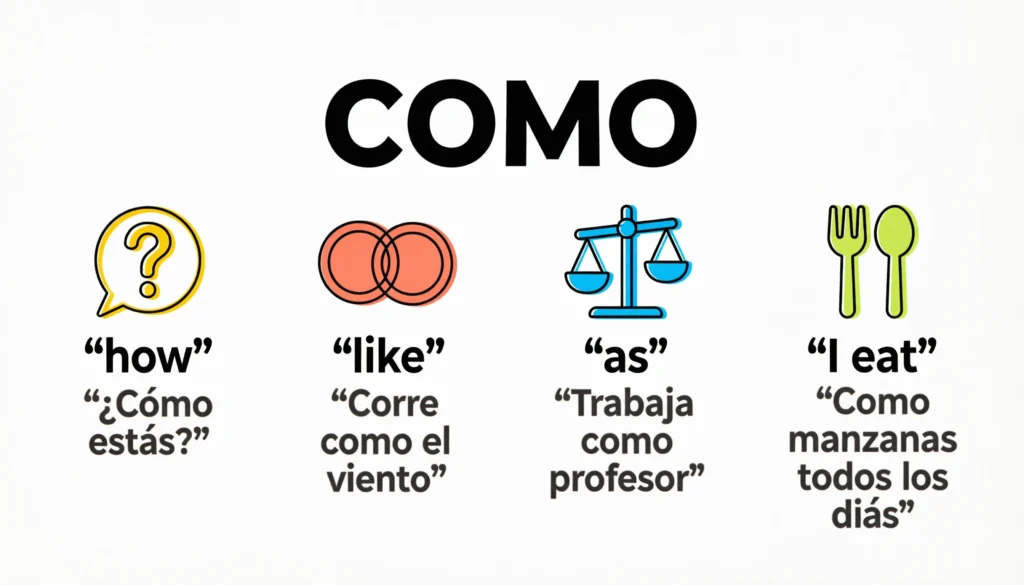
“Como” is a Spanish word that most commonly translates to “how,” “like,” or “as” in English, depending on the context of the sentence.
It is frequently used in questions, comparisons, and descriptions in everyday Spanish conversation.
Example:
¿Cómo estás? → How are you?
Corre como un atleta. → He runs like an athlete.
Have you ever heard someone say “¿Cómo estás?” or seen the word “como” in Spanish and wondered what it means in English? You’re not alone. The word “como” is one of the most commonly used words in Spanish, and it appears in everyday conversations, questions, and even comparisons.
Understanding what “como” means in English can help you recognize common Spanish phrases, improve your language skills, and communicate more naturally with Spanish speakers.
In this guide, we’ll break down the definition, origin, real-world usage, examples, tone differences, and related words so you can fully understand how “como” works in English
Because Spanish relies heavily on context, “como” can have several meanings, which we’ll explore in detail below.
Origin of the Word “Como”
The Spanish word “como” comes from the Latin word “quomodo,” which means “in what manner” or “how.”
Over time, as Latin evolved into Spanish and other Romance languages, the word gradually shortened and transformed into “como.”
Historical evolution
| Language | Word | Meaning |
|---|---|---|
| Latin | quomodo | how / in what way |
| Old Spanish | como | how / like |
| Modern Spanish | como | how, like, as |
Because of its Latin roots, similar versions exist in other Romance languages:
- Portuguese: como
- Italian: come
- French: comme
All of these carry meanings related to “how,” “like,” or “as.”
The Main Meanings of “Como” in English
The meaning of “como” changes based on context. Below are the most common translations used in English.
1. “How” (Most Common Meaning)
The most frequent meaning of “como” is “how.”
It is commonly used in questions asking about someone’s condition, method, or manner.
Examples
| Spanish Sentence | English Translation | Tone |
|---|---|---|
| ¿Cómo estás? | How are you? | Friendly |
| ¿Cómo funciona esto? | How does this work? | Neutral |
| ¿Cómo llegaste aquí? | How did you get here? | Curious |
This is the meaning most beginners learn first.
2. “Like” (Comparison)
“Como” can also mean “like” when comparing things.
Examples
| Spanish | English |
|---|---|
| Él corre como un campeón | He runs like a champion |
| Brilla como el sol | It shines like the sun |
| Habla como su madre | He speaks like his mother |
In these cases, “como” creates a comparison between two things.
3. “As” (Role or Function)
Sometimes “como” means “as,” especially when describing roles, jobs, or functions.
Examples
- Trabaja como profesor.
He works as a teacher. - Usa esto como ejemplo.
Use this as an example.
This meaning appears frequently in formal or descriptive sentences.
4. “I Eat” (From the Verb Comer)
Another interesting meaning appears when “como” is a verb form.
In this case, it comes from “comer,” which means “to eat.”
“Como” = “I eat.”
Examples
| Spanish Sentence | English Translation |
|---|---|
| Como pizza todos los viernes | I eat pizza every Friday |
| Como muy rápido | I eat very quickly |
Context determines whether “como” means “how” or “I eat.”
How Context Changes the Meaning of “Como”
Spanish relies heavily on context. The exact translation of “como” depends on punctuation and sentence structure.
| Sentence | Meaning |
|---|---|
| ¿Cómo estás? | How are you? |
| Como pizza | I eat pizza |
| Corre como un atleta | Runs like an athlete |
Notice how the question mark and sentence structure determine the meaning.
Real-World Usage of “Como”
“Como” appears everywhere in Spanish—from casual chats to formal writing.
Everyday phrases
- ¿Cómo estás? – How are you?
- ¿Cómo te llamas? – What is your name?
- ¿Cómo funciona? – How does it work?
These phrases are some of the first expressions Spanish learners memorize.
Tone and Context in Conversation
The tone of “como” can shift depending on the situation.
Friendly tone 😊
- ¿Cómo estás hoy?
How are you today?
Neutral tone
- ¿Cómo funciona este sistema?
How does this system work?
Slightly frustrated tone 😅
- ¿Cómo pasó esto?
How did this happen?
Tone mostly depends on voice and context, not the word itself.
Common Spanish Expressions With “Como”
Here are some popular phrases where “como” appears.
| Phrase | Meaning |
|---|---|
| ¿Cómo estás? | How are you? |
| ¿Cómo te llamas? | What is your name? |
| Como siempre | As always |
| Tal como | Just like |
| Como si | As if |
These expressions appear often in daily conversations and media.
Comparison With Similar Spanish Words
Spanish has several words similar to “como.” Understanding the differences helps avoid confusion.
| Word | Meaning | Example |
|---|---|---|
| Como | How / like / as | Corre como un atleta |
| Qué | What | ¿Qué haces? |
| Cuál | Which | ¿Cuál quieres? |
| De qué manera | In what way | Formal version of “how” |
Quick tip
- “Cómo” with an accent → question word (“how”)
- “Como” without accent → comparison or verb
Accent Mark: “Cómo” vs “Como”
Spanish uses accent marks to change meaning.
| Word | Meaning |
|---|---|
| Cómo | How (question form) |
| Como | Like / as / I eat |
Example
- ¿Cómo estás? → How are you?
- Corre como el viento. → Runs like the wind.
The accent helps identify questions vs statements.
Polite or Professional Alternatives
In formal Spanish or professional writing, other phrases may replace “como.”
| Alternative | Meaning |
|---|---|
| De qué manera | In what way |
| De qué forma | In what form |
| Tal como | Just as |
Example:
- Explique de qué manera funciona el sistema.
Explain how the system works.
These versions sound more formal or academic.
Alternate Meanings of “Como”
While “how,” “like,” and “as” are the main meanings, “como” may appear in other contexts.
1. Informal filler
Sometimes used casually in speech.
Example:
- Es como… raro.
It’s kind of… weird.
2. Idiomatic expressions
Spanish idioms sometimes use “como” creatively.
Example:
- Como pez en el agua
Like a fish in water (very comfortable)
Example Sentences With Context
| Spanish | English | Context |
|---|---|---|
| ¿Cómo te sientes? | How do you feel? | Friendly |
| Habla como un experto | Speaks like an expert | Comparison |
| Trabajo como diseñador | I work as a designer | Role |
| Como frutas todos los días | I eat fruits every day | Verb form |
These examples highlight how one word can have multiple meanings.
Why “Como” Is So Popular in Spanish
The word “como” is extremely common because it serves multiple grammatical roles.
Reasons for its popularity
- Used in questions
- Used in comparisons
- Used in descriptions
- Used as a verb form
Because of this versatility, Spanish speakers use “como” daily.
Language learners often encounter it within their first few lessons.
Tips for Using “Como” Correctly
If you’re learning Spanish, these tips will help.
1. Look for punctuation
- ¿Cómo? → Question
- Como → Statement or comparison
2. Identify the sentence structure
Example:
- Como pizza → Verb
- Como un campeón → Comparison
3. Pay attention to accent marks
The accent changes the meaning significantly.
FAQs:
- What does “como” translate to in English?
“Como” most commonly translates to “how,” “like,” or “as,” depending on the sentence context. - What does “¿cómo estás?” mean?
“¿Cómo estás?” means “How are you?”
It is one of the most common Spanish greetings. - Does “como” mean “I eat”?
Yes. “Como” can also mean “I eat” because it is the first-person form of the verb comer (to eat).
Example:
Como arroz todos los días. → I eat rice every day.
- What is the difference between “como” and “cómo”?
- Cómo (with accent) → used in questions meaning how
- Como (no accent) → used for comparisons or verbs
- Is “como” formal or informal?
“Como” itself is neutral and can be used in both formal and informal Spanish. - Can “como” mean “like”?
Yes. When making comparisons, “como” translates to “like.”
Example:
Corre como el viento. → Runs like the wind.
- Why does “como” have multiple meanings?
Spanish words often serve multiple grammatical roles, and context determines the exact translation. - Is “como” used in everyday Spanish?
Yes. It is one of the most frequently used Spanish words, especially in questions and comparisons.
Conclusion
The Spanish word “como” is small but incredibly powerful. Depending on context, it can mean “how,” “like,” “as,” or even “I eat.”
Understanding how it works requires paying attention to punctuation, sentence structure, and accent marks.
By recognizing how “como” functions in real conversations, you’ll better understand Spanish and communicate more naturally.
Discover More Related Articles:
- PFP Mean in Text: Complete Guide for Social Media Users (2026)
- Shabbat Shalom Mean in English: Usage, and Significance in 2026

Amanda Lewis is a professional content writer and word-meaning researcher who specializes in explaining definitions, slang, abbreviations, and modern language terms. She writes for WordNexy.com, where she creates clear, accurate, and reader-friendly articles to help users understand word meanings and proper usage. Her work is especially useful for students, writers, and online readers seeking quick and reliable explanations.