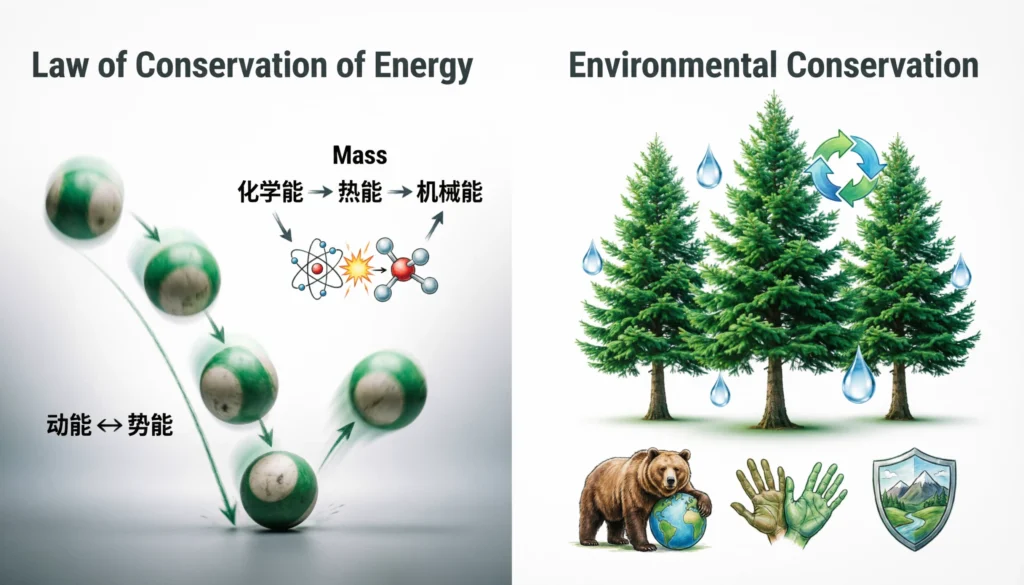
Definition:
Conservation in science refers to the principle that certain properties such as energy, mass, momentum, or charge cannot be created or destroyed, only transformed or transferred from one form to another.
In environmental science, conservation also means the responsible protection and management of natural resources to prevent depletion and maintain ecological balance.
Have you ever heard someone say, “Energy can’t be created or destroyed”? Or maybe you’ve seen signs encouraging water conservation or wildlife conservation. These ideas may sound different, but they’re connected by one powerful scientific concept: conservation.
In this comprehensive guide, we’ll explore what conservation means in science, where the term comes from, how it’s used in physics, chemistry, and environmental science, and why it matters in the real world. Whether you’re a student, teacher, or simply curious, this article will break it down in a clear, friendly, and practical way.
What Does Conservation Mean in Science?
In science, conservation generally means that a specific measurable quantity remains constant over time within a closed system.
There are two major ways the term is used:
- Physical Sciences (Physics & Chemistry) – Conservation refers to laws that state certain quantities stay constant.
- Environmental Science – Conservation refers to protecting and preserving natural resources.
Let’s explore both meanings in depth.
The Origin of the Word “Conservation”
The word conservation comes from the Latin word conservare, which means “to keep, preserve, or maintain.”
In early scientific history, the term became prominent when scientists began recognizing patterns in nature. During the 18th and 19th centuries, scientists like:
- Antoine Lavoisier
- James Prescott Joule
- Hermann von Helmholtz
helped establish foundational conservation laws in chemistry and physics.
Meanwhile, environmental conservation gained global attention in the late 19th and early 20th centuries, supported by leaders like:
- Theodore Roosevelt
Today, conservation is one of the most important ideas in science and sustainability.
Conservation in Physics
In physics, conservation laws describe quantities that remain constant in an isolated system.
1. Law of Conservation of Energy
This law states:
Energy cannot be created or destroyed; it can only change forms.
For example:
- Electrical energy → Light energy (in a bulb 💡)
- Chemical energy → Kinetic energy (in a car 🚗)
The total energy remains constant even if it changes form.
Real-World Example
When you eat food:
- Food contains chemical energy
- Your body converts it into kinetic energy (movement) and thermal energy (body heat)
Energy isn’t lost it’s transformed.
2. Law of Conservation of Mass
Proposed by Antoine Lavoisier, this law states:
Matter cannot be created or destroyed in a chemical reaction.
If you burn paper:
- The paper turns into ash and gases
- The total mass before and after remains the same
Even if it looks like something disappeared, the atoms are still there just rearranged.
3. Conservation of Momentum
Momentum = mass × velocity.
This law states:
In a closed system, total momentum remains constant.
Example:
- When two billiard balls collide 🎱
- The momentum transfers from one ball to another
- Total momentum stays the same
4. Conservation of Charge
In physics:
Electric charge cannot be created or destroyed.
If a system starts with zero net charge, it must end with zero net charge.
Summary Table: Major Conservation Laws
| Conservation Law | What Stays Constant | Field of Science | Example |
|---|---|---|---|
| Conservation of Energy | Total energy | Physics | Roller coaster motion |
| Conservation of Mass | Total mass | Chemistry | Chemical reactions |
| Conservation of Momentum | Total momentum | Physics | Car collisions |
| Conservation of Charge | Electric charge | Physics | Static electricity |
Conservation in Environmental Science
In environmental science, conservation means:
The responsible use, protection, and management of natural resources to prevent waste, depletion, or extinction.
This includes:
- Wildlife conservation 🐅
- Water conservation 💧
- Forest conservation 🌳
- Soil conservation
- Energy conservation
Real-World Environmental Examples
1. Wildlife Conservation
Protecting endangered species from extinction.
Example:
Organizations like World Wildlife Fund work to protect species and habitats.
Tone example:
- Friendly: “Let’s conserve wildlife so future generations can enjoy biodiversity!”
- Urgent: “Without conservation efforts, species could disappear forever.”
2. Water Conservation
Reducing water waste through:
- Fixing leaks
- Using efficient irrigation
- Installing low-flow fixtures
3. Forest Conservation
Preventing deforestation and maintaining ecosystems.
This helps:
- Reduce climate change
- Protect habitats
- Maintain biodiversity
Conservation vs Preservation
People often confuse conservation and preservation. Here’s the difference:
| Term | Meaning | Key Idea |
|---|---|---|
| Conservation | Sustainable use and management | Responsible use |
| Preservation | Protecting from any use | No human interference |
Example:
- Conservation: Regulated logging 🌲
- Preservation: No logging allowed 🚫
Conservation vs Sustainability
Another related term is sustainability.
| Term | Focus |
|---|---|
| Conservation | Protecting and managing resources |
| Sustainability | Meeting present needs without harming future generations |
Conservation supports sustainability but they’re not identical.
Why Conservation Is Important in Science
Conservation principles:
- Help scientists predict outcomes
- Form the basis of physics and chemistry
- Support environmental protection
- Guide sustainable development
Without conservation laws, science would lack consistency and predictability.
Alternate Meanings of Conservation
Although primarily scientific, “conservation” can also mean:
- Art conservation (protecting paintings 🖼️)
- Historical conservation (protecting buildings)
- Data conservation (limiting resource usage in tech)
However, the scientific meaning remains the most widely used.
Tone & Usage Examples
Depending on context, conservation can carry different tones:
Neutral/Scientific Tone
“The law of conservation of energy applies to all closed systems.”
Encouraging Tone
“We must practice water conservation to protect our planet.”
Urgent Tone
“Failure to prioritize conservation could result in ecological collapse.”
Practical Tips for Students
If you’re learning about conservation:
- Always ask: What quantity is staying constant?
- Identify whether the system is closed or open
- Remember: transformation ≠ destruction
Quick memory trick:
Conservation = Constant quantity
FAQs:
1. What is the simple definition of conservation in science?
Conservation means certain quantities (like energy or mass) cannot be created or destroyed only transformed.
2. What is the law of conservation of energy?
It states that energy cannot be created or destroyed, only converted from one form to another.
3. What is conservation of mass?
It means matter remains constant during chemical reactions.
4. Is conservation the same as preservation?
No. Conservation allows responsible use; preservation restricts use entirely.
5. Why is conservation important?
It ensures scientific consistency and protects natural resources.
6. What are examples of conservation?
Energy transformation, wildlife protection, water-saving methods.
7. Who discovered conservation of mass?
Antoine Lavoisier.
8. What does conservation mean in environmental science?
It means protecting and managing natural resources responsibly.
Conclusion:
So, what does conservation mean in science?
At its core, conservation means something stays constant whether it’s energy in physics or natural resources in environmental science.
It’s one of the most powerful and unifying ideas in science.
Whether you’re studying physics or protecting forests, conservation reminds us of one important truth:
Nature follows balance and it’s our responsibility to respect it.
Discover More Related Articles:
- PFP Mean in Text: Complete Guide for Social Media Users (2026)
- Shabbat Shalom Mean in English: Usage, and Significance in 2026

Sarah Williams is the passionate author behind WordNexy.com, dedicated to creating content that informs, inspires, and sparks curiosity. With a love for words and storytelling, she transforms ideas into meaningful articles that educate, entertain, and leave a lasting impression on every reader.