Definition:
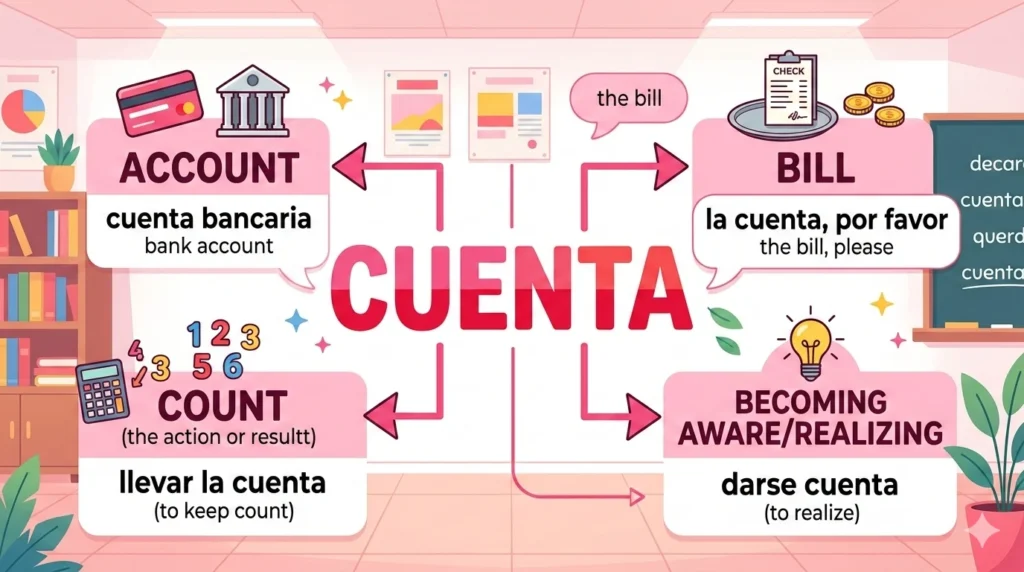
“Cuenta” in Spanish most commonly means “account,” “bill,” or “count,” depending on the context. It comes from the Spanish verb “contar,” meaning to count or to tell.
The word is widely used in financial situations (bank account), restaurants (the bill), and expressions related to counting or considering something.
If you’re learning Spanish or browsing Spanish conversations online, you’ve probably seen the word “cuenta.” It’s a common word used in everyday situations from ordering food at a restaurant to managing your bank account. But depending on the context, “cuenta” can have several meanings, which can sometimes confuse learners.
In this guide, we’ll break down what “cuenta” means in Spanish, how it’s used in real conversations, and how to understand its meaning based on context.
Origin of the Word “Cuenta”
The word “cuenta” comes from the Spanish verb “contar.”
Linguistic Roots
- Latin origin: computare (to calculate or count)
- Spanish evolution: contar → cuenta
Originally, the word referred to counting or calculating numbers, which explains why it later became associated with financial accounts and bills.
Why the Word Became So Popular
“Cuenta” is extremely common because it’s used in several everyday situations:
- Banking
- Restaurants
- Mathematics
- Online accounts
- Everyday expressions
In fact, many Spanish learners encounter this word within their first few weeks of learning the language.
Main Meanings of “Cuenta” in Spanish
“Cuenta” can mean different things depending on context.
| Spanish Word | English Meaning | Context |
|---|---|---|
| Cuenta | Account | Banking or online accounts |
| Cuenta | Bill | Restaurant or payment situations |
| Cuenta | Count | Math or calculations |
| Cuenta | Story (informal) | Rare or regional usage |
Understanding context is the key to interpreting the correct meaning.
Common Uses of “Cuenta” in Everyday Spanish
1. Cuenta = Account (Bank or Online)
One of the most common meanings is account, especially financial or digital accounts.
Examples:
- Tengo una cuenta bancaria.
I have a bank account. - Necesito crear una cuenta nueva.
I need to create a new account. - Mi cuenta de correo está llena.
My email account is full.
Common phrases:
- Cuenta bancaria — Bank account
- Cuenta de usuario — User account
- Cuenta de correo — Email account
2. Cuenta = Bill (Restaurant or Payment)
In restaurants, “la cuenta” refers to the bill or check.
Examples:
- La cuenta, por favor.
The bill, please. - ¿Quién paga la cuenta?
Who’s paying the bill?
Tone:
Friendly and polite. Often used with “por favor.”
3. Cuenta = Count or Calculation
In mathematics or basic counting contexts, cuenta can refer to a calculation or math problem.
Examples:
- Haz la cuenta otra vez.
Do the calculation again. - Esta cuenta es fácil.
This math problem is easy.
This meaning is more common in schools and academic settings.
4. Cuenta in Expressions
Spanish uses “cuenta” in several popular expressions.
Dar cuenta de
Meaning: To report or explain something
Example:
El jefe dio cuenta del problema.
The boss reported the problem.
Darse cuenta
Meaning: To realize or notice
Examples:
- Me di cuenta del error.
I realized the mistake. - ¿Te diste cuenta?
Did you notice?
This is one of the most common Spanish phrases involving “cuenta.”
Tener en cuenta
Meaning: To take something into account
Example:
Debemos tener en cuenta el presupuesto.
We must take the budget into account.
Example Sentences With Context
Here are more real-world examples showing how cuenta changes meaning based on situation.
| Spanish Sentence | English Translation | Meaning |
|---|---|---|
| Abrí una cuenta bancaria. | I opened a bank account. | Financial account |
| La cuenta es de 20 dólares. | The bill is 20 dollars. | Restaurant bill |
| Haz la cuenta otra vez. | Do the calculation again. | Math |
| Me di cuenta tarde. | I realized it late. | Awareness |
| Ten en cuenta esto. | Take this into account. | Consideration |
Tone and Context Explained
Unlike slang words, “cuenta” is neutral and widely acceptable in all settings.
Friendly Tone
- La cuenta, por favor 😊
Neutral Tone
- Necesito revisar mi cuenta bancaria.
Professional Tone
- Tome en cuenta las condiciones del contrato.
Because the word is so flexible, it fits casual conversations and formal situations.
Comparison With Similar Spanish Words
Spanish contains several words related to cuenta.
| Word | Meaning | Difference |
|---|---|---|
| Cuenta | Account, bill, calculation | Most common |
| Contar | To count or tell | Verb form |
| Conteo | Counting | Technical counting term |
| Factura | Invoice | Formal billing term |
| Recibo | Receipt | Proof of payment |
Example:
- Factura is usually used in business settings.
- Cuenta is more common in restaurants and everyday speech.
Polite or Professional Alternatives
In certain contexts, Spanish speakers might use alternatives.
Instead of “la cuenta”
You might hear:
- La factura — Invoice
- El recibo — Receipt
- El total — Total amount
Example:
- ¿Me puede traer la factura, por favor?
This sounds slightly more formal than “la cuenta.”
Alternate Meanings of “Cuenta”
While the main meanings are account, bill, and calculation, cuenta can appear in other contexts.
1. Story (rare usage)
In some regions, it can refer to a short story or tale, though “cuento” is far more common.
2. Responsibility
In some expressions:
Rendir cuentas
Meaning:
To be accountable.
Example:
El gobierno debe rendir cuentas.
Common Spanish Phrases With “Cuenta”
Here are some expressions that Spanish speakers use daily.
| Phrase | Meaning |
|---|---|
| Darse cuenta | To realize |
| Tener en cuenta | To consider |
| Tomar en cuenta | To take into account |
| Pedir la cuenta | To ask for the bill |
| Abrir una cuenta | To open an account |
| Cerrar una cuenta | To close an account |
Real-Life Conversation Examples
Restaurant Conversation
Customer:
La cuenta, por favor.
Waiter:
Claro, enseguida se la traigo.
Translation:
Customer:
The bill, please.
Waiter:
Of course, I’ll bring it right away.
Realization Example
Friend 1:
¿Te diste cuenta del error?
Friend 2:
Sí, ahora lo veo.
Translation:
Friend 1:
Did you notice the mistake?
Friend 2:
Yes, I see it now.
Usage Tips for Spanish Learners
If you’re learning Spanish, these tips will help you use cuenta correctly.
1. Pay Attention to Context
The meaning changes depending on the situation.
2. Remember the Verb Connection
“Cuenta” comes from contar (to count).
3. Learn Key Expressions
Expressions like “darse cuenta” are extremely common.
4. Practice Restaurant Situations
“La cuenta, por favor” is one of the most useful travel phrases.
FAQs:
1. What does “cuenta” literally mean in Spanish?
“Cuenta” literally means account or count, but it can also mean bill depending on context.
2. What does “la cuenta, por favor” mean?
It means “the bill, please.” People say this in restaurants when asking for the check.
3. What does “darse cuenta” mean?
It means “to realize” or “to notice something.”
Example: Me di cuenta del error. → I realized the mistake.
4. Is “cuenta” formal or informal?
It is neutral, meaning it works in both formal and informal situations.
5. Does “cuenta” always mean bank account?
No. It can mean:
- Bank account
- Restaurant bill
- Calculation
- Part of expressions (like darse cuenta)
6. What is the difference between “cuenta” and “factura”?
- Cuenta: casual bill (restaurant)
- Factura: formal invoice (business)
7. What does “tener en cuenta” mean?
It means “to take something into consideration.”
Example: Debemos tener en cuenta el tiempo. → We must take the time into account.
8. Is “cuenta” common in Spanish?
Yes. It’s one of the most frequently used Spanish words, especially in everyday conversations.
Conclusion
The Spanish word “cuenta” is simple but incredibly versatile. Depending on the context, it can mean:
- Account (bank or online)
- Bill (restaurant check)
- Calculation (math)
- Realization (in expressions like darse cuenta)
Understanding context and common expressions is the key to using this word correctly.
Once you start noticing it, you’ll see “cuenta” everywhere in Spanish conversations from restaurants to banking apps and everyday expressions.
Discover More Related Articles:

James Anderson is an experienced content writer and language researcher who focuses on explaining word meanings, definitions, slang terms, and modern expressions. He writes for WordNexy.com, where his articles are designed to provide accurate meanings, practical usage examples, and easy-to-understand explanations for readers worldwide.