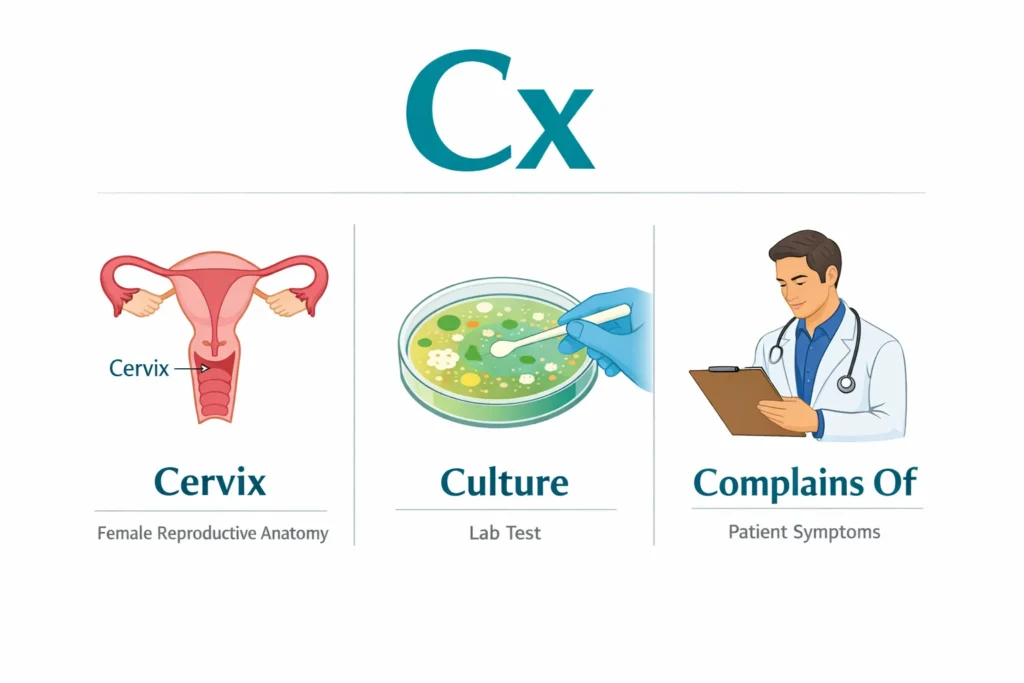
“Cx” in medical terms most commonly stands for cervix (the lower part of the uterus). Depending on context, it may also mean culture (as in a lab test) or complains of in clinical notes.
The exact meaning is determined by where and how the abbreviation appears in medical documentation.
If you’ve ever read a lab report, hospital discharge summary, or doctor’s notes and spotted “Cx,” you’re not alone in wondering what it means. Medical shorthand is designed for speed and efficiency but for patients, it can feel like decoding a secret language.
The abbreviation “Cx” is especially confusing because it has multiple meanings across specialties like gynecology, microbiology, and clinical charting.
This guide breaks it all down in plain English what “Cx” means, where you’ll see it, how doctors use it in real life, and how to interpret it correctly. By the end, you’ll be able to read medical notes with more confidence and clarity.
What Does “Cx” Mean in Medical Terms?
In healthcare documentation, Cx is a context-dependent abbreviation. The three most common meanings are:
- Cervix → anatomical structure in gynecology and obstetrics
- Culture → laboratory test for detecting infection
- Complains of → shorthand in patient symptom notes
Less commonly, it may appear in administrative or specialty-specific contexts, but those three account for the vast majority of uses.
Quick Reference Table
| Abbreviation | Meaning | Medical Field | Example |
|---|---|---|---|
| Cx | Cervix | Gynecology/Obstetrics | “Cx dilated 3 cm” |
| Cx | Culture (lab test) | Microbiology/Infectious Disease | “Wound Cx pending” |
| Cx | Complains of | Clinical Notes | “Pt Cx chest pain” |
Understanding where you see “Cx” is the key to interpreting it correctly.
Origin and Evolution of “Cx” in Medicine
Medical abbreviations date back centuries, but modern shorthand gained momentum in the 19th and 20th centuries as patient documentation became more standardized. “Cx” emerged as a time-saving notation used in handwritten charts and later adopted into electronic medical records (EMRs).
Why “Cx” Became Popular
- Efficiency: Clinicians often write hundreds of notes daily.
- Standardization: Abbreviations help maintain consistency across institutions.
- Space-saving: Especially important in older paper charts.
- Cross-specialty adaptation: Same letters adopted by different fields for different meanings.
Today, some healthcare systems are moving away from ambiguous abbreviations to improve patient safety. However, “Cx” remains widely used in many settings.
Primary Meaning #1: “Cx” = Cervix
What Is the Cervix?
The cervix is the lower, narrow portion of the uterus that connects to the vagina. It plays essential roles in:
- Menstruation
- Pregnancy and childbirth
- Fertility
- Protection from infection
In gynecology and obstetrics, “Cx” almost always refers to this anatomical structure.
Common Clinical Uses
Doctors may use “Cx” when documenting:
- Cervical dilation during labor
- Cervical screening results (Pap smear)
- Cervical inflammation or infection
- Cervical length measurements in pregnancy
Real-World Examples
| Medical Note | Meaning in Plain Language |
|---|---|
| “Cx closed” | The cervix is not dilated |
| “Cx 5 cm dilated” | Cervix opened to 5 centimeters during labor |
| “Abnormal Cx cells” | Unusual cervical cell changes detected |
Tone Context
- Neutral clinical tone: “Cx appears normal.”
- Concern-focused tone: “Irregularities noted on Cx.”
- Routine documentation: “Cx exam completed.”
No emotional tone is implied it’s strictly anatomical.
Primary Meaning #2: “Cx” = Culture
In microbiology and infectious disease care, “Cx” stands for “culture”, a test used to identify bacteria, fungi, or other microorganisms causing infection.
What Is a Culture Test?
A healthcare provider collects a sample (blood, urine, wound fluid, throat swab, etc.) and sends it to a lab where microorganisms are grown and identified.
Common Types of Cultures
- Blood culture
- Urine culture
- Wound culture
- Throat culture
- Sputum culture
Examples in Medical Documentation
| Medical Note | Meaning |
|---|---|
| “Urine Cx positive” | Infection detected in urine sample |
| “Blood Cx pending” | Lab results not ready yet |
| “Wound Cx negative” | No infection found |
Tone Context
- Neutral: “Cx ordered for evaluation.”
- Reassuring: “Cx showed no growth 🙂”
- Concern-oriented: “Cx positive for bacteria.”
The tone reflects the result rather than the abbreviation itself.
Primary Meaning #3: “Cx” = Complains Of
In general clinical notes, “Cx” may mean “complains of”, especially in quick documentation of symptoms.
Example Usage
| Medical Note | Meaning |
|---|---|
| “Pt Cx headache” | Patient reports headache |
| “Cx nausea x 3 days” | Patient reports nausea for 3 days |
| “Cx chest tightness” | Patient reports chest discomfort |
This usage is less common in formal reports but still appears in fast-paced clinical environments.
How Context Determines Meaning
Because “Cx” has multiple meanings, context is everything. Here’s how to decode it quickly:
Step-by-Step Interpretation Guide
- Look at the specialty
- Gynecology → Cervix
- Lab results → Culture
- Symptom notes → Complains of
- Check surrounding words
- Numbers like “cm” → Cervix dilation
- Words like “positive/negative” → Culture result
- “Pt” or “patient” → Complains of
- Identify document type
- Lab report → Culture
- OB chart → Cervix
- Progress note → Complains of
Comparison With Related Medical Abbreviations
Medical shorthand often overlaps. Here’s how “Cx” compares to similar terms:
| Abbreviation | Meaning | How It Differs From Cx |
|---|---|---|
| Dx | Diagnosis | Identifies condition, not anatomy or test |
| Tx | Treatment | Refers to therapy or management |
| Rx | Prescription | Medication instructions |
| Hx | History | Patient’s medical background |
| Px | Prognosis | Predicted outcome |
These abbreviations follow a similar pattern but represent entirely different concepts.
Alternate Meanings of “Cx” Outside Medicine
Although uncommon in healthcare, “Cx” may appear in other fields:
- Customer experience (business context)
- Circuit (engineering shorthand)
- Complexity (academic writing)
In medical settings, these meanings are rarely relevant.
Professional Alternatives to Using “Cx”
Because abbreviations can cause confusion, many healthcare organizations encourage full terminology.
Preferred Professional Terms
- Cervix instead of Cx
- Culture instead of Cx
- Patient reports instead of Cx
Using full words improves clarity for patients and reduces misinterpretation.
Example Usage Scenarios
Scenario 1: Labor and Delivery
“Cx dilated 4 cm” → Cervix opened during labor progression.
Scenario 2: Infection Testing
“Wound Cx ordered” → Lab test requested to identify bacteria.
Scenario 3: Clinical Intake Note
“Patient Cx dizziness” → Patient reports dizziness.
When “Cx” Might Be Confusing
Ambiguity can occur when documentation lacks context.
Example:
“Cx results abnormal.”
Without additional information, it could refer to:
- Cervical findings
- Culture test results
Healthcare providers typically clarify in formal reports, but asking for explanation is always appropriate.
FAQs
1. Does “Cx” always mean cervix?
No. While cervix is the most common meaning, it can also refer to a culture test or “complains of” depending on context.
2. What does “Cx positive” mean?
It usually indicates a positive culture result, meaning infection was detected.
3. What does “Cx closed” mean in pregnancy?
It refers to the cervix not being dilated.
4. Why do doctors use abbreviations like “Cx”?
They save time and space in documentation, especially in fast-paced clinical settings.
5. Is “Cx” used in lab reports?
Yes. It commonly appears when referring to culture tests.
6. Should patients worry when they see “Cx” in records?
Not necessarily. It’s a neutral abbreviation. Concern depends on the associated findings.
7. Is “Cx” still recommended in medical writing?
Many institutions encourage full terms to avoid confusion, though the abbreviation is still widely used.
8. How can I know which meaning applies?
Check the document type, surrounding words, and medical specialty.
Practical Tips for Reading Medical Abbreviations
- Look for context clues nearby.
- Identify the medical specialty of the document.
- When unsure, ask a healthcare provider for clarification.
- Keep a personal glossary of common abbreviations.
Understanding medical shorthand empowers patients to participate actively in their care.
Conclusion:
“Cx” is a small abbreviation with big significance. Most often, it refers to the cervix, especially in gynecology and obstetrics. In lab settings, it commonly means a culture test, while in clinical notes it may indicate a patient complains of symptoms.
Medical language can feel intimidating but once you know how to decode abbreviations like “Cx,” reading healthcare information becomes much easier and more empowering.
Discover More Related Articles:

Amanda Lewis is a professional content writer and word-meaning researcher who specializes in explaining definitions, slang, abbreviations, and modern language terms. She writes for WordNexy.com, where she creates clear, accurate, and reader-friendly articles to help users understand word meanings and proper usage. Her work is especially useful for students, writers, and online readers seeking quick and reliable explanations.