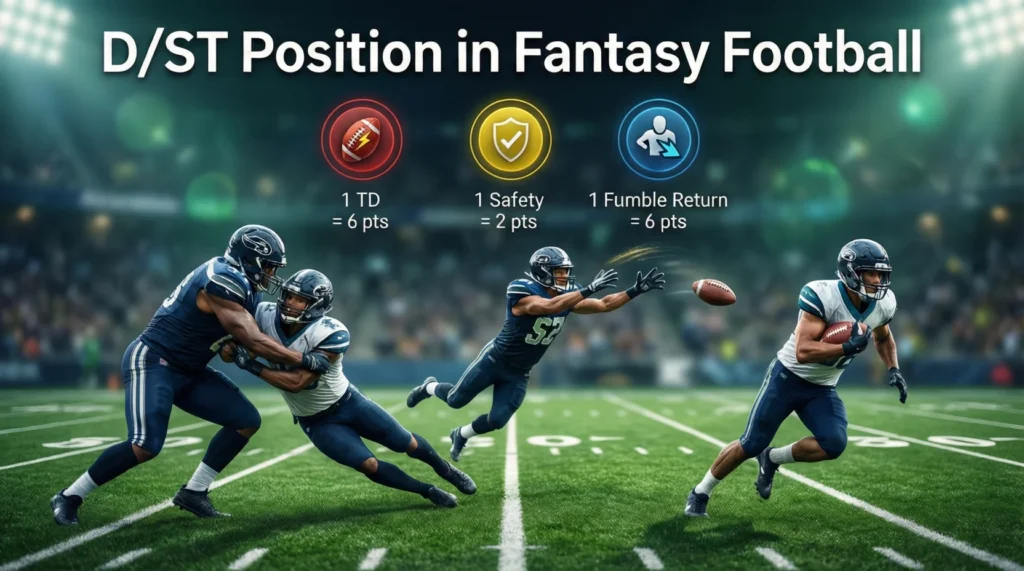
Fantasy football can feel like a world of abbreviations, stats, and quirky terms. One of the most common yet sometimes confusing abbreviations you’ll see on draft boards or fantasy score sheets is D/ST Position in Fantasy Football.
If you’ve ever paused over your draft picks and asked, “Wait, what does D/ST even mean?” you’re not alone. Understanding D/ST can give you a strategic edge and help you maximize points in weekly matchups.
Definition:
In fantasy football, D/ST stands for Defense/Special Teams. It represents the combined performance of a team’s defensive unit and special teams, including sacks, interceptions, fumble recoveries, defensive touchdowns, kick and punt returns, and points allowed. Fantasy players draft D/ST units to earn points based on how well a team defends and executes special teams plays during a game.
Origin of D/ST in Fantasy Football
The D/ST concept in fantasy football originated in the early days of fantasy leagues, when most games focused primarily on offensive players like quarterbacks, running backs, and wide receivers. Fantasy players realized that a strong defense could significantly impact game outcomes and wanted to reward that in their scoring systems.
Rather than splitting defensive and special teams into separate positions, many fantasy platforms combined them into one D/ST unit for simplicity. This trend became popular in the 1980s and 1990s with the rise of computer-based fantasy leagues, solidifying D/ST as a standard term in nearly all fantasy football formats today.
How D/ST Works in Fantasy Football
Unlike individual offensive players who earn points through yards, touchdowns, and receptions, a D/ST unit earns points based on defensive and special teams performance. Here’s a breakdown of typical scoring categories:
| D/ST Scoring Category | Points (Standard PPR Scoring) |
| Sack | 1 point |
| Interception | 2 points |
| Fumble Recovery | 2 points |
| Defensive Touchdown | 6 points |
| Safety | 2 points |
| Blocked Kick | 2 points |
| Points Allowed (0) | 10 points |
| Points Allowed (1-6) | 7 points |
| Points Allowed (7-13) | 4 points |
| Points Allowed (14-20) | 1 point |
| Points Allowed (21-27) | 0 points |
| Points Allowed (28-34) | -1 point |
| Points Allowed (35+) | -4 points |
Tip: Scoring systems may vary across fantasy platforms. Always check your league’s rules before drafting a D/ST unit.
Examples
Here are some examples to illustrate D/ST in real-life fantasy football:
- Friendly/Positive Example
“I picked the San Francisco 49ers D/ST this week, and they dominated! Three sacks, two interceptions, and a defensive touchdown. My opponent didn’t stand a chance.” - Neutral Example
“The Chicago Bears D/ST had a quiet game todayno turnovers and only one sackbut they allowed just 10 points, which still earned some points for my team.” - Negative/Dismissive Example
“I regret drafting the Jets D/ST. They gave up 31 points and didn’t even manage a sack. Total wasted pick.”
These examples show how variable D/ST performance can be week to week.
Comparison With Related Terms
Understanding D/ST often requires comparison with other fantasy positions:
| Term | Definition | Key Difference from D/ST |
| DEF | Shorthand for Defense | DEF sometimes excludes special teams scoring |
| K | Kicker | Individual scoring, not tied to defense |
| QB | Quarterback | Offensive scoring; independent player stats |
| RB/WR/TE | Running Back / Wide Receiver / Tight End | Offensive skill positions, no defensive stats |
Alternate Meanings of D/ST
Although in fantasy football, D/ST is clearly understood as Defense/Special Teams, it may have other meanings in different contexts:
- Data Storage/Transfer – In technology contexts, D/ST could refer to storage systems or file transfers.
- Daylight Saving Time (DST) – Sometimes people mistakenly type D/ST when referencing time changes.
Tip: When communicating with others about fantasy football, clarify that you mean Defense/Special Teams to avoid confusion.
How to Strategically Use D/ST in Fantasy Football
Draft Strategy Tips
- Early vs. Late Drafting: Many fantasy players draft their D/ST in later rounds to prioritize high-scoring offensive players first.
- Matchup-Based Picking: Look at weekly matchups. Some defenses excel against weak offenses and can yield high weekly points.
- Streaming D/STs: Some managers “stream” defenses weekly based on matchups rather than committing to a single D/ST all season.
Selection Considerations
- Turnover potential (interceptions/fumbles)
- Sack numbers (pressure on quarterback)
- Special teams scoring (punt/kick returns for touchdowns)
- Injury reports (missing defensive starters can hurt scoring)
D/ST in Daily Fantasy Football
In daily fantasy leagues, D/ST units are treated slightly differently. While they still score on defensive and special teams stats, their salary costs are often lower compared to star quarterbacks or wide receivers. Savvy DFS players leverage cheap, high-upside D/STs to free up budget for top-tier offensive players.
Common Mistakes With D/ST
- Ignoring matchups: Drafting a strong defense without checking weekly opponents.
- Overvaluing a “famous” defense: Reputation does not guarantee fantasy points every week.
- Neglecting scoring variations: Not all leagues give points for safeties or blocked kicks.
Tip: Use historical data and recent form to make informed D/ST picks rather than relying on reputation alone.
Conclusion
In fantasy football, the D/ST position (Defense/Special Teams) plays a bigger role than many managers expect. It represents an entire team’s defense and special teams unit, not individual players.
Your D/ST can earn points through sacks,interceptions, fumble recoveries, defensive touchdowns, and even special teams scores, while also losing points for allowing too many yards or points.
FAQs
- What does D/ST stand for in fantasy football?
It stands for Defense/Special Teams, a combined unit scoring points for defensive plays and special teams actions. - Should I draft D/ST early in my fantasy draft?
Generally, no. D/STs are often drafted in the later rounds unless a league heavily favors defensive scoring. - Can I start a D/ST unit every week?
Yes. Most leagues allow you to start one D/ST per week, and many players rotate units based on matchups. - Are D/STs consistent scorers?
Not always. Performance varies based on matchups, injuries, and game flow. - What’s the difference between D/ST and DEF?
DEF sometimes refers only to the defense without special teams, while D/ST includes both. - Can a D/ST score negative points?
Yes. Many leagues deduct points for giving up too many points or allowing safeties/kick returns. - Are there alternatives to drafting a D/ST?
You can stream defenses weekly based on matchups or play IDP leagues focusing on individual defensive players.

Sarah Williams is the passionate author behind WordNexy.com, dedicated to creating content that informs, inspires, and sparks curiosity. With a love for words and storytelling, she transforms ideas into meaningful articles that educate, entertain, and leave a lasting impression on every reader.