Definition
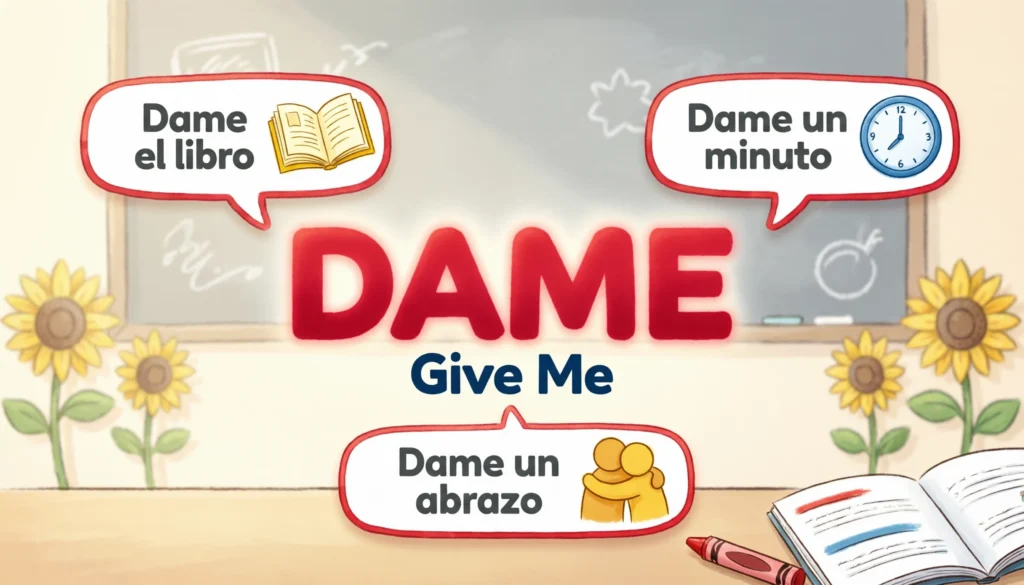
“Dame” in Spanish means “give me.”
It is the informal command form of the verb “dar” (to give) combined with the pronoun “me” (to me). Spanish speakers use dame when asking someone they know well to give them something.
Example:
Dame el libro. → “Give me the book.”
If you’ve watched Spanish movies, listened to Latin music, or studied basic Spanish phrases, you’ve probably heard the word “dame.” It appears everywhere from casual conversations and song lyrics to everyday requests.
But what exactly does “dame” mean in Spanish, and how should it be used correctly?
The answer is simple on the surface, yet the word carries nuances in tone, grammar, and social context. Depending on how it’s said, dame can sound:
- Friendly 😊
- Playful
- Direct
- Slightly demanding
Understanding these subtle differences is important if you want to speak natural Spanish and avoid sounding rude or overly formal.
In this guide, you’ll learn:
- The exact meaning of “dame”
- Its grammatical origin
- Real-life examples in conversation
- How tone changes meaning
- Differences between dame and similar phrases
- Polite alternatives
- Common questions people ask about the word
Let’s start by breaking down the language structure behind this popular Spanish expression.
This expression is common in everyday Spanish conversations and can sound friendly, casual, or slightly demanding depending on tone and context.
Origin and Grammar of “Dame”
To fully understand what “dame” means in Spanish, it helps to break it into two parts.
| Part | Meaning | Explanation |
|---|---|---|
| Da | Give | Imperative (command) form of the verb dar |
| Me | To me | Indirect object pronoun |
When combined:
Da + me → Dame
Literal meaning:
“Give to me”
Natural English meaning:
“Give me”
The Verb “Dar”
The Spanish verb dar means “to give.”
It is an irregular verb, meaning its forms change differently compared to standard verbs.
Example conjugation (present):
| Subject | Conjugation |
|---|---|
| Yo | doy |
| Tú | das |
| Él/Ella | da |
| Nosotros | damos |
| Ellos | dan |
The command “da” is used when telling someone informally to give something.
When you attach me, it becomes “dame.”
How “Dame” Is Used in Everyday Spanish
Spanish speakers use dame frequently in daily life because asking for things is common in conversation.
It often appears in situations like:
- Asking for food
- Requesting objects
- Sharing items
- Casual instructions
Examples of everyday usage
- Dame agua.
→ Give me water. - Dame un minuto.
→ Give me a minute. - Dame tu opinión.
→ Give me your opinion. - Dame el control remoto.
→ Give me the remote control.
Because Spanish often sounds more direct than English, “dame” isn’t necessarily rude. Tone and context matter.
Tone and Context: Friendly vs Demanding
The word dame can feel different depending on tone, relationship, and situation.
1. Friendly Tone 😊
Used among friends or family.
Example:
Dame un abrazo.
“Give me a hug.”
2. Casual Request
Neutral everyday request.
Example:
Dame el teléfono.
“Give me the phone.”
3. Slightly Demanding Tone
If spoken sharply, it may sound impatient.
Example:
¡Dame eso ahora!
“Give me that now!”
Tone changes everything.
Common Examples of “Dame” in Sentences
Below are realistic examples showing how the word appears in conversations.
| Spanish Sentence | English Translation | Tone |
|---|---|---|
| Dame el libro. | Give me the book. | Neutral |
| Dame un segundo. | Give me a second. | Casual |
| Dame tu número. | Give me your number. | Friendly |
| Dame eso ahora. | Give me that now. | Demanding |
| Dame un abrazo. | Give me a hug. | Warm |
“Dame” in Spanish Songs and Pop Culture
The word dame appears frequently in Latin music.
Many popular songs use it because it sounds direct, emotional, and rhythmic.
Common lyrical phrases include:
- Dame tu amor — Give me your love
- Dame un beso — Give me a kiss
- Dame más — Give me more
These phrases often express romantic or emotional intensity.
Comparison With Similar Spanish Expressions
Spanish has several phrases similar to dame, but each one has slightly different usage.
| Expression | Meaning | Formality |
|---|---|---|
| Dame | Give me | Informal |
| Deme | Give me | Formal |
| Me das | You give me | Neutral request |
| Podrías darme | Could you give me | Polite |
Example comparison
Informal:
Dame agua.
Give me water.
Formal:
Deme agua, por favor.
Please give me water.
Polite request:
¿Podrías darme agua?
Could you give me water?
Polite Alternatives to “Dame”
Sometimes using dame directly may sound too blunt, especially with strangers or elders.
Here are more polite options.
1. Por favor
Dame agua, por favor.
Give me water, please.
2. ¿Me das…?
¿Me das el libro?
Will you give me the book?
3. ¿Podrías darme…?
¿Podrías darme ayuda?
Could you give me help?
These options sound softer and more respectful.
Alternate Meanings of “Dame”
While dame normally means “give me,” context can slightly shift its meaning.
1. Asking for Time
Dame un momento.
Give me a moment.
Meaning: wait a moment
2. Requesting Attention
Dame tu atención.
Give me your attention.
Meaning: listen to me
3. Asking for Permission
Dame una oportunidad.
Give me a chance.
Meaning: allow me a chance
Usage Tips for Learners
If you’re learning Spanish, here are some helpful tips.
Use “dame” when speaking to:
- Friends
- Family
- Children
- People your age
Avoid using it directly with:
- Bosses
- Strangers in formal settings
Instead use:
- deme
- ¿podría darme…?
Example Conversation Using “Dame”
Friend conversation:
A: Tengo hambre.
(I’m hungry.)
B: Dame un minuto y preparo algo.
(Give me a minute and I’ll prepare something.)
A: Bueno, dame una bebida mientras tanto.
(Okay, give me a drink meanwhile.)
This shows how naturally dame appears in casual dialogue.
FAQs
- What does “dame” mean in Spanish?
Dame means “give me.” It combines the command “da” (give) with the pronoun “me” (to me). - Is “dame” rude in Spanish?
Not usually. Among friends or family it sounds normal, but tone can make it seem demanding. - What is the difference between “dame” and “deme”?
Dame is informal, used with friends or people you know well. Deme is formal, used with strangers, elders, or in professional settings. - How do you pronounce “dame”?
It is pronounced DAH-meh (IPA: /ˈda.me/). - Can “dame” mean something romantic?
Yes. In romantic contexts, it can mean “give me a kiss” or “give me your love,” for example, “Dame un beso.” - What verb does “dame” come from?
It comes from the Spanish verb “dar,” which means “to give.” - Is “dame” used in Latin music?
Yes. It is commonly used in Spanish songs because it expresses desire, emotion, or requests. - How do you say “please give me” in Spanish?
You can say “Dame ___, por favor.” Example: “Dame agua, por favor.”
Conclusion
The Spanish word “dame” is a simple yet powerful expression used in everyday conversation. At its core, it means “give me,” combining the command form of dar (to give) with the pronoun me (to me).
However, like many Spanish phrases, its meaning depends heavily on tone, context, and relationship between speakers.
Whether you’re learning Spanish or just curious about the phrase, understanding how and when to use “dame” helps you communicate more naturally and confidently.
Discover More Related Articles:

Amanda Lewis is a professional content writer and word-meaning researcher who specializes in explaining definitions, slang, abbreviations, and modern language terms. She writes for WordNexy.com, where she creates clear, accurate, and reader-friendly articles to help users understand word meanings and proper usage. Her work is especially useful for students, writers, and online readers seeking quick and reliable explanations.