Definition:
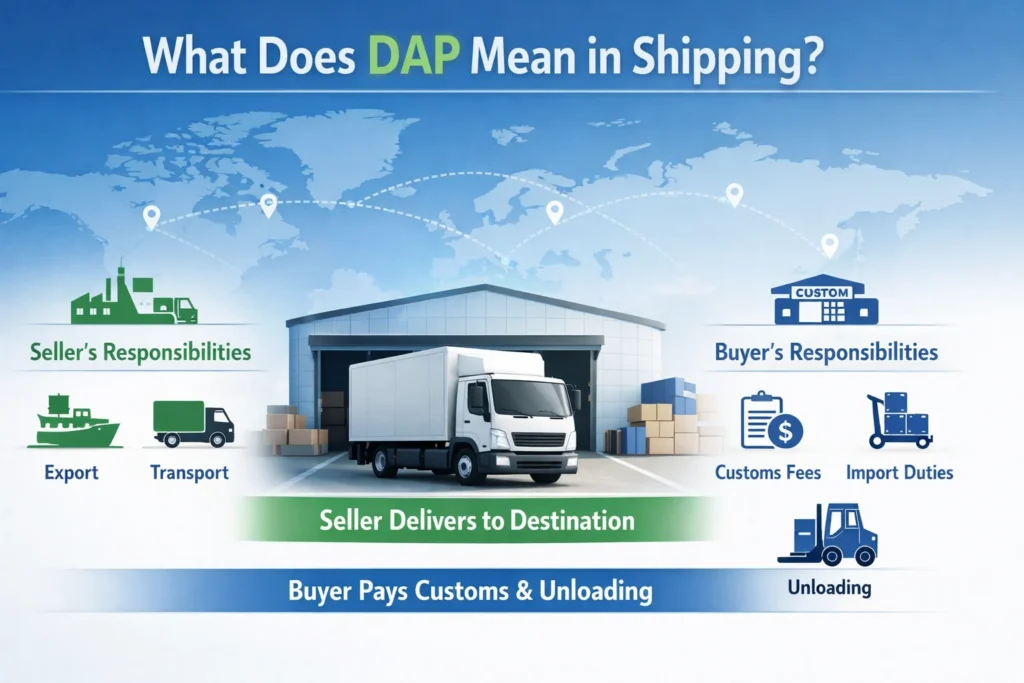
DAP (Delivered at Place) is an international shipping term under Incoterms that means the seller is responsible for delivering goods to a specified destination, ready for unloading, while the buyer is responsible for import duties, taxes, and unloading costs.
If you’ve ever dealt with international shipping, freight quotes, or global trade documents, you’ve probably come across the term DAP. At first glance, it might look like just another confusing logistics acronym but understanding it can save you money, prevent disputes, and make your shipping process smoother.
Whether you’re a business owner, importer, exporter, or just curious about shipping terms, this guide will break down what DAP means in shipping, how it works in real-world scenarios, and how it compares to other Incoterms. By the end, you’ll know exactly when to use DAP and when to avoid it.
What Is DAP in Shipping?
DAP stands for Delivered at Place, one of the official rules defined under Incoterms (International Commercial Terms) by the International Chamber of Commerce (ICC).
Simple Explanation:
- The seller handles transportation to the agreed destination.
- The buyer handles import duties, taxes, and unloading.
Key Idea:
👉 The seller delivers the goods to your doorstep, but you (the buyer) handle customs and unloading.
Origin and Popularity of DAP
DAP was introduced as part of Incoterms 2010, replacing older terms like DAF (Delivered at Frontier), DES (Delivered Ex Ship), and DDU (Delivered Duty Unpaid).
Why DAP Became Popular:
- 🌍 Simplifies global trade agreements
- 📦 Works for all modes of transport (air, sea, road, rail)
- 🤝 Clearly defines responsibilities between buyer and seller
- 📑 Reduces confusion compared to older terms
Today, DAP is widely used in:
- International eCommerce shipping
- B2B trade agreements
- Freight forwarding contracts
- Import/export businesses
How DAP Works in Real Life
Let’s break it down with a practical example.
Example Scenario:
A company in China sells goods to a buyer in Pakistan under DAP terms.
Responsibilities:
Seller (Exporter):
- Packs goods
- Handles export documentation
- Pays for shipping and freight
- Delivers goods to buyer’s location
Buyer (Importer):
- Pays import duties and taxes
- Handles customs clearance
- Pays for unloading
👉 The seller’s responsibility ends once the goods arrive at the agreed destination (before unloading).
Responsibilities Breakdown
| Responsibility | Seller (Exporter) | Buyer (Importer) |
|---|---|---|
| Packaging | ✅ | ❌ |
| Export clearance | ✅ | ❌ |
| Freight charges | ✅ | ❌ |
| Delivery to destination | ✅ | ❌ |
| Import duties & taxes | ❌ | ✅ |
| Customs clearance | ❌ | ✅ |
| Unloading goods | ❌ | ✅ |
When Should You Use DAP?
DAP is ideal when:
- You want the seller to handle most of the logistics
- You’re comfortable managing customs and import duties
- You want delivery directly to your location
- You want a clear cost split between buyer and seller
Best Use Cases:
- Small businesses importing goods
- First-time importers
- eCommerce international shipping
- Buyers who want convenience but control over customs
DAP Examples with Context and Tone
Even though DAP is a logistics term, the way it’s used in communication can vary depending on tone.
Friendly Tone 😊
“Don’t worry, we’ll ship everything under DAP you’ll just need to handle customs when it arrives.”
Neutral/Professional Tone 📦
“The shipment will be delivered under DAP terms. Please note that import duties and unloading are the buyer’s responsibility.”
Slightly Cautionary Tone ⚠️
“This is a DAP shipment, so make sure you’re prepared for customs fees and unloading charges.”
DAP vs Other Shipping Terms
Understanding DAP becomes easier when you compare it with similar Incoterms.
DAP vs DDP (Delivered Duty Paid)
| Feature | DAP | DDP |
|---|---|---|
| Delivery | Seller delivers | Seller delivers |
| Import duties | Buyer pays | Seller pays |
| Risk transfer | At destination | At destination |
| Buyer effort | Medium | Low |
👉 DDP is more convenient, but usually more expensive.
DAP vs FOB (Free On Board)
| Feature | DAP | FOB |
|---|---|---|
| Transport coverage | Full delivery | Only until ship loading |
| Risk transfer | At destination | At port of shipment |
| Buyer responsibility | Lower | Higher |
👉 DAP is more buyer-friendly than FOB.
DAP vs EXW (Ex Works)
| Feature | DAP | EXW |
|---|---|---|
| Seller responsibility | High | Very low |
| Buyer responsibility | Moderate | Very high |
| Logistics control | Seller | Buyer |
👉 EXW gives full control to the buyer, while DAP is more balanced.
Advantages and Disadvantages of DAP
Advantages ✅
- Seller handles most logistics
- Easy for buyers to manage
- Works across all transport types
- Transparent responsibility split
Disadvantages ❌
- Buyer must handle customs clearance
- Unexpected import taxes can occur
- Unloading is buyer’s responsibility
- Possible delays if buyer isn’t prepared
Usage Tips for DAP Shipping
To avoid surprises, keep these tips in mind:
- ✔️ Always confirm the exact delivery location
- ✔️ Clarify who handles customs paperwork
- ✔️ Estimate import duties in advance
- ✔️ Arrange unloading equipment if needed
- ✔️ Work with a reliable freight forwarder
Alternate Meanings of DAP
While DAP mainly refers to shipping, it can have other meanings depending on context:
- Digital Audio Player (electronics)
- Directory Access Protocol (IT/networking)
- Dap (slang) – A friendly handshake or greeting
👉 Always consider context to understand the correct meaning.
Professional Alternatives or Related Terms
If DAP doesn’t suit your needs, consider these alternatives:
- DDP (Delivered Duty Paid) – Seller handles everything
- CIF (Cost, Insurance, Freight) – Seller covers cost until port
- FOB (Free On Board) – Buyer takes over at shipping port
- EXW (Ex Works) – Buyer handles almost everything
FAQs
1. What does DAP mean in simple terms?
DAP means the seller delivers the goods to your location, but you (the buyer) are responsible for paying import duties and unloading them.
2. Who pays customs in DAP shipping?
The buyer is responsible for paying all customs duties, taxes, and handling the clearance process.
3. Is DAP better than DDP?
It depends on your needs. DDP is more convenient for buyers since the seller handles everything, while DAP is often cheaper and gives buyers more control over customs.
4. Does DAP include unloading?
No, unloading is not included. The buyer is responsible for unloading the goods once they arrive.
5. Who is responsible for risk in DAP?
The seller is responsible for the goods and bears the risk until they reach the agreed destination.
6. Can DAP be used for air and sea shipping?
Yes, DAP can be used for all types of transport, including air, sea, road, and rail.
7. Is DAP suitable for beginners?
Yes, it is suitable for beginners, especially if they want the seller to handle most of the shipping process.
8. What happens if customs delays occur?
If there are delays at customs, the buyer is responsible for resolving the issue since they handle import clearance.
Conclusion
Understanding what DAP means in shipping can make a huge difference in how smoothly your international transactions run. It strikes a balance between convenience and responsibility where the seller handles transportation, and the buyer manages customs and unloading.
When used correctly, DAP can simplify your shipping process and help you avoid costly misunderstandings.
Discover More Related Articles:

Amanda Lewis is a professional content writer and word-meaning researcher who specializes in explaining definitions, slang, abbreviations, and modern language terms. She writes for WordNexy.com, where she creates clear, accurate, and reader-friendly articles to help users understand word meanings and proper usage. Her work is especially useful for students, writers, and online readers seeking quick and reliable explanations.