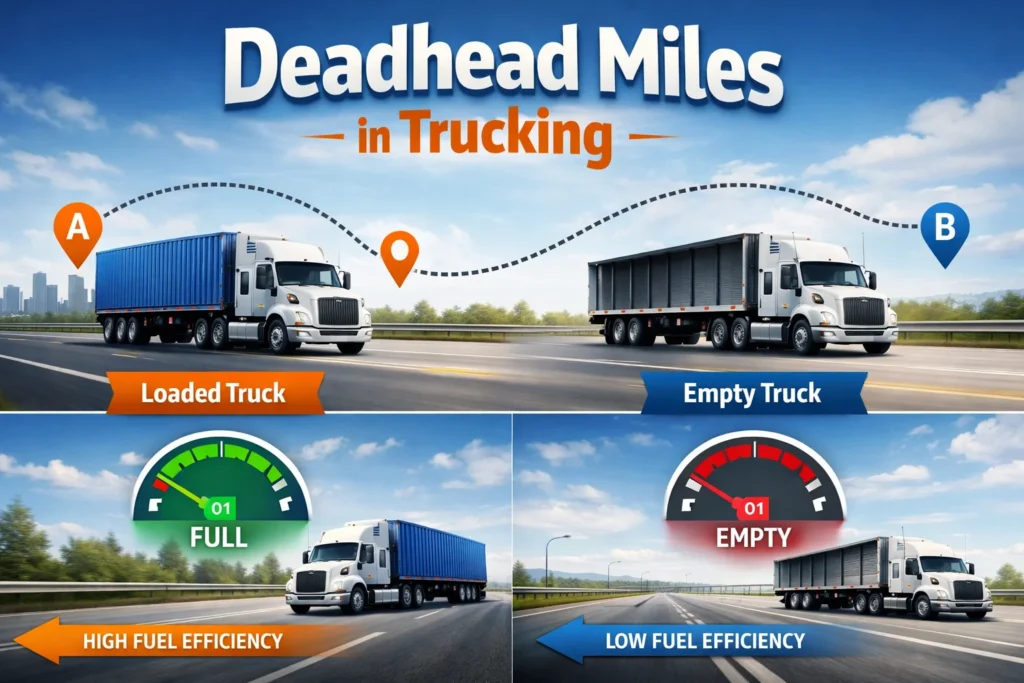
Definition:
Deadhead in trucking refers to a situation where a truck is driven without any cargo (empty trailer) usually while returning from a delivery or traveling to pick up the next load.
These miles are unpaid or less profitable, making deadheading a key concern for truck drivers and logistics companies.
Imagine driving hundreds of miles with a fully loaded truck then heading back completely empty. No cargo. No revenue. Just fuel costs and time ticking away. That’s exactly what “deadhead” means in the trucking world.
If you’re new to logistics or curious about trucking terms, understanding deadhead miles is essential. It directly impacts profits, fuel efficiency, driver earnings, and fleet management strategies.
Let’s break it all down in simple, real-world language.
What Does Deadhead Mean in Trucking?
In everyday trucking language:
- Deadhead = Driving an empty truck
- Happens after a delivery or before picking up a load
- Also called “empty miles”
Key Points:
- No freight = no income (in most cases)
- Still incurs fuel, time, and wear-and-tear costs
- Affects overall trucking efficiency
👉 Example:
A driver delivers goods from Karachi to Lahore. After unloading, they must drive 200 km to Islamabad to pick up the next shipment. That 200 km = deadhead miles.
Origin of the Term “Deadhead”
The word “deadhead” didn’t originally come from trucking it has roots in older industries:
- Railroads (1800s): Workers or train cars traveling without cargo or passengers
- Aviation: Airline crew flying without assigned duties
- Trucking: Adopted later to describe empty freight movement
Why “Deadhead”?
- “Dead” = not producing revenue
- “Head” = movement or travel
So, it literally means “moving without earning”.
Why Deadhead Miles Are Important in Trucking
Deadheading isn’t just a minor inconvenience it has real financial impact.
🚨 Major Challenges:
- Fuel Costs: Drivers still pay for diesel
- Lost Revenue: No payment for empty trips
- Time Waste: Hours spent without earning
- Vehicle Wear: Tires and engine still degrade
📊 Example Impact:
| Factor | Loaded Trip | Deadhead Trip |
|---|---|---|
| Revenue | ✅ Yes | ❌ No |
| Fuel Cost | ✅ Yes | ✅ Yes |
| Profit | ✅ High | ❌ Negative |
👉 This is why companies aim to minimize deadhead miles.
Real-World Usage of “Deadhead”
1. Neutral Tone
- “I had to deadhead 150 miles to the next pickup.”
👉 Just stating a fact.
2. Frustrated Tone 😤
- “Another deadhead run? That’s a waste of fuel!”
👉 Shows dissatisfaction.
3. Professional Tone
- “We’re working to reduce deadhead miles through better route planning.”
👉 Common in business discussions.
4. Casual Tone
- “Yeah, I’m deadheading back no load this time.”
👉 Everyday driver conversation.
Common Examples of Deadhead Situations
Here are some typical scenarios:
- 🚚 Post-Delivery Return: After dropping off cargo
- 📍 Relocation Trips: Moving to a high-demand area
- 📦 Missed Loads: No available freight nearby
- 🔄 Repositioning: Fleet balancing across regions
Deadhead vs Related Trucking Terms
Understanding similar terms helps avoid confusion.
Comparison Table
| Term | Meaning | Key Difference |
|---|---|---|
| Deadhead | Driving empty | No cargo at all |
| Backhaul | Return trip with cargo | Generates revenue |
| Layover | Waiting time between loads | No movement |
| Bobtail | Driving without trailer | Different from empty trailer |
Quick Breakdown:
- Deadhead = Empty trailer
- Bobtail = No trailer at all
- Backhaul = Paid return trip
👉 Pro Tip: Drivers aim for backhauls to avoid deadhead losses.
How Trucking Companies Reduce Deadhead Miles
Modern logistics focuses heavily on efficiency.
📦 Strategies Used:
- Smart route planning software
- Load-matching platforms
- Regional freight balancing
- Pre-booked return loads
🚀 Technologies:
- GPS tracking
- AI-powered dispatch systems
- Freight marketplaces
👉 These tools help maximize loaded miles and minimize empty trips.
Alternate Meanings of “Deadhead”
Although common in trucking, “deadhead” has other meanings:
- 🎸 Music Fans: Fans of the band Grateful Dead
- ✈️ Airlines: Crew traveling without working
- 🌱 Gardening: Removing dead flowers
👉 Context matters trucking meaning is very specific.
Polite or Professional Alternatives
In formal or business settings, you might avoid slang like “deadhead.”
Better Alternatives:
- Empty miles
- Non-revenue miles
- Unloaded travel
- Repositioning trip
👉 Example:
Instead of saying: “We had a lot of deadhead runs”
Say: “We experienced increased non-revenue miles this quarter.”
Usage Tips for Beginners
If you’re new to trucking or logistics:
✅ Do:
- Use “deadhead” in informal or industry conversations
- Understand its financial impact
- Pair it with numbers (e.g., “100 deadhead miles”)
❌ Don’t:
- Confuse it with “bobtail”
- Use it in highly formal documents without context
Labeled Example Table
| Scenario | Sentence Example | Tone |
|---|---|---|
| After delivery | “I’m deadheading 80 miles to the next pickup.” | Neutral |
| Complaint | “Too much deadheading this week!” | Negative |
| Business report | “Deadhead miles increased by 12%.” | Professional |
| Casual chat | “Just deadheading back home 😅” | Friendly |
FAQs:
1. What are deadhead miles in trucking?
Deadhead miles are the distance a truck travels without carrying cargo.
2. Do truck drivers get paid for deadhead miles?
Sometimes but often less than loaded miles, or not at all.
3. Why is deadheading bad for trucking companies?
It increases costs without generating revenue, reducing profit margins.
4. How can drivers avoid deadhead miles?
By finding backhaul loads or using load boards.
5. Is deadhead the same as bobtail?
No. Deadhead = empty trailer. Bobtail = no trailer.
6. What is a backhaul in trucking?
A return trip with cargo, which helps eliminate deadhead miles.
7. Are deadhead miles tax-deductible?
Often yes, as business expenses (check local tax laws).
8. What percentage of trucking is deadhead?
It varies, but typically 10–20% of miles may be empty.
Conclusion:
Deadhead in trucking might sound simple, but it plays a huge role in the industry’s efficiency and profitability.
Deadhead in trucking refers to driving a truck without cargo, which means spending fuel, time, and resources without earning revenue. While it’s often unavoidable, excessive deadheading can reduce profits and efficiency for both drivers and companies.
Understanding this term helps you better grasp how trucking businesses operate and why every mile matters.
Discover More Related Articles:

Amanda Lewis is a professional content writer and word-meaning researcher who specializes in explaining definitions, slang, abbreviations, and modern language terms. She writes for WordNexy.com, where she creates clear, accurate, and reader-friendly articles to help users understand word meanings and proper usage. Her work is especially useful for students, writers, and online readers seeking quick and reliable explanations.