
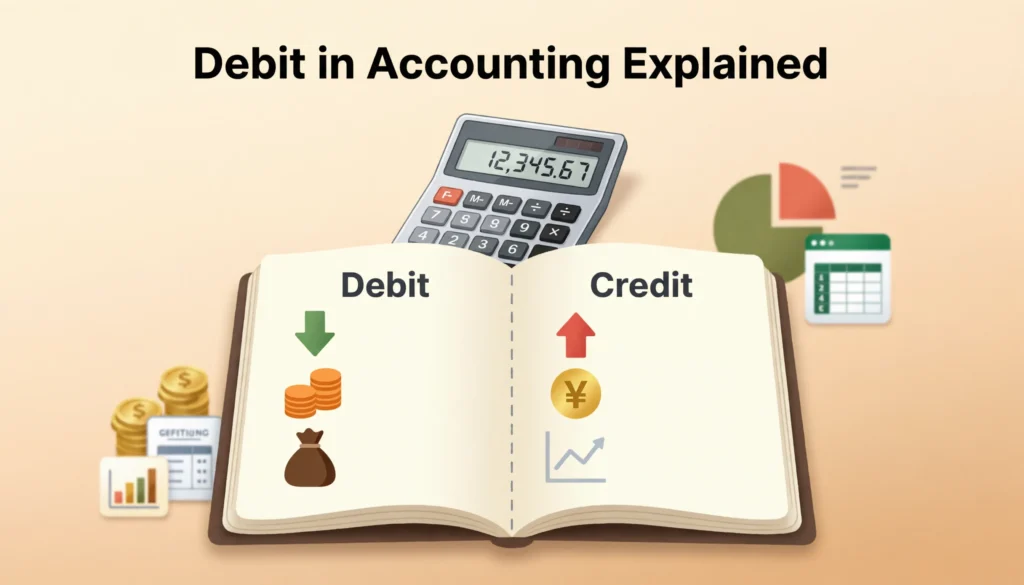
In accounting, a debit is an entry recorded on the left side of an account that increases assets and expenses or decreases liabilities, equity, and revenue.
In short: debit describes the direction of an accounting entry not whether money increases or decreases overall.
If accounting ever felt confusing, “debit” is probably one of the reasons. Many people assume debit simply means money leaving an account but in accounting, the meaning is more precise and depends on account type. Once you understand how debits work, the entire double-entry system suddenly makes sense.
Why Understanding Debits Is Essential
Debits are half of the double-entry accounting system, the global standard method for recording financial transactions. Every transaction includes:
- One debit entry
- One credit entry
- Equal total amounts
This system ensures financial records stay balanced.
If you want to read financial statements, manage business books, or understand accounting basics, you must understand what a debit does and what it does not mean.
Origin and Evolution of the Term “Debit”
The word debit comes from the Latin debere, meaning “to owe.” Early accounting systems used the term to represent what a person or business owed or received.
Historical Development
The concept of debits and credits was formalized in Renaissance Italy as part of double-entry bookkeeping. Over time, standardized accounting rules clarified how debits function across industries and countries.
Today, modern standards from organizations like the Financial Accounting Standards Board and the IFRS Foundation ensure consistent interpretation worldwide.
How Debits Work in Accounting
To understand debits, you must understand account types. Debits do different things depending on the category of account.
The Core Rule
| Account Type | What a Debit Does |
|---|---|
| Assets | Increases |
| Expenses | Increases |
| Liabilities | Decreases |
| Equity | Decreases |
| Revenue | Decreases |
Why This Happens
Accounting tracks the flow of value in a business. Debits increase what the business owns or spends and reduce what it owes or earns.
The Left-Side Rule
In accounting ledgers:
- Debit = Left side
- Credit = Right side
This rule never changes regardless of account type.
Visual Layout Example
| Account Name | Debit (Left) | Credit (Right) |
|---|---|---|
| Cash | +1,000 | |
| Loan Payable | +1,000 |
This entry shows receiving cash by taking a loan.
Real-World Examples of Debits
Understanding debits becomes easy when you see practical scenarios.
Example 1: Business Buys Equipment
A company buys a laptop for $1,000 cash.
| Account | Debit | Credit |
|---|---|---|
| Equipment (Asset) | 1,000 | |
| Cash (Asset) | 1,000 |
Explanation:
- Equipment increases → debit
- Cash decreases → credit
Example 2: Paying Rent
A business pays $800 in rent.
| Account | Debit | Credit |
|---|---|---|
| Rent Expense | 800 | |
| Cash | 800 |
Explanation:
- Expense increases → debit
- Cash decreases → credit
Example 3: Receiving Payment from Customer
A customer pays $500.
| Account | Debit | Credit |
|---|---|---|
| Cash | 500 | |
| Revenue | 500 |
Explanation:
- Asset increases → debit
- Revenue increases → credit
Everyday Explanation
Think of debits as entries that record value coming into certain parts of the business.
- Money coming into assets → debit
- Business spending money → debit
- Reducing what the business owes → debit
That’s why debit doesn’t automatically mean “bad” or “loss.”
Tone and Context Examples
Friendly Explanation 🙂
“A debit just means the left-side entry it often increases assets or expenses.”
Neutral Professional Tone
“The transaction records a debit to inventory and a credit to accounts payable.”
Confusing Everyday Interpretation 😅
“My bank account was debited so money left.”
(Banking language differs from accounting terminology.)
Debit vs Credit: The Essential Comparison
Debits and credits always work together.
| Feature | Debit | Credit |
|---|---|---|
| Ledger Position | Left | Right |
| Increases | Assets, Expenses | Liabilities, Equity, Revenue |
| Decreases | Liabilities, Equity, Revenue | Assets, Expenses |
| Purpose | Record incoming value to certain accounts | Record outgoing or balancing value |
Memory Trick
DEA-LER Rule
- Dividends
- Expenses
- Assets
→ Increase with Debits - Liabilities
- Equity
- Revenue
→ Increase with Credits
Debit in Banking vs Accounting
Many people mix up these meanings.
Banking Usage
When your bank says your account was debited:
👉 Money left your account.
Accounting Usage
Debit describes account direction not gain or loss.
This difference causes common misunderstandings for beginners.
Common Situations Where Debits Appear
Debits are recorded when businesses:
- Buy assets
- Pay expenses
- Receive cash
- Reduce liabilities
- Record losses
- Return borrowed funds
Essentially, debits document how resources move within a business.
Example Transactions Table
| Business Event | Debit Entry | Why |
|---|---|---|
| Purchase inventory | Inventory | Asset increased |
| Pay employee wages | Wages Expense | Expense increased |
| Repay loan principal | Loan Payable | Liability decreased |
| Owner withdraws cash | Owner Draw | Equity decreased |
| Prepay insurance | Prepaid Insurance | Asset increased |
Alternate Meanings of “Debit”
Outside accounting, debit can mean:
- A charge to a bank account
- A reduction in available funds
- A payment transaction using a debit card
But in formal accounting, the meaning is technical and rule-based.
Professional Alternatives and Related Terms
In formal financial communication, professionals may use:
- Record a debit entry
- Debit the account
- Charge the account
- Post to the debit side
- Recognize an increase in assets
These alternatives appear in accounting textbooks and reports.
Why Debits and Credits Must Balance
Double-entry accounting ensures accuracy.
The Balance Equation
Assets = Liabilities + Equity
Every debit must have an equal credit so this equation always remains true.
If debits and credits don’t match:
🚨 The books are incorrect.
Common Misconceptions About Debits
Myth 1: Debit Always Means Loss
False debits often increase value.
Myth 2: Debit Means Money Leaving
Only true in banking language, not accounting.
Myth 3: Debits Are Negative
Debits are directional entries, not positive or negative values.
Practical Tips for Remembering Debits
✔ Think in account types, not cash movement
✔ Remember: left side of ledger
✔ Use the DEA-LER rule
✔ Focus on what increases vs decreases
✔ Practice journal entries regularly
How Students and Professionals Use the Concept
Debits appear in:
- Financial statements
- Journal entries
- Trial balances
- Audits
- Tax preparation
- Business bookkeeping
Understanding debits is foundational for anyone studying finance, accounting, or business operations.
FAQs
What does debit mean in accounting terms?
A debit is a left-side entry that increases assets and expenses or decreases liabilities, equity, and revenue.
Does debit mean money coming in?
Sometimes but only for certain account types like assets.
Is debit the opposite of credit?
Yes. They are complementary entries in double-entry accounting.
Why do assets increase with debits?
Because accounting rules define value entering asset accounts as a debit entry.
What is a debit entry example?
Buying equipment with cash: debit equipment, credit cash.
Are debits good or bad?
Neither they are neutral accounting classifications.
What side is debit on?
Always the left side of an account ledger.
Do debits and credits have to match?
Yes. Total debits must equal total credits in every transaction.
Easy Memory Trick
Debit = Destination of value for assets and expenses.
If something valuable enters those accounts, debit it.
Conclusion
Understanding what debit means in accounting unlocks the logic behind financial records. Rather than indicating loss or gain, a debit simply identifies how a transaction affects specific account types within the structured system of double-entry bookkeeping.
Once you remember the core rule debits increase assets and expenses accounting becomes far less intimidating. Whether you’re reading financial statements, studying accounting, or managing business books, mastering debits gives you a clear view of how money and value move through an organization.
Discover More Related Articles:
- PFP Mean in Text: Complete Guide for Social Media Users (2026)
- Shabbat Shalom Mean in English: Usage, and Significance in 2026

Sarah Williams is the passionate author behind WordNexy.com, dedicated to creating content that informs, inspires, and sparks curiosity. With a love for words and storytelling, she transforms ideas into meaningful articles that educate, entertain, and leave a lasting impression on every reader.

