Definition:
Decoding in reading is the process of translating written words into spoken language by using knowledge of letter-sound relationships (phonics) and word patterns.
It allows readers to “sound out” unfamiliar words and recognize known words quickly and accurately.
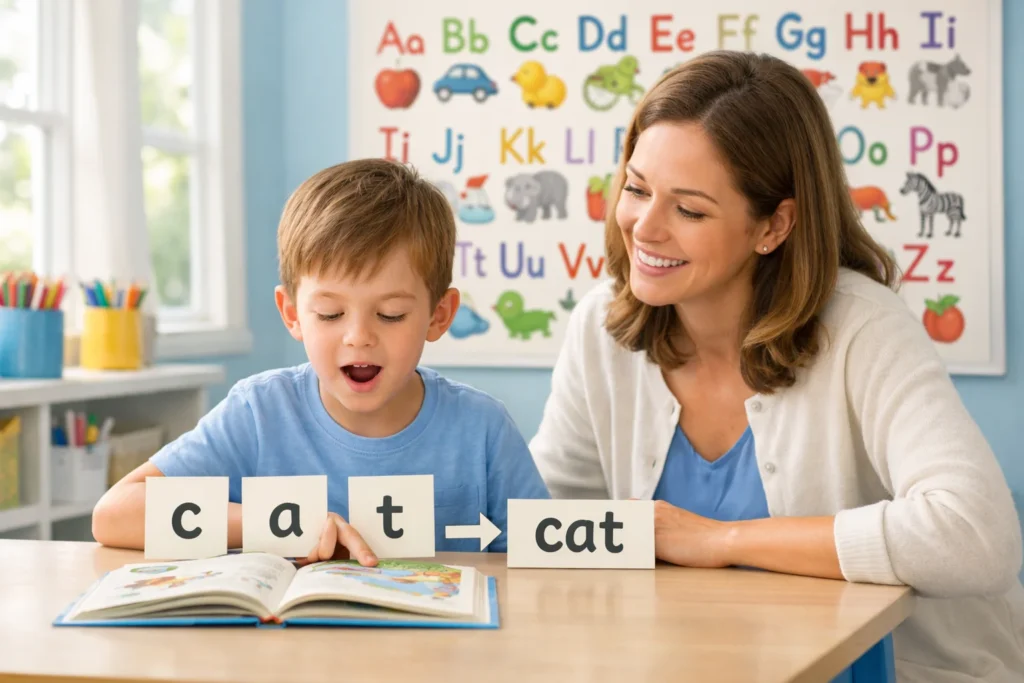
Have you ever watched a child slowly sound out a word like c-a-t… then suddenly smile and say, “Cat!”? That magical moment is called decoding.
But what does decoding mean in reading, really? Is it just sounding out words? Is it the same as comprehension? And why do teachers emphasize it so much in early literacy instruction?
In this complete guide, we’ll break down:
- The clear meaning of decoding in reading
- Where the term comes from
- Why it’s essential for reading success
- Real-life examples (with tone variations 😊)
- Differences between decoding and similar literacy terms
- Practical strategies and professional alternatives
- An 8-question FAQ section for deeper clarity
Let’s decode decoding step by step.
What Does Decoding Mean in Reading?
In simple terms:
Decoding means using letter-sound knowledge to read written words accurately.
It involves:
- Recognizing letters
- Knowing the sounds letters represent
- Blending those sounds together
- Identifying the word
For example:
- Word: ship
- Sounds: /sh/ /i/ /p/
- Blended: ship
Without decoding skills, reading becomes guessing. With decoding skills, reading becomes systematic and accurate.
Origin of the Term “Decoding”
The word decode comes from:
- “Code” a system of symbols
- “De-” meaning to reverse or undo
So to decode literally means to “unlock a code.”
In reading, the “code” is the alphabetic system letters representing sounds. English is considered an alphabetic writing system, meaning letters correspond to phonemes (speech sounds).
The concept became widely discussed in literacy research during the 20th century, especially in studies related to:
- Jeanne Chall
- The National Reading Panel (2000)
- The science of reading movement
Today, decoding is a foundational pillar of structured literacy instruction.
Why Is Decoding Important in Reading?
Decoding is not optional it’s essential.
Here’s why:
1. It Builds Reading Accuracy
Without decoding, students rely on guessing or memorization.
2. It Supports Reading Fluency
Automatic decoding allows smooth, natural reading.
3. It Strengthens Comprehension
You can’t understand what you can’t read.
4. It Prevents Reading Frustration 😟
Students who struggle with decoding often avoid reading.
5. It Supports Spelling
Decoding and encoding (spelling) are connected skills.
How Decoding Works: The Reading Brain in Action
When a child sees a word:
- The brain recognizes the letters.
- It retrieves sound knowledge.
- It blends sounds.
- It connects the word to meaning.
For skilled readers, this happens in milliseconds.
For early readers, it’s a conscious process:
“B… r… i… d… g… e… bridge!”
With practice, decoding becomes automatic.
Decoding Examples
Let’s look at decoding in real-life situations.
Friendly Classroom Example 😊
Teacher:
“Try sounding it out. What sound does ‘th’ make?”
Student:
“/th/… /a/… /t/… That!”
Tone: Encouraging, supportive.
Neutral Academic Example
“The student demonstrated improved decoding accuracy by correctly identifying multisyllabic words.”
Tone: Professional, objective.
Frustrated/Dismissive Tone 😕
“I already read that! I don’t need to sound it out.”
This often happens when students resist phonics practice.
Decoding vs. Related Reading Terms
Many people confuse decoding with other literacy skills. Let’s clarify.
Comparison Table: Decoding vs Other Reading Terms
| Term | Definition | Focus | Example |
|---|---|---|---|
| Decoding | Translating letters into sounds | Accuracy | Sounding out “lamp” |
| Phonics | Teaching letter-sound relationships | Instruction method | Learning that “sh” = /sh/ |
| Fluency | Reading smoothly and quickly | Speed + accuracy | Reading aloud naturally |
| Comprehension | Understanding meaning | Thinking | Explaining what happened in a story |
| Sight Word Recognition | Instantly recognizing common words | Memory | Reading “the” without sounding it out |
Key Difference:
- Decoding = reading the word
- Comprehension = understanding the word
You need both for successful reading.
Decoding vs. Encoding
These two terms are often paired.
| Decoding | Encoding |
|---|---|
| Reading words | Spelling words |
| Letters → Sounds | Sounds → Letters |
| “ship” read aloud | Writing “ship” from dictation |
They are two sides of the same literacy coin.
Real-World Usage of the Term
You’ll often hear decoding used in:
- Elementary classrooms
- Reading intervention programs
- Special education meetings
- Literacy assessments
- Parent-teacher conferences
Example:
“Your child needs additional support in decoding multisyllabic words.”
This means the child struggles to sound out longer words accurately.
Is Decoding Only for Young Children?
No.
While decoding is emphasized in early grades (K–3), it is also critical for:
- Struggling readers in upper grades
- English language learners
- Students with dyslexia
- Adults improving literacy skills
Research on dyslexia and structured literacy, influenced by experts like Sally Shaywitz, highlights decoding as a core intervention focus.
Types of Decoding Skills
Decoding develops in stages:
1. Letter Recognition
Knowing alphabet names and shapes.
2. Phonemic Awareness
Hearing and manipulating sounds in spoken words.
3. Phonics Knowledge
Understanding sound-letter patterns.
4. Blending
Combining sounds smoothly.
5. Multisyllabic Decoding
Breaking longer words into parts.
Example:
un-believ-able
Breaking words into chunks makes them manageable.
Common Decoding Strategies
Teachers often use structured approaches such as:
- Sound-by-sound blending
- Syllable division rules
- Word families (-at, -ing, -ake)
- Prefix/suffix identification
- Controlled text reading
Some literacy programs incorporate systematic phonics approaches inspired by methods like the Orton-Gillingham approach.
Challenges in Decoding
Some common difficulties include:
- Confusing similar letters (b/d)
- Skipping vowel sounds
- Guessing based on pictures
- Struggling with irregular words (e.g., “said”)
Decoding English can be tricky because English is not perfectly phonetic.
Alternate Meanings of “Decoding”
Outside of reading, decoding can mean:
- Interpreting secret messages
- Breaking encryption codes
- Analyzing genetic sequences in science
- Understanding body language
But in literacy discussions, decoding specifically refers to reading words accurately.
Professional Alternatives to Saying “Decoding Difficulty”
In formal communication, you might say:
- “Needs support with word recognition”
- “Developing phonics skills”
- “Building foundational reading accuracy”
- “Strengthening word-level reading”
These sound constructive and solution-focused.
Practical Tips to Improve Decoding Skills
If you’re a teacher or parent, try:
Daily Phonics Practice
Short, consistent practice works best.
Read Decodable Books
Books aligned to taught phonics patterns.
Practice Sound Manipulation
Play with rhymes and sound swaps.
Model Blending
Show how to stretch sounds smoothly.
Encourage Patience 😊
Confidence matters just as much as skill.
Labeled Example Table: Decoding in Action
| Word | Step 1: Break Apart | Step 2: Blend | Final Word |
|---|---|---|---|
| cat | c-a-t | /k/ /a/ /t/ | cat |
| train | tr-ai-n | /tr/ /ā/ /n/ | train |
| jumping | jump-ing | /j/ /ŭ/ /mp/ /ing/ | jumping |
| fantastic | fan-tas-tic | /f/ /a/ /n/ /t/ /a/ /s/ /t/ /ik/ | fantastic |
FAQs
1. What does decoding mean in simple words?
Decoding is the process of sounding out written words by using the sounds that letters and letter combinations make.
2. Is decoding the same as phonics?
Not exactly. Phonics is the method of teaching letter-sound relationships, while decoding is when a reader applies that knowledge to actually read words.
3. Why is decoding important in early reading?
Decoding helps children read accurately, build fluency, and lays the foundation for understanding what they read.
4. Can a child understand a text without decoding?
Almost never. Accurate word reading is usually needed before a child can fully understand the meaning of a text.
5. What are examples of decoding skills?
- Blending sounds to form words
- Breaking words into syllables
- Reading unfamiliar words correctly
6. How do you teach decoding?
Decoding is taught through systematic phonics instruction, guided reading practice, and using decodable books that match the child’s skill level.
7. What causes decoding difficulties?
Common causes include weak awareness of sounds in words (phonemic awareness), limited phonics instruction, or reading disorders such as dyslexia.
8. At what age should decoding be mastered?
Basic decoding skills usually develop between ages 5 and 7, but learning to decode more complex words continues through later elementary grades.
Conclusion:
So, what does decoding mean in reading?
It means unlocking written language letter by letter, sound by sound.
Without decoding:
- Reading becomes guessing.
- Fluency suffers.
- Confidence drops.
With strong decoding:
- Accuracy improves.
- Fluency increases.
- Comprehension strengthens.
- Reading becomes enjoyable. 📚
Whether you’re a parent, teacher, or literacy learner, remember:
Decoding isn’t just a skill it’s the gateway to lifelong learning.
Focus on structured practice, patience, and consistency. The results compound over time.
Discover More Related Articles:
- PFP Mean in Text: Complete Guide for Social Media Users (2026)
- Shabbat Shalom Mean in English: Usage, and Significance in 2026

Amanda Lewis is a professional content writer and word-meaning researcher who specializes in explaining definitions, slang, abbreviations, and modern language terms. She writes for WordNexy.com, where she creates clear, accurate, and reader-friendly articles to help users understand word meanings and proper usage. Her work is especially useful for students, writers, and online readers seeking quick and reliable explanations.