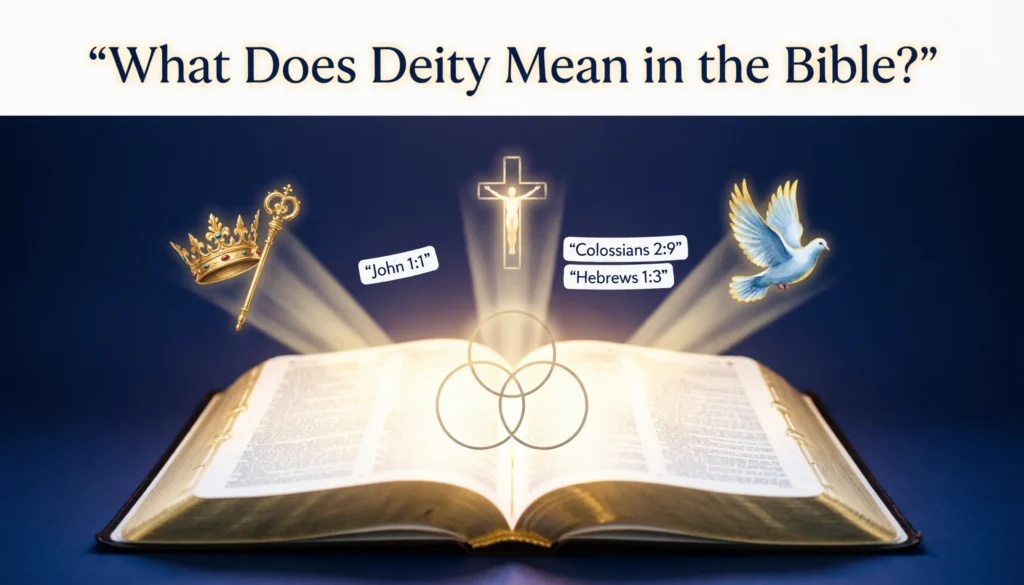
Definition:
Deity in the Bible refers to the divine nature, status, or being of God. In biblical theology, the word deity describes the supreme divine identity of God, emphasizing His power, holiness, and eternal nature.
Christians often use the term to refer to God Himself or the divine nature of Jesus Christ, especially when discussing the deity of Christ, which means that Jesus is fully God.
If you’ve ever read a Bible study article or listened to a sermon, you may have heard the phrase “the deity of Christ.” But what exactly does deity mean in the Bible?
The word carries deep theological meaning. It is not just another word for God it describes the divine nature that belongs only to God. In Christian belief, understanding deity is essential because it explains who God is, how He reveals Himself, and why Jesus is considered divine.
Throughout the Bible, the concept of deity appears in discussions about:
- The nature of God
- The Trinity (Father, Son, and Holy Spirit)
- The divinity of Jesus Christ
- God’s authority and holiness
In this guide, we’ll explore the meaning of deity in the Bible, its origins, how it’s used in theology, examples from scripture, and how it compares with related terms like divinity and godhead.
Origin and Etymology of the Word “Deity”
The word deity comes from the Latin word “deitas,” which means divine nature or godhood. This Latin term itself is derived from “deus,” meaning “god.”
Linguistic History
| Language | Word | Meaning |
|---|---|---|
| Latin | Deitas | Divine nature |
| Latin Root | Deus | God |
| English | Deity | God or divine being |
Although the English word “deity” does not appear frequently in older Bible translations, the concept it represents is clearly present throughout scripture.
Biblical writers often used other words that express the same idea, such as:
- God
- Lord
- Godhead
- Divine nature
For example, the King James Version uses the word “Godhead” to express the concept of deity.
What Deity Means in Biblical Theology
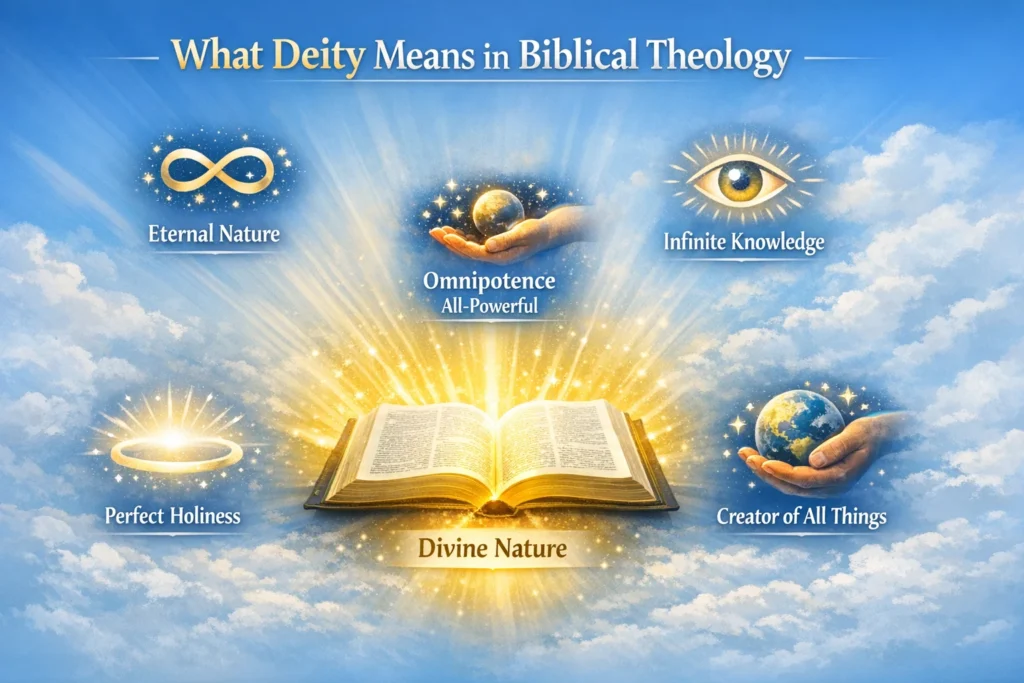
In biblical theology, deity refers to the divine nature and authority of God. It highlights the qualities that make God different from humans or created beings.
These qualities include:
- Eternal existence
- Absolute power
- Perfect holiness
- Infinite knowledge
- Creator of all things
Key Characteristics of Deity in the Bible
- Eternal Nature
God has no beginning and no end. - Omnipotence (All-Powerful)
God has unlimited power. - Omniscience (All-Knowing)
God knows everything. - Holiness
God is morally perfect and pure. - Creator Authority
God created the universe and rules over it.
These attributes define true deity according to biblical teaching.
The Deity of Christ in the Bible
One of the most important uses of the word deity in Christian theology is the phrase “the deity of Christ.”
This phrase means that Jesus Christ is fully God, not just a prophet or teacher.
Key Bible Verses Supporting the Deity of Christ
Several passages are often cited to show that Jesus shares the divine nature of God.
John 1:1
“In the beginning was the Word, and the Word was with God, and the Word was God.”
Colossians 2:9
“For in Christ all the fullness of the Deity lives in bodily form.”
John 10:30
“I and the Father are one.”
These verses are central to Christian belief that Jesus possesses the same divine nature as God the Father.
The Concept of the Trinity and Deity
Another major theological concept connected to deity is the Trinity.
The Trinity teaches that one God exists in three persons:
- Father
- Son (Jesus Christ)
- Holy Spirit
Each person is fully divine, sharing the same deity or divine essence.
Trinity Overview
| Person | Role | Deity Status |
|---|---|---|
| Father | Creator and source | Fully God |
| Son (Jesus) | Savior and Redeemer | Fully God |
| Holy Spirit | Comforter and guide | Fully God |
This concept is foundational in Christian doctrine.
Examples of Deity Usage in Christian Context
Although the Bible itself uses different words, the term deity is widely used in theology, sermons, and Christian writings.
Here are some common ways the word appears.
| Example Sentence | Context | Tone |
|---|---|---|
| “Christians believe in the deity of Jesus.” | Theology discussion | Neutral |
| “The miracle confirmed Christ’s deity.” | Sermon or teaching | Faith-based |
| “Some scholars debate the deity of Christ.” | Academic context | Analytical |
| “The Bible reveals God’s deity and power.” | Religious teaching | Reverent |
The tone of the word is typically respectful and theological, since it refers to divine nature.
Real-World Usage of the Word Deity
Outside the Bible, deity is used broadly in religion, philosophy, and comparative theology.
Common Modern Uses
- Religious Studies
Example:
“Ancient Egyptians worshiped several deities.”
- Academic Writing
Example:
“Different cultures interpret deity in unique ways.”
- Philosophy
“Philosophers debate the nature of deity and existence.”
Even though the Bible focuses on one true God, other religions may use the word deity to describe multiple gods.
Deity vs Other Related Biblical Terms
Many people confuse deity with similar words like divinity or godhead. While related, they are not always identical.
Comparison Table
| Term | Meaning | Biblical Usage |
|---|---|---|
| Deity | Divine nature or Godhood | Often used in theology |
| Divinity | The state of being divine | General religious term |
| Godhead | The divine essence of God | Used in some Bible translations |
| Lord | Title of authority for God | Common in scripture |
Key takeaway:
- Deity focuses on the nature of being God.
- Godhead emphasizes the divine essence of the Trinity.
Alternate Meanings of Deity
While the biblical meaning is specific, the word deity can have broader meanings depending on context.
General Definition
A deity can simply mean any god or divine being worshiped by a religion.
Examples include:
- Greek gods like Zeus
- Roman gods like Jupiter
- Hindu deities like Vishnu or Shiva
However, in Christian biblical context, deity refers specifically to the one true God and His divine nature.
Polite or Professional Alternatives
In some contexts, writers may use other words instead of deity, depending on the tone.
Alternative Words
- God
- Divine nature
- Divine being
- Godhead
- Supreme being
Example Rewriting
Instead of:
“Christians believe in the deity of Christ.”
You might say:
“Christians believe that Jesus is divine and fully God.”
These alternatives may sound more conversational or clearer for general readers.
Common Misunderstandings About Deity
Many people misunderstand what the Bible means by deity.
Misconception 1: Deity means any spiritual being
Not exactly.
In the Bible, deity refers specifically to God’s divine nature, not angels or spirits.
Misconception 2: Jesus was only a prophet
Christian theology teaches that Jesus shares the same divine nature as God.
Misconception 3: Deity means multiple gods in Christianity
Christianity teaches monotheism, meaning one God, even though He exists in the Trinity.
FAQs
What does deity mean in the Bible?
In the Bible, deity refers to the divine nature of God, including His power, holiness, and eternal existence. It is often used in theology to describe the divinity of Jesus Christ.
Is the word deity in the Bible?
Some modern translations include the word deity, but older versions often use terms like Godhead instead.
What is the deity of Christ?
The deity of Christ means that Jesus Christ is fully God, sharing the same divine nature as God the Father.
What Bible verse mentions deity?
One key verse is Colossians 2:9, which says that the fullness of deity lives in Christ.
What is the difference between deity and divinity?
Deity refers to the state of being God, while divinity is a broader term that describes anything related to God or the divine.
Does the Bible teach that Jesus is God?
Many Christian denominations believe the Bible teaches that Jesus is God, based on verses such as John 1:1 and John 10:30.
Is deity the same as the Trinity?
No. Deity refers to divine nature, while the Trinity describes the three persons who share that divine nature.
Why is the deity of Christ important?
It is important because it forms the foundation of Christian belief about salvation, worship, and the identity of Jesus.
Conclusion
Understanding what deity means in the Bible helps readers grasp one of the most important ideas in Christian theology: the divine nature of God.
The word deity refers to God’s divine essence, power, and eternal nature, and it plays a central role in discussions about the Trinity and the deity of Christ.
By understanding this concept, readers can better appreciate the deeper theological message of scripture and how Christians understand the identity of God.
Discover More Related Articles:

Amanda Lewis is a professional content writer and word-meaning researcher who specializes in explaining definitions, slang, abbreviations, and modern language terms. She writes for WordNexy.com, where she creates clear, accurate, and reader-friendly articles to help users understand word meanings and proper usage. Her work is especially useful for students, writers, and online readers seeking quick and reliable explanations.