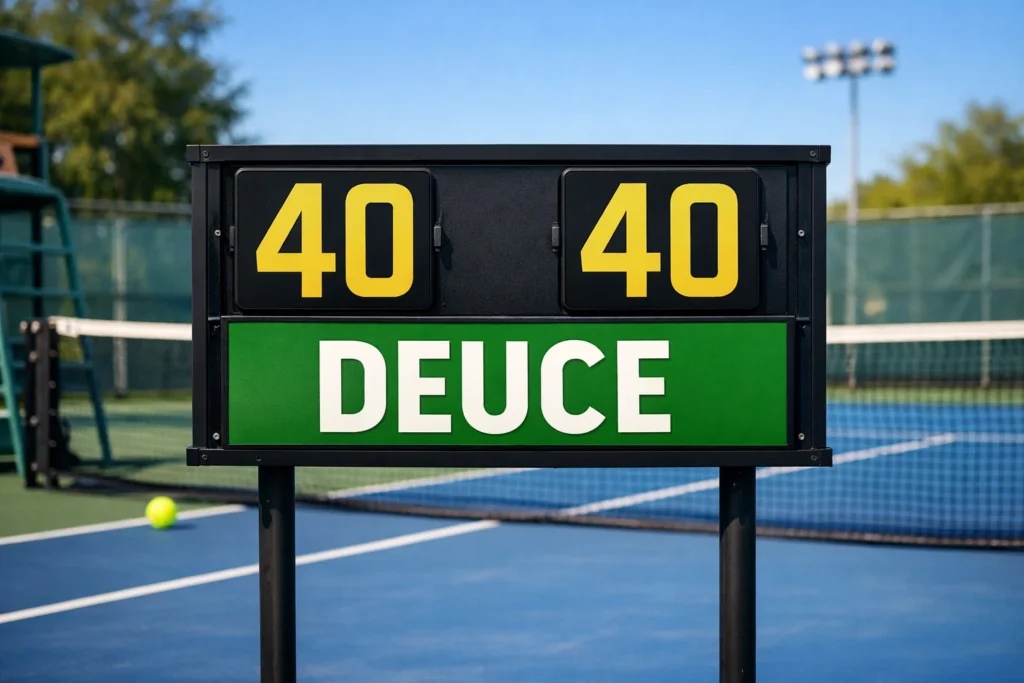
Definition:
In tennis, “deuce” means the score is tied at 40–40, and a player must win two consecutive points to win the game.
After deuce, one player gains “advantage,” and winning the next point wins the game unless the opponent ties it again.
If you’ve ever watched a tennis match and heard the umpire call “deuce,” you know the tension instantly spikes. One point can decide everything but only after someone breaks the tie. Understanding what deuce means in tennis helps you follow scoring, strategy, and those dramatic back-and-forth moments that define the sport.
Why “Deuce” Matters in Tennis Scoring
Tennis scoring is unique, and deuce is where games become truly competitive. When both players reach 40, the game cannot be won with a single point. Instead, the match enters a win-by-two system.
What Happens at Deuce
- Score reaches 40–40
- One player must win a point → gains advantage
- If the advantaged player wins again → wins the game
- If the opponent wins → score returns to deuce
This cycle can repeat multiple times, creating long and dramatic games.
Origin and History of the Term “Deuce”
The word deuce comes from the French word “deux,” meaning “two.” The idea reflects the need to win two consecutive points after a tie.
Historical Development
Early tennis evolved from European court games, and French terminology influenced many scoring terms. Over time, deuce became standard in international tennis language.
Today, the term is universally used in professional, amateur, and recreational play.
How Tennis Scoring Works
To fully understand deuce, you need to see where it fits in the scoring system.
Standard Point Progression
- Love (0)
- 15
- 30
- 40
- Game (if leading)
But when both players reach 40 → deuce.
Visual Breakdown
| Score Situation | Call | What It Means |
|---|---|---|
| 40–30 | “Forty-thirty” | One point from winning |
| 40–40 | “Deuce” | Must win by two |
| Advantage server | “Ad in” | Server leads |
| Advantage receiver | “Ad out” | Receiver leads |
Real-World Usage in Matches
You’ll hear deuce constantly in professional tennis commentary.
Common Commentary Lines
- “We’re back to deuce!”
- “Three deuces in this game.”
- “She saved two break points to reach deuce.”
In high-level tournaments like the Wimbledon Championships or the US Open, extended deuce battles often become defining moments of matches.
Examples of “Deuce” in Context
Friendly / Informational Tone 🙂
“It’s deuce both players are tied at 40, so the next two points decide the game.”
Neutral / Commentary Tone
“The score returns to deuce after a strong return.”
Dramatic / High-Stakes Tone 🎾
“After five deuces, the pressure is immense!”
Casual Explanation
“They’re tied and someone needs two straight points to win.”
Example Match Scenarios Table
| Situation | Sequence of Points | Result |
|---|---|---|
| Standard deuce win | Deuce → Advantage → Game | Player wins |
| Extended rally | Deuce → Ad → Deuce → Ad → Game | Long battle |
| Momentum shift | Deuce → Opponent wins → Deuce again | No advantage held |
| Comeback moment | Down 40–15 → Deuce → Win | Game stolen |
Strategic Importance of Deuce
Deuce isn’t just a score it’s a pressure test.
Why Players Care About Deuce
1. Psychological Pressure
Players must perform under high stress because mistakes are costly.
2. Momentum Swings
Winning multiple deuce points can shift the match’s emotional tone.
3. Physical Endurance
Long deuce games drain energy, especially in long matches.
4. Break Point Battles
Deuce often occurs when a player is close to breaking serve.
Deuce vs Advantage: Key Difference
Understanding the relationship between these two terms is essential.
| Term | Meaning | Outcome |
|---|---|---|
| Deuce | Tie at 40–40 | Need two points to win |
| Advantage | One point lead after deuce | One more point wins |
| Back to Deuce | Opponent wins after advantage | Tie restored |
Simple Rule
Deuce = tied
Advantage = temporary lead
Tone and Emotional Meaning in Commentary
The word itself is neutral, but the situation is often intense.
What “Deuce” Signals
- High tension
- Equal competition
- Turning point in game
- Pressure moment
Typical Reactions
- Fans → Excitement 😄
- Players → Focus and caution
- Commentators → Heightened drama
Comparison with Similar Tennis Terms
Understanding related scoring terms helps clarify deuce’s role.
| Term | Meaning | Relation to Deuce |
|---|---|---|
| Break Point | Chance to win opponent’s serve | Often leads to deuce battles |
| Game Point | Chance to win game | Occurs after advantage |
| Tie-break | Separate scoring system | Different from deuce |
| Love | Zero points | Starting score |
Alternate Meanings of “Deuce”
Outside tennis, deuce has several unrelated meanings.
Common Non-Tennis Uses
- Informal expression of surprise (“What the deuce?!”)
- Card value of two
- Slang references (context-specific)
However, in tennis, the meaning is precise and technical.
Professional and Informal Ways to Explain Deuce
Depending on your audience, you might say:
Professional Explanation
“The score is tied at forty-all, requiring a two-point margin to win the game.”
Casual Explanation
“They’re tied someone needs two straight points.”
Beginner-Friendly Version
“Deuce means no one can win yet.”
When Deuce Happens Frequently
Some match conditions lead to many deuce games.
Common Causes
- Evenly matched players
- Strong return games
- Pressure situations
- Long rallies
- Defensive play styles
These scenarios often produce memorable matches.
Why Tennis Uses the Deuce Rule
The rule ensures fairness. A player cannot win by a single lucky point at a critical tie.
Purpose of the Rule
- Rewards consistency
- Tests mental strength
- Prevents abrupt endings
- Adds competitive balance
It’s one of the features that make tennis uniquely dramatic.
Usage Tips for Beginners Watching Tennis
If you’re new to tennis, remember:
✔ Deuce happens at 40–40
✔ A player must win two points in a row
✔ Advantage comes after deuce
✔ The score can return to deuce repeatedly
Easy Memory Trick
Deuce = Two Needed
FAQ
1. What does deuce mean in tennis scoring?
It means the score is tied at 40–40 and a player must win two consecutive points to win the game.
2. Why is it called deuce?
The term comes from the French word for “two,” reflecting the need to win two points in a row.
3. What happens after deuce in tennis?
The next point gives a player advantage. Winning the following point wins the game.
4. Can a game have multiple deuces?
Yes. Players can return to deuce many times before someone wins.
5. Is deuce used in professional tennis?
Yes, it’s used at all levels of tennis competition.
6. What is the difference between deuce and tie-break?
Deuce is part of normal game scoring. A tie-break is a separate system used to decide sets.
7. Does deuce happen in every game?
No. It only occurs when both players reach 40.
8. Why is deuce important in tennis strategy?
It tests mental strength and often determines momentum in a match.
Conclusion
The term deuce represents one of tennis’s most exciting moments when players are evenly matched and must prove consistency under pressure. It ensures fairness, builds suspense, and produces some of the sport’s most memorable exchanges.
Whether you’re watching a major tournament or playing a casual match, understanding deuce helps you appreciate the rhythm and intensity of tennis scoring.
When the umpire calls “deuce,” the message is simple:
👉 The game is tied and now it truly counts.
Discover More Related Articles:
- Shabbat Shalom Mean in English: Usage, and Significance in 2026
- PFP Mean in Text: Complete Guide for Social Media Users (2026)

Sarah Williams is the passionate author behind WordNexy.com, dedicated to creating content that informs, inspires, and sparks curiosity. With a love for words and storytelling, she transforms ideas into meaningful articles that educate, entertain, and leave a lasting impression on every reader.