DME in medical terms stands for Durable Medical Equipment. It refers to reusable medical devices prescribed by a healthcare provider for home use to help patients manage a medical condition, recover from injury, or improve daily functioning.
Examples include wheelchairs, oxygen equipment, hospital beds, and walkers.
If you’ve ever seen “DME” on a prescription, insurance statement, or hospital paperwork and wondered what it actually means, you’re not alone. This three-letter abbreviation shows up frequently in healthcare, insurance billing, and patient care plans but its real-world impact is much bigger than it sounds.
From helping people breathe easier at home to supporting mobility after surgery, DME plays a crucial role in modern healthcare. Let’s break down exactly what it means, where it came from, how it’s used, and why it matters.
DME stands for Digital Motor Electronics.
It is the engine control unit that manages fuel injection, ignition timing, and performance.
In simple terms, it acts as the car’s brain to keep the engine running efficiently.
What Does DME Mean in Healthcare?
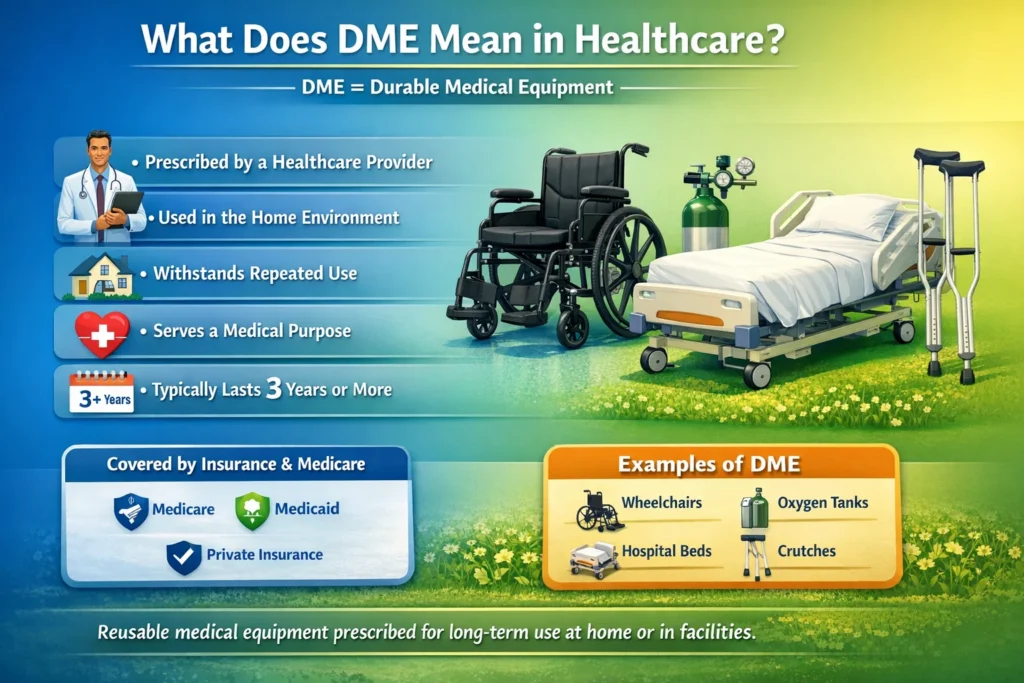
In healthcare, Durable Medical Equipment (DME) includes medically necessary devices that:
- Are prescribed by a licensed healthcare provider
- Are used in the home (not just hospitals)
- Can withstand repeated use
- Serve a medical purpose
- Typically last at least 3 years
DME is often covered by insurance plans, including government programs like Centers for Medicare & Medicaid Services, when deemed medically necessary.
DME stands for Durable Medical Equipment in healthcare.
It refers to reusable medical items like wheelchairs, oxygen tanks, and hospital beds.
These devices are prescribed for long-term use to support patient care at home or in medical facilities.
Why DME Matters in Patient Care
DME bridges the gap between hospital care and independent living. It allows patients to safely manage health conditions outside clinical settings.
Key Benefits
- Improves mobility and independence
- Supports recovery after surgery or injury
- Helps manage chronic diseases
- Reduces hospital readmissions
- Enables aging in place
Think of DME as the “infrastructure of home healthcare.”
DME stands for Digital Motor Electronics.
It is the computer system in a car that controls the engine’s functions.
It manages fuel injection, ignition timing, and emissions for optimal performance.
Essentially, it’s the “brain” of the engine, ensuring efficiency and smooth operation.
Origin and Evolution of the Term DME
The term “Durable Medical Equipment” gained prominence in U.S. healthcare policy during the expansion of Medicare coverage in the 1960s and 1970s. As more patients received care outside hospitals, insurers needed a standardized category for reusable medical devices used at home.
Over time, DME became a formal billing classification used by:
- Hospitals
- Insurance providers
- Medical suppliers
- Government healthcare programs
Today, the term is deeply embedded in insurance reimbursement systems and healthcare regulations.
DME Medical Abbreviation
DME stands for Durable Medical Equipment, a term commonly used in healthcare and medical billing.
It refers to medical devices that are designed for long-term use, such as wheelchairs, oxygen equipment, and hospital beds.
These items are typically prescribed by a doctor to help patients manage medical conditions at home.
DME is often covered by insurance plans if it is considered medically necessary.
Overall, DME plays an important role in improving patient comfort, mobility, and quality of life outside the hospital.
DME Full Form
DME stands for Durable Medical Equipment, which refers to medical devices used for long-term care at home.
These include items like wheelchairs, oxygen machines, and hospital beds that help patients with daily health needs.
DME Full Form in Medical
DME stands for Durable Medical Equipment.
It refers to reusable medical devices like wheelchairs, oxygen tanks, and hospital beds used for patient care.
These items are designed for long-term use to support treatment, recovery, or daily living needs.
What Does DME Mean in Text?
DME in texting usually stands for “Direct Message Me.” It’s a casual way of asking someone to send a private message instead of replying publicly in comments or chats. People commonly use it on social media platforms like Instagram, Twitter (X), or TikTok when they want to continue a conversation privately.
For example, someone might say, “If you’re interested, DME,” meaning you should message them directly for more details. The tone is friendly and informal, making it suitable for everyday online conversations.
Common Types of Durable Medical Equipment
Below are some of the most widely recognized examples of DME.
Mobility Equipment
- Wheelchairs (manual and electric)
- Walkers
- Canes
- Crutches
- Scooters
Respiratory Equipment
- Oxygen tanks
- CPAP machines
- Nebulizers
- Ventilators
Home Care Equipment
- Hospital beds
- Patient lifts
- Blood glucose monitors
- Infusion pumps
Safety & Support Devices
- Commode chairs
- Pressure mattresses
- Grab bars
- Orthopedic braces
DME Examples in Real-Life Medical Contexts
Here’s how the term appears in everyday healthcare communication.
Friendly/Supportive Tone
- “Your doctor prescribed DME to help you recover comfortably at home.”
- “Insurance approved the DME order for your walker 😊”
Neutral Clinical Tone
- “Patient requires DME for mobility assistance.”
- “DME order submitted for oxygen therapy equipment.”
Negative or Administrative Tone
- “DME coverage denied due to insufficient documentation.”
- “Prior authorization required before DME approval.”
Example
| Scenario | Medical Condition | DME Provided | Purpose |
|---|---|---|---|
| Post-surgery recovery | Hip replacement | Walker | Prevent falls, aid mobility |
| Chronic respiratory disease | COPD | Oxygen concentrator | Support breathing |
| Diabetes management | Type 1 diabetes | Glucose monitor | Track blood sugar |
| Limited mobility | Spinal injury | Wheelchair | Restore independence |
| Sleep disorder | Sleep apnea | CPAP machine | Maintain airway during sleep |
Insurance Coverage and Medical Necessity
Most insurance providers cover DME when specific criteria are met. Policies are often guided by standards from Centers for Medicare & Medicaid Services and clinical guidelines from groups like the American Diabetes Association.
Typical Coverage Requirements
- Physician prescription
- Proof of medical necessity
- Approved supplier
- Home-use qualification
Rental vs Purchase
Some equipment is rented monthly (e.g., oxygen equipment), while others are purchased outright (e.g., walkers).
DME vs Related Medical Abbreviations
Medical abbreviations can be confusing. Here’s how DME compares with similar terms.
Difference DME vs HME
| Term | Meaning | Key Difference |
|---|---|---|
| DME | Durable Medical Equipment | Broad insurance category |
| HME | Home Medical Equipment | Informal term, often used by suppliers |
Using DME vs Medical Supplies
| DME | Medical Supplies |
|---|---|
| Reusable | Disposable |
| Long-term use | Short-term use |
| Examples: wheelchairs | Examples: bandages |
DME vs Assistive Devices
Assistive devices may include non-medical tools like ergonomic tools or adaptive utensils, while DME must serve a medical purpose and meet regulatory criteria.
Regulatory Oversight and Safety Standards
Many devices classified as DME must meet safety and manufacturing standards set by the U.S. Food and Drug Administration. These regulations ensure equipment reliability, safety, and effectiveness.
Alternate Meanings of DME
While “Durable Medical Equipment” is the most common medical meaning, DME can also stand for:
- Diabetic Macular Edema (eye condition)
- Digital Mobile Equipment (telecommunications)
- Distributed Management Environment (IT systems)
Context usually clarifies which meaning applies.
How Healthcare Professionals Use the Term
Medical professionals often use DME in documentation, insurance coding, and discharge planning.
Clinical Communication Example
“Patient discharged with DME including hospital bed and oxygen support.”
Billing & Administration Example
“Submit DME authorization request with supporting documentation.”
When Patients Encounter the Term
You may see DME in:
- Discharge papers
- Insurance claims
- Prescriptions
- Home healthcare plans
- Supplier invoices
If you’re unsure what equipment qualifies, your provider or supplier can explain.
Professional Alternatives and Plain-Language Explanations
Healthcare professionals sometimes replace “DME” with more patient-friendly language.
| Technical Term | Patient-Friendly Alternative |
|---|---|
| Durable Medical Equipment | Medical equipment for home use |
| DME supplier | Medical equipment provider |
| DME authorization | Insurance approval for equipment |
Practical Tips for Patients Using DME
- Ask if the equipment is rented or purchased
- Verify insurance coverage before ordering
- Learn proper usage and maintenance
- Keep documentation for claims
- Report equipment issues immediately
FAQs
1. What qualifies as durable medical equipment?
Devices that are medically necessary, reusable, and prescribed for home use qualify as DME.
2. Is DME covered by insurance?
Many plans cover DME when medically necessary and prescribed by a doctor.
3. What is an example of DME?
Wheelchairs, oxygen equipment, walkers, and hospital beds are common examples.
4. What is the difference between DME and medical supplies?
DME is reusable and long-term; supplies are disposable and short-term.
5. Who prescribes durable medical equipment?
Licensed healthcare providers prescribe DME based on medical need.
6. How long can DME be used?
Most DME is designed for at least three years of use.
7. Can DME be used outside the home?
It is primarily intended for home use but may be portable.
8. What does DME mean in eye care?
In ophthalmology, DME may refer to diabetic macular edema, a different medical condition.
Conclusion
Durable Medical Equipment may sound like technical jargon, but its impact is deeply personal. From enabling mobility to supporting life-sustaining treatment at home, DME plays a foundational role in patient-centered healthcare.
Whether you’re a patient, caregiver, or simply researching medical terminology, knowing what DME means empowers you to make informed healthcare decisions, communicate effectively with providers, and understand insurance processes more clearly.
Discover More Related Articles:

Amanda Lewis is a professional content writer and word-meaning researcher who specializes in explaining definitions, slang, abbreviations, and modern language terms. She writes for WordNexy.com, where she creates clear, accurate, and reader-friendly articles to help users understand word meanings and proper usage. Her work is especially useful for students, writers, and online readers seeking quick and reliable explanations.