Definition:
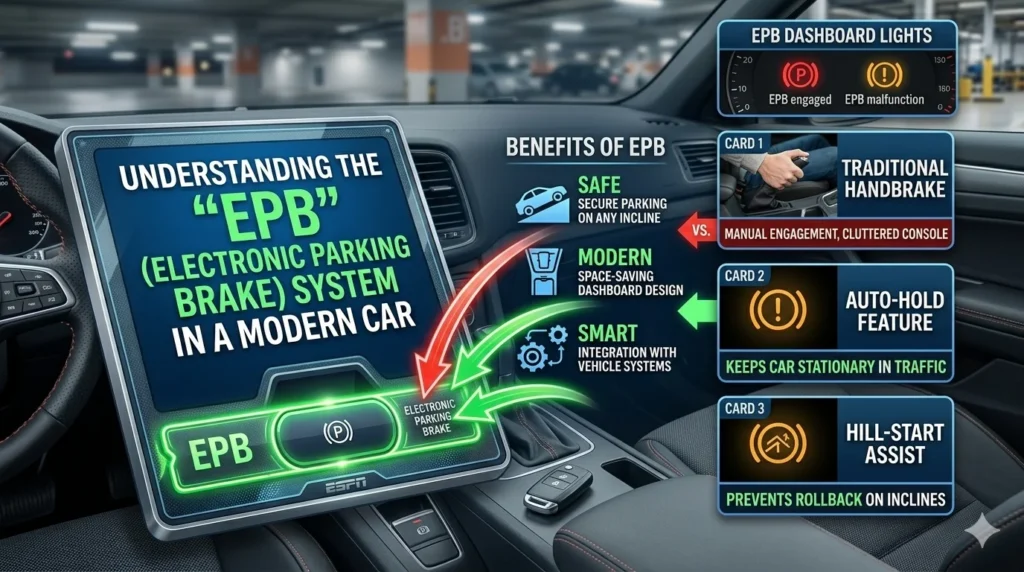
EPB in a car stands for Electronic Parking Brake, a modern braking system that replaces the traditional handbrake lever with an electronically controlled mechanism. Instead of manually pulling a lever, drivers can engage or release the parking brake with the push of a button, often integrated with other smart car features.
Origin of EPB
What EPB Means in Automotive History
The Electronic Parking Brake (EPB) originated in the early 2000s as automakers sought to modernize vehicle control systems and reduce mechanical complexity. Traditional handbrakes relied on cables and levers that could wear out over time, requiring maintenance. EPB technology uses electric motors and electronic controls, improving reliability and integrating with advanced safety systems like auto-hold and hill-start assist.
Popularity in Modern Cars
EPB systems have become increasingly common in mid-range and luxury vehicles, including brands like BMW, Audi, Mercedes-Benz, and Toyota. Its popularity stems from:
- Reduced cabin clutter by removing the mechanical lever
- Integration with advanced driver-assistance systems (ADAS)
- Increased precision in braking, especially on inclines
Real-World Implementation
Many drivers first encounter EPB through a small button, usually marked with a “P” inside a circle on the dashboard. Some systems automatically engage the brake when the engine is turned off or when the car is parked, providing added convenience and safety.
How EPB Works
Components of an EPB System
An EPB system typically includes:
- Electric motor(s): Replace the manual lever’s mechanical force
- Control module: Interprets signals from the EPB switch
- Actuators: Apply brake pressure to the rear wheels
- Sensors: Detect wheel rotation and vehicle slope
Operation Modes
- Manual Mode: Driver presses the EPB button to engage or release the brake
- Automatic Mode: Brake engages automatically when parking
- Emergency Mode: EPB can act as a backup brake if the main system fails
Advantages Over Traditional Handbrakes
- Less wear and tear on mechanical cables
- Cleaner dashboard design
- Enhanced safety features (prevents rollback on slopes)
- Integration with smart car features
Examples of EPB in Action
Friendly/Positive Context
- Example 1: A driver on a steep hill presses the EPB button, and the car remains securely in place, thanks to the auto-hold function. ✅
- Example 2: Modern cars like the Audi A6 use EPB in combination with hill-start assist, making city driving stress-free.
Neutral Context
- Some drivers feel indifferent, saying, “It’s just a button instead of a lever,” appreciating convenience but missing the tactile feedback of a traditional handbrake.
Negative/Dismissive Context
- In older vehicles, when EPB malfunctions, the system can trigger warning lights and prevent parking safely, leaving drivers frustrated. 😕
- Some mechanics warn that EPB repairs can be more expensive than traditional brake cable replacements.
EPB vs Traditional Handbrake: A Comparison
| Feature | EPB (Electronic Parking Brake) | Traditional Handbrake |
|---|---|---|
| Activation | Push-button or automatic | Manual lever |
| Integration with smart features | Yes (auto-hold, hill start) | No |
| Maintenance | Low, but expensive if repairs needed | Higher, but cheaper to fix |
| Dashboard space | Minimal | Requires lever space |
| Safety | Enhanced, prevents rollback | Depends on manual force |
| Tactile feedback | Minimal | Strong, mechanical feel |
This table shows why many modern cars have transitioned to EPB, despite occasional repair concerns.
Alternate Meanings of EPB
While Electronic Parking Brake is the most common automotive meaning, EPB may also refer to:
- Engineering Practice Board – unrelated to cars, used in professional certifications
- Earnings per Book – financial term in accounting
- European Polymer Bank – industrial term
In automotive contexts, EPB always refers to the braking system.
Polite or Professional Alternatives
When discussing EPB professionally, you can use:
- Electronic Park Brake (slight variation)
- Electric Parking Brake System
- Avoid slang terms like “button brake” or “tech brake,” which can sound casual or dismissive.
Common EPB Issues and Usage Tips
Common Problems
- Warning light stuck on
- Brake not engaging fully
- Automatic mode malfunction
Tips for Smooth Operation
- Always engage the EPB fully before leaving the vehicle
- Avoid relying solely on auto-hold; manually check brakes on steep slopes
- Follow manufacturer guidelines for maintenance
FAQs
1. What does EPB stand for in a car?
EPB stands for Electronic Parking Brake, a system replacing the manual handbrake with electronic controls.
2. How do I engage or release an EPB?
Simply press the EPB button to engage or release. Some vehicles automatically engage it when parked.
3. Can EPB fail?
Yes, like any electronic system. Common causes include sensor failure, motor issues, or wiring problems.
4. Is EPB safer than a handbrake?
Generally, yes. EPB integrates with smart systems like auto-hold and hill-start assist, preventing rollbacks.
5. Does EPB work on slopes?
Yes, most EPB systems include a hill-hold function to prevent the car from rolling backward.
6. How much does EPB repair cost?
Repairs can range from $200–$800 depending on the car model and issue.
7. Do all modern cars have EPB?
Not all, but it is increasingly common in mid-range and luxury vehicles. Entry-level cars may still use a traditional handbrake.
8. Can I manually release EPB if it fails?
Most EPB systems have a mechanical override for emergencies, but consult your owner’s manual before attempting.
Conclusion:
The Electronic Parking Brake (EPB) is a modern upgrade to the traditional handbrake, offering convenience, safety, and integration with smart car features. By simply pressing a button, drivers can secure their vehicles, benefit from auto-hold and hill-start assist, and enjoy a cleaner, more modern dashboard design.
While EPB systems reduce mechanical wear, occasional electronic malfunctions may require professional attention. Familiarizing yourself with its operation, emergency release procedures, and regular brake maintenance ensures optimal performance.
- EPB = Electronic Parking Brake – replaces traditional handbrake with a push-button system
- Enhances convenience, safety, and dashboard aesthetics
- Integrates with features like auto-hold and hill-start assist
- Occasional repairs can be costly but maintenance is generally low
- Always follow manufacturer guidelines for proper use
💡 Pro Tip: Even with EPB, it’s smart to check your brakes regularly and be familiar with the emergency release procedure.
Discover More Related Articles:
- PFP Mean in Text: Complete Guide for Social Media Users (2026)
- Shabbat Shalom Mean in English: Usage, and Significance in 2026

Amanda Lewis is a professional content writer and word-meaning researcher who specializes in explaining definitions, slang, abbreviations, and modern language terms. She writes for WordNexy.com, where she creates clear, accurate, and reader-friendly articles to help users understand word meanings and proper usage. Her work is especially useful for students, writers, and online readers seeking quick and reliable explanations.