Definition:
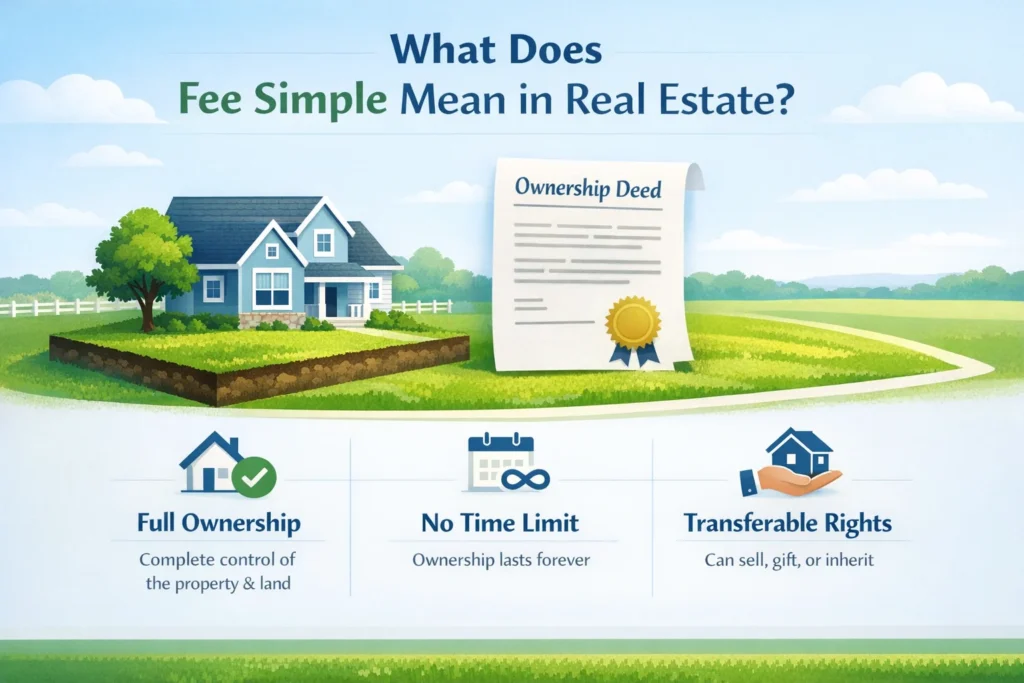
Fee simple is the highest form of property ownership in real estate, giving the owner full legal rights to the land and any structures on it, with the freedom to use, sell, lease, or transfer the property indefinitely subject only to laws, taxes, and local regulations.
If you’ve ever browsed property listings or spoken with a real estate agent, you’ve likely come across the term fee simple. At first glance, it might sound technical or even confusing but in reality, it’s one of the most important concepts in property ownership.
Understanding what fee simple means in real estate can help you:
- Make smarter buying decisions
- Understand your ownership rights
- Avoid legal confusion
- Compare property types with confidence
Whether you’re a first-time homebuyer, investor, or just curious, this guide breaks it all down in a simple, friendly way without legal jargon overload.
Origin and Meaning of Fee Simple
The term fee simple has deep historical roots dating back to medieval England. It comes from the feudal system, where land ownership was tied to obligations and hierarchy.
- “Fee” originally meant a hereditary estate (property passed down through generations)
- “Simple” indicated that the ownership had no conditions or limitations
Over time, fee simple evolved into the modern concept of complete ownership rights.
Why It Became Popular
Today, fee simple ownership is the most common type of real estate ownership, especially in countries like the United States, Canada, and many parts of the world. It’s widely used because:
- It gives owners maximum control
- It allows easy buying, selling, and inheritance
- It offers long-term security
Types of Fee Simple Ownership
Not all fee simple ownership is exactly the same. There are two main types:
1. Fee Simple Absolute
This is the purest form of ownership.
- Full ownership with no conditions
- Owner can sell, rent, or transfer freely
- Ownership lasts indefinitely
- Can be passed to heirs
👉 Example: You buy a house and own it completely forever (as long as you pay taxes and follow laws).
2. Fee Simple Defeasible
This type comes with certain conditions.
- Ownership can be revoked if conditions are broken
- Usually includes specific restrictions
- May revert to the original owner
👉 Example: A property given for use as a school if it stops being used as a school, ownership may be taken back.
Real-World Usage of Fee Simple
In everyday real estate, fee simple appears in:
- Property listings
- Legal documents
- Sales agreements
- Mortgage paperwork
Common Contexts
- “This home is sold as fee simple ownership.”
- “Buyer will receive fee simple absolute title.”
Tone and Interpretation
Unlike slang terms, fee simple is:
- Professional and neutral 🏡
- Used in legal and formal contexts
- Not emotional or conversational
Examples of Fee Simple in Context
Friendly Context 😊
- “Congrats! You now own your home in fee simple it’s fully yours!”
Neutral Context 📄
- “The buyer receives fee simple ownership upon closing.”
Slightly Negative / Restrictive Context ⚠️
- “The property is fee simple defeasible, meaning conditions apply.”
Fee Simple vs Other Property Ownership Types
Understanding fee simple becomes easier when you compare it with similar terms.
Comparison Table
| Ownership Type | Ownership Rights | Duration | Key Feature |
|---|---|---|---|
| Fee Simple | Full rights | Unlimited | Complete ownership |
| Leasehold | Limited rights | Fixed term | Land leased, not owned |
| Life Estate | Rights during lifetime only | Ends after death | Temporary ownership |
| Joint Tenancy | Shared ownership | Until death/sale | Survivorship rights |
| Tenancy in Common | Shared, unequal ownership | Flexible | No automatic transfer |
Fee Simple vs Leasehold: Key Differences
- Fee Simple
- You own the land and building
- No time limit
- Higher control
- Leasehold
- You lease the property
- Ownership expires after a set period
- Less control
👉 Tip: Always check whether a property is fee simple or leasehold before buying it significantly affects value and rights.
Advantages of Fee Simple Ownership
- ✅ Full control over property
- ✅ Can sell, rent, or transfer freely
- ✅ Long-term investment security
- ✅ Easier to finance (banks prefer it)
- ✅ Can pass property to heirs
Disadvantages or Limitations
Even though fee simple offers maximum ownership, it’s not completely unlimited:
- ❌ Subject to property taxes
- ❌ Must follow zoning laws
- ❌ Government can exercise eminent domain
- ❌ HOA rules may apply
Practical Usage Tips
If you’re dealing with real estate, keep these tips in mind:
- ✔️ Always confirm ownership type before purchase
- ✔️ Read legal documents carefully
- ✔️ Ask your agent or lawyer for clarification
- ✔️ Understand local property laws
Alternate Meanings of Fee Simple
In most contexts, fee simple refers strictly to real estate ownership. However:
- It may appear in legal studies or law exams
- Rarely used outside property law
- No slang or casual meaning
Professional Alternatives or Related Terms
While “fee simple” is standard, you might also hear:
- Full ownership
- Absolute ownership
- Freehold ownership (common in UK and similar systems)
👉 Note: Freehold is often used interchangeably with fee simple, though technical differences may exist depending on jurisdiction.
FAQs:
1. What does fee simple mean in simple terms?
Fee simple means you fully own a property, including the land and building, with no time limit.
2. Is fee simple the best type of ownership?
Yes, it’s considered the strongest and most complete form of ownership.
3. What is the difference between fee simple and freehold?
They are often used interchangeably, but freehold is more common in some countries, while fee simple is a legal term.
4. Can fee simple ownership expire?
No, fee simple absolute ownership does not expire it lasts indefinitely.
5. What is fee simple defeasible?
It’s ownership with conditions. If conditions are broken, ownership can be revoked.
6. Do you pay taxes on fee simple property?
Yes, property taxes still apply even with full ownership.
7. Is fee simple common in real estate?
Yes, it is the most common type of property ownership.
8. Can you sell a fee simple property?
Yes, you can sell, lease, or transfer it freely.
Conclusion:
Understanding what fee simple means in real estate is essential if you want to make confident property decisions. It represents the highest level of ownership, giving you full control over your land and property with no time limit. You can sell it, rent it, pass it to heirs, or use it as you wish while still following local laws and paying taxes.
In simple terms, fee simple ownership offers security, flexibility, and long-term value, making it the most preferred option for homeowners and investors. Before buying any property, always confirm the ownership type so you know exactly what rights you’re getting.
Discover More Related Articles:

James Anderson is an experienced content writer and language researcher who focuses on explaining word meanings, definitions, slang terms, and modern expressions. He writes for WordNexy.com, where his articles are designed to provide accurate meanings, practical usage examples, and easy-to-understand explanations for readers worldwide.