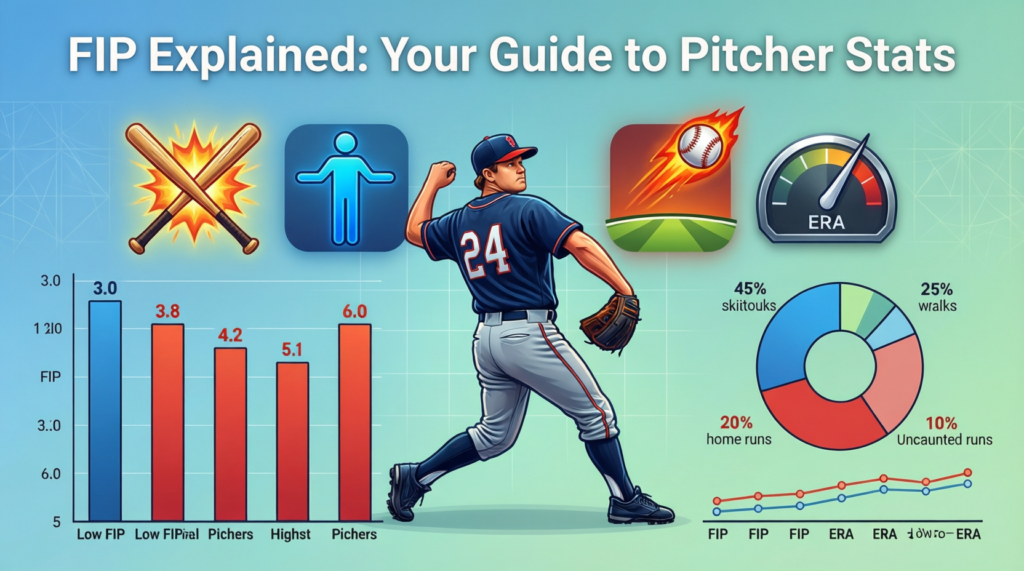
If you’ve ever looked at baseball statistics or watched a baseball broadcast, you may have come across the acronym FIP and wondered, “FIP Meaning in Baseball Explained” Whether you’re a casual fan, a fantasy league player, or understanding FIP is crucial for evaluating pitchers beyond traditional stats like ERA or wins.
Definition:
FIP (Fielding Independent Pitching) is a baseball statistic that estimates a pitcher’s effectiveness by focusing solely on outcomes a pitcher can control: strikeouts, unintentional walks, hit-by-pitches, and home runs allowed. Unlike ERA, FIP removes the impact of fielders, giving a clearer view of a pitcher’s true performance.
In this article, we’ll break down the origins, meaning, usage, and examples of FIP, compare it to similar metrics, explore alternatives, and answer common questions. By the end, you’ll have a complete understanding of FIP and how it can improve your baseball insights. ⚾
Origin of FIP
FIP, or Fielding Independent Pitching, was developed in the early 2000s by sabermetricians, statisticians who study baseball with advanced metrics. The goal was simple. Traditional pitching stats, like ERA (Earned Run Average), are heavily influenced by a pitcher’s defense.
A great pitcher could have a high ERA if his team fields poorly, while an average pitcher might appear dominant with excellent defense behind him.
FIP isolates what pitchers directly control:
- Strikeouts (K)
- Walks (BB)
- Hit-by-pitches (HBP)
- Home runs allowed (HR)
By focusing on these factors, FIP provides a truer measure of a pitcher’s skill, especially for predicting future performance.
Formula for FIP:
FIP=(13×HR)+(3×(BB+HBP))−(2×K)IP+constantFIP = \frac{(13 \times HR) + (3 \times (BB + HBP)) – (2 \times K)}{IP} + \text{constant}FIP=IP(13×HR)+(3×(BB+HBP))−(2×K)+constant
Where:
- HR = Home runs allowed
- BB = Walks
- HBP = Hit-by-pitches
- K = Strikeouts
- IP = Innings pitched
- Constant = Adjusted so league-average FIP equals league-average ERA
This formula isolates the pitcher’s performance from defense and luck.
Why FIP Became Popular
FIP has grown in popularity among analysts, fantasy baseball players, and broadcasters because it gives a more predictive view of a pitcher’s future performance than ERA.
Here’s why:
- Defense-independent: Unlike ERA, FIP doesn’t punish pitchers for poor fielding
- Predictive power: FIP correlates strongly with a pitcher’s ERA in future games, making it valuable for fantasy leagues and team management
- Simpler than advanced metrics: Compared to DRA (Deserved Run Average) or xFIP (expected FIP), FIP is straightforward and widely recognized
📊 On sites like FanGraphs or Baseball Reference, FIP is now a standard stat alongside ERA, WHIP, and strikeout rate. Even casual fans are seeing it during broadcasts, especially when analysts discuss underperforming pitchers.
How FIP is Used in Baseball
FIP is not just a numberit’s a tool for evaluating pitchers in multiple contexts:
Fantasy Baseball
Fantasy players rely on FIP to predict pitcher performance independent of team defense. A pitcher with a low FIP but high ERA may be undervalued, signaling a potential breakout.
Player Evaluation
Teams use FIP to assess pitchers’ true skill levels. A pitcher with mediocre ERA but excellent FIP may be considered a strong asset for the next season.
Scouting and Analysis
FIP helps identify pitchers who rely on skill (strikeouts, limiting walks) versus luck (fielder-dependent outcomes). Analysts often highlight discrepancies between ERA and FIP to explain performance swings.
Examples
Here’s how FIP can change the perception of a pitcher:
| Pitcher | ERA | FIP | Interpretation |
| John Doe | 4.50 | 3.20 | ERA inflated by poor defense; underlying skill strong |
| Jane Smith | 2.90 | 3.50 | ERA looks good but FIP suggests some luck involved |
| Mike Johnson | 3.80 | 3.80 | ERA and FIP match; performance aligned with skill |
Friendly and Neutral Examples
- “Look at Clayton Kershaw’s FIP of 3.05. That’s low and shows he’s dominant even if the ERA is higher this season” 😎
- “This rookie pitcher’s ERA is 4.20, but FIP says 3.10. He’s probably better than the numbers suggest”
Negative or Dismissive Example
- “His ERA is 2.85, but FIP is 4.20. He’s lucky, and fielders are saving him” 🙃
Comparing FIP to Related Metrics
FIP is part of a family of advanced pitching stats, each with unique nuances:
| Metric | Focus | Key Difference from FIP |
| ERA (Earned Run Average) | Runs allowed | Influenced by defense and luck |
| xFIP (Expected FIP) | Predictive | Normalizes HR/FB rate to league average |
| SIERA (Skill-Interactive ERA) | Advanced | Accounts for batted ball types and pitcher skill |
| WHIP (Walks + Hits per Inning) | Base runners | Simpler, less predictive of ERA |
💡 Key Insight: FIP is simpler than SIERA or xFIP but often aligns closely with them, making it ideal for fans and analysts seeking a clear, predictive measure
Alternate Meanings of FIP
While FIP in baseball is the most common context, FIP can also mean:
- Feline Infectious Peritonitis – a disease in cats 🐱
- Financial Institutions Plan – in finance
- First Inning Pitch – sometimes informally in amateur leagues
In baseball discussions, however, FIP almost always refers to Fielding Independent Pitching
Polite or Professional Alternatives
When discussing pitchers in a professional setting, you can avoid jargon and still convey FIP-related insights:
- “Defense-independent performance” – Good for broadcasts or articles
- “Underlying pitcher skill metric” – Friendly for casual readers
- “Predictive ERA” – Easy for fantasy players to understand
Example sentence:
“Although his ERA is 4.10, his defense-independent performance shows he’s pitching like a sub-3.00 ERA pitcher”
Conclusion:
In conclusion, BTW stands for “By The Way.” It is a commonly used abbreviation in texting, chatting, and social media to add extra or side information in a casual way. Using BTW helps keep conversations short, friendly, and informal.
However, it is best avoided in formal or professional writing. Understanding the meaning and correct usage of BTW can improve your everyday communication online.
FAQs
- What does a low FIP indicate?
A low FIP suggests the pitcher is effective at strikeouts, limiting walks, and preventing home runs, showing strong underlying performance. - Is FIP better than ERA?
FIP is better for predicting future performance because it removes defensive influence, while ERA reflects actual runs allowed. - Can a pitcher have a good ERA but bad FIP?
Yes. This usually happens when a pitcher benefits from excellent fielding or luck. - Does FIP consider balls in play?
No. FIP only considers strikeouts, walks, hit-by-pitches, and home runs. - What is a good FIP value?
Around 3.00 is excellent, 3.50–4.00 is average, and above 4.50 is below average, depending on the league. - Is FIP used in MLB broadcasts?
Increasingly yes. Analysts now cite FIP to explain pitcher performance beyond ERA. - How is FIP different from xFIP?
xFIP normalizes home run rates to the league average to reduce luck, while FIP uses actual home runs allowed. - Does FIP matter in fantasy baseball?
Absolutely. It helps identify undervalued pitchers who may outperform their ERA in upcoming games.

James Anderson is an experienced content writer and language researcher who focuses on explaining word meanings, definitions, slang terms, and modern expressions. He writes for WordNexy.com, where his articles are designed to provide accurate meanings, practical usage examples, and easy-to-understand explanations for readers worldwide.