Definition
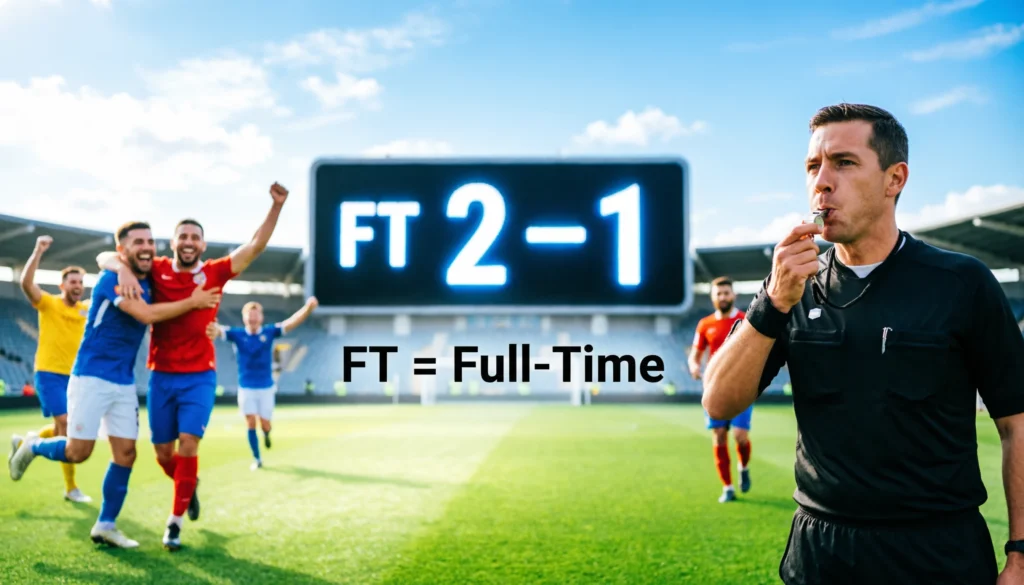
FT in soccer stands for “Full-Time.”
It indicates that a match has ended after the regulation 90 minutes (plus added time), and the final score is confirmed.
If you’ve ever checked a live match score, watched a football highlight, or followed a game on social media, you’ve probably seen “FT” next to a scoreline. It’s one of the most common abbreviations in soccer but if you’re new to the sport, it can feel confusing at first.
Let’s break it down in a simple, clear, and practical way so you’ll never wonder about it again.
What Does FT Mean in Soccer?
In soccer, FT (Full-Time) is used to show that the game is officially over.
A standard soccer match consists of:
- 90 minutes of play (two halves of 45 minutes each)
- Added (stoppage) time at the end of each half
Once the referee blows the final whistle, the match result becomes FT, meaning:
- No more play will happen
- The score is final (unless it’s a knockout match with extra time)
Example:
- Manchester United 2–1 Chelsea (FT)
👉 This means the match has ended, and Manchester United won 2–1.
Origin of the Term “FT”
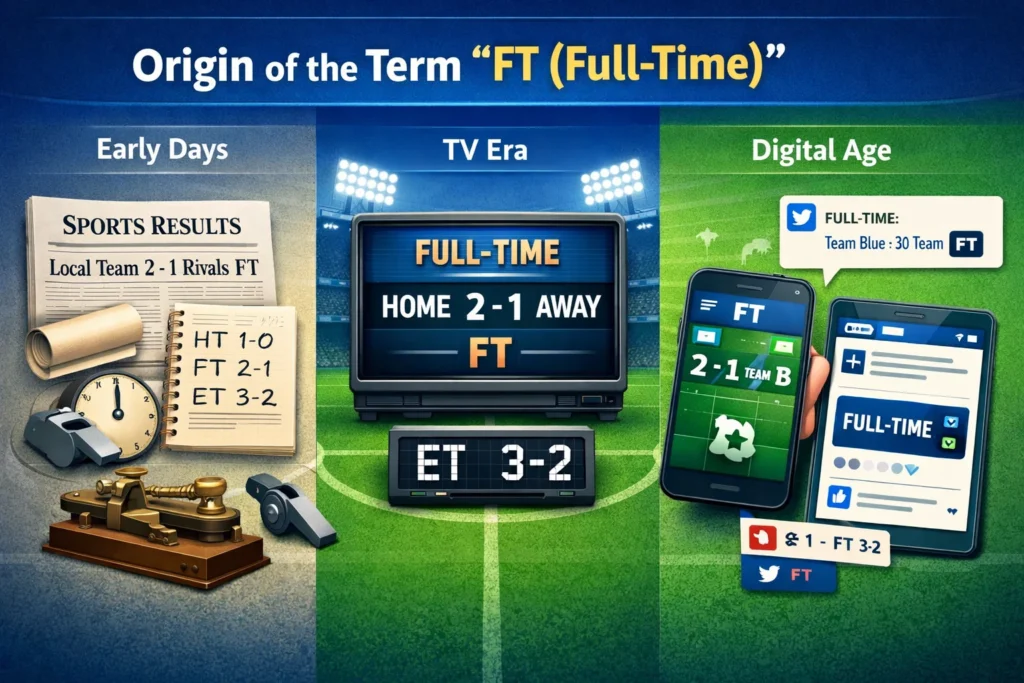
The abbreviation FT (Full-Time) comes from traditional sports reporting and scoreboard shorthand.
Before digital apps and live broadcasts:
- Newspapers and telegraphs needed short, quick ways to report results
- Abbreviations like FT, HT (Half-Time), ET (Extra Time) became standard
Over time, these abbreviations:
- Spread across TV broadcasts
- Became common in live score apps
- Are now used globally in football coverage
Today, you’ll see FT everywhere from TV graphics to Twitter match updates.
How FT Is Used in Real Life

You’ll encounter “FT” in many real-world situations:
1. Live Score Apps
Apps like ESPN or FlashScore display:
- FT when the match ends
- Example: Barcelona 3–0 Sevilla (FT)
2. TV Broadcasts
Commentators often say:
- “That’s full-time!”
- Graphics show FT next to the score
3. Social Media Updates
Clubs and fans post:
- “FT: We take all three points! 🔥”
4. Betting Platforms
“FT result” refers to:
- The outcome after the full 90 minutes (not including penalties)
Examples of FT in Context
Here are different ways “FT” appears, along with tone and meaning:
Neutral / Informational
- FT: Arsenal 1–1 Liverpool
👉 A simple match result
Excited / Positive
- FT: We win 3–0! What a performance! 🎉
👉 Celebratory tone
Disappointed / Negative
- FT: Lost again… 0–2 😞
👉 Frustration or disappointment
Dramatic
- FT: 2–2 after a last-minute equalizer! 😱
👉 Highlights excitement
Example Table: FT in Soccer Scoreboards
| Scenario | Example Scoreline | Meaning |
|---|---|---|
| Match Finished | Real Madrid 2–0 Valencia (FT) | Final result confirmed |
| Draw | PSG 1–1 Lyon (FT) | Match ended in a draw |
| High-Scoring Game | Bayern 5–3 Dortmund (FT) | Final score after full-time |
| After Added Time | Juventus 2–1 Inter (FT) | Includes stoppage time |
| Betting Context | FT Result: 1 | Home team wins after full-time |
FT vs Other Soccer Abbreviations
Understanding “FT” is easier when you compare it with similar terms:
| Abbreviation | Meaning | When It’s Used |
|---|---|---|
| FT | Full-Time | End of match |
| HT | Half-Time | Midway (after 45 minutes) |
| ET | Extra Time | Additional 30 minutes (knockout games) |
| AET | After Extra Time | Result after extra time ends |
| FT-Pens | Full-Time + Penalties | Match decided by penalty shootout |
Key Tip:
- FT only refers to the end of regular play (90 minutes + stoppage time)
- It does not include penalty shootouts
Why FT Matters in Soccer
“FT” isn’t just a label it’s important for several reasons:
1. Confirms the Final Result
No confusion the game is officially over.
2. Important for Standings
- Points are awarded based on FT results:
- Win = 3 points
- Draw = 1 point
- Loss = 0 points
3. Essential for Betting
- Many bets depend on the FT score only
4. Used in Statistics & Analysis
- Analysts rely on FT data for:
- Team performance
- Goal averages
- Match outcomes
Alternate Meanings of FT (Outside Soccer)
Although “FT” mainly means Full-Time in soccer, it can have other meanings in different contexts:
| Context | Meaning |
|---|---|
| Music | Featuring (e.g., Drake ft. Artist) |
| Measurement | Feet (unit of length) |
| Jobs | Full-Time employment |
| Social Media Slang | Sometimes “for trade” |
👉 Always use context to understand the meaning correctly.
Polite or Professional Alternatives
If you’re writing formally or professionally, you can replace “FT” with:
- “Full-time result”
- “Final score”
- “Match ended”
- “After 90 minutes”
Example:
- Informal: FT: Chelsea 2–0 Spurs
- Formal: The match ended 2–0 in favor of Chelsea
Usage Tips for Beginners
- ✔ Use FT only when the match is completely finished
- ✔ Combine it with scores for clarity
- ✔ Avoid using FT during live play (use “Live” instead)
- ✔ Remember: FT ≠ penalties result
FAQs:
1. What does FT mean in soccer scores?
FT means Full-Time, indicating the match has ended and the score is final.
2. Does FT include extra time?
No, FT usually refers to 90 minutes + stoppage time, not extra time.
3. What is FT in betting?
FT refers to the result at the end of regulation time (before penalties).
4. What’s the difference between FT and HT?
- FT = End of match
- HT = Halfway point (after 45 minutes)
5. Can a match continue after FT?
Only in knockout competitions but it’s labeled as ET, not FT.
6. What does FT-Pens mean?
It means the match ended and was decided by a penalty shootout.
7. Why do people use FT instead of “final score”?
Because it’s short, quick, and universally understood in sports.
8. Is FT used in other sports?
Yes, but it’s most commonly used in soccer/football.
Conclusion
“FT” is one of the simplest yet most important terms in soccer. It stands for Full-Time, signaling the end of a match and confirming the final score.
Whether you’re checking scores, watching a game, or posting on social media, understanding FT helps you:
- Follow matches more confidently
- Interpret results correctly
- Communicate like a true football fan
- 👉 If you see “FT,” the game is over and the result is official.
Discover More Related Articles:

Amanda Lewis is a professional content writer and word-meaning researcher who specializes in explaining definitions, slang, abbreviations, and modern language terms. She writes for WordNexy.com, where she creates clear, accurate, and reader-friendly articles to help users understand word meanings and proper usage. Her work is especially useful for students, writers, and online readers seeking quick and reliable explanations.