Definition
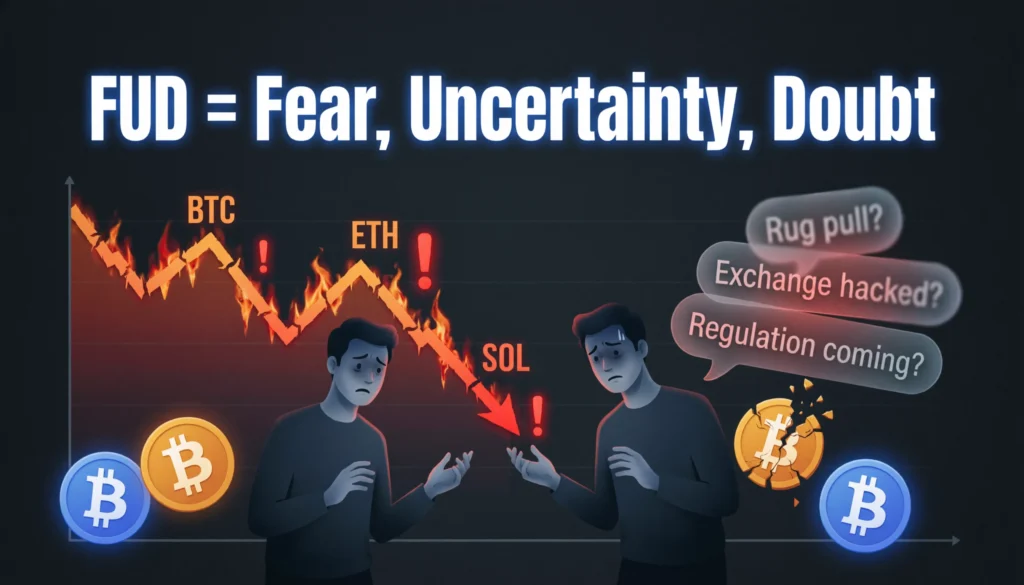
FUD in crypto stands for “Fear, Uncertainty, and Doubt.” It refers to the spread of negative or misleading information about a cryptocurrency, project, or market in order to create panic among investors.
If you spend even a little time in cryptocurrency communities, forums, or social media, you’ll quickly come across the term FUD. Crypto traders often say things like:
- “Ignore the FUD.”
- “That’s just FUD to make people sell.”
- “Stop spreading FUD about this project.”
But what exactly does FUD mean in crypto, and why does it matter so much?
Cryptocurrency markets are heavily influenced by investor sentiment. Because crypto is still relatively new and volatile, news, rumors, and opinions can move prices dramatically. When negative narratives spread whether true or false they can create panic selling and market instability.
Understanding FUD in cryptocurrency helps investors make better decisions, avoid emotional trading, and recognize when market narratives might be exaggerated.
In this guide, we’ll explore:
- The origin of the term FUD
- How it is used in crypto communities
- Real examples of FUD
- The difference between FUD and legitimate criticism
- Related crypto slang
- Practical tips for dealing with FUD
In many cases, FUD causes people to sell their assets quickly, which can lead to price drops and increased market volatility. Sometimes the information may be partially true, but often it is exaggerated, misleading, or intentionally spread to manipulate market sentiment.
In simple terms:
- F – Fear
- U – Uncertainty
- D – Doubt
Together, these emotions can influence how people think and act in the crypto market, especially during periods of market instability.
Origin of the Term FUD

Although FUD is now strongly associated with cryptocurrency, the term did not originate in crypto.
Early Use in Technology and Marketing
The phrase “Fear, Uncertainty, and Doubt” dates back to the 1970s technology industry. Large companies allegedly used FUD as a marketing tactic to discourage customers from choosing competitors.
For example, a company might spread messages such as:
- “That software isn’t secure.”
- “Their system might fail.”
- “Their technology may not be supported in the future.”
Even without direct proof, such statements could make customers hesitate or lose confidence in competing products.
Adoption in Crypto Culture
When cryptocurrency communities began growing in the 2010s, the term FUD quickly became part of crypto slang.
Crypto investors began using it to describe:
- Negative news about a coin
- Rumors intended to crash prices
- Skeptical comments about projects
Today, FUD is one of the most commonly used terms in crypto discussions, especially on platforms like:
- Twitter (X)
- Telegram groups
- Discord communities
- Crypto trading forums
Why FUD Is So Powerful in Crypto
Cryptocurrency markets are particularly vulnerable to FUD for several reasons.
1. High Market Volatility
Crypto prices can change dramatically within minutes. When fear spreads, many investors react quickly.
2. Large Number of Retail Investors
Many crypto traders are individual investors rather than institutions. Emotional decisions are more common.
3. Social Media Influence
News spreads extremely fast across platforms like:
- YouTube
- Telegram
A single viral tweet can trigger massive panic selling.
4. Lack of Regulation
Compared to traditional financial markets, crypto is still relatively less regulated, making it easier for rumors to spread.
Common Types of Crypto FUD
Not all FUD looks the same. It can appear in several forms.
1. Regulatory FUD
Rumors about governments banning cryptocurrency often trigger fear.
Example:
“Country X is banning Bitcoin completely.”
Even when such claims are exaggerated, they can cause price drops.
2. Security FUD
News about hacks or vulnerabilities can create doubt.
Example:
“A major exchange was hacked — your funds might not be safe.”
3. Project-Specific FUD
Sometimes specific crypto projects are targeted.
Example:
“This blockchain project is a scam.”
4. Market Crash Predictions
Dramatic predictions can also spread FUD.
Example:
“Bitcoin is going to zero!”
These statements often create panic among inexperienced investors.
Real-World Usage of FUD in Crypto Conversations
In everyday crypto discussions, the word FUD is used frequently.
Common Statements
- “Ignore the FUD, the project fundamentals are strong.”
- “That article is pure FUD.”
- “People are spreading FUD to buy the dip.”
The tone can vary depending on context.
Tone Types
| Tone | Example | Meaning |
|---|---|---|
| Friendly | “Don’t worry, it’s just FUD.” | Reassuring other investors |
| Neutral | “There’s a lot of FUD in the market today.” | Observing market sentiment |
| Dismissive | “That’s total FUD.” | Rejecting criticism |
| Defensive | “Stop spreading FUD about the project.” | Protecting a project’s reputation |
Sometimes the term is used accurately, but other times it is used simply to dismiss legitimate concerns.
Examples of FUD in Crypto
Here are some realistic examples showing how FUD may appear in the crypto world.
| Scenario | FUD Statement | Impact |
|---|---|---|
| Government regulation rumors | “Crypto will be banned everywhere soon.” | Investors panic sell |
| Exchange security rumors | “Your funds aren’t safe on exchanges.” | Withdrawals increase |
| Competitor attacks | “That coin has no real technology.” | Market trust declines |
| Influencer speculation | “This project is collapsing.” | Price drops rapidly |
These examples show how information even rumors can strongly influence market behavior.
FUD vs Legitimate Criticism
One important thing to understand is that not all criticism is FUD.
Sometimes investors label any negative opinion as FUD, even when the concern is valid.
Key Differences
| Factor | FUD | Legitimate Criticism |
|---|---|---|
| Evidence | Often lacks evidence | Usually supported by facts |
| Intent | May aim to manipulate sentiment | Seeks transparency or improvement |
| Tone | Emotional or dramatic | Analytical and logical |
| Accuracy | May include rumors | Based on research |
Healthy crypto communities encourage constructive criticism, not blind optimism.
Related Crypto Terms and Slang
FUD is part of a larger vocabulary used in crypto trading.
| Term | Meaning | Relation to FUD |
|---|---|---|
| HODL | Hold your crypto long-term | Often used to resist FUD |
| FOMO | Fear of missing out | Opposite emotional driver |
| DYOR | Do your own research | Advice to avoid falling for FUD |
| Bearish | Expecting prices to fall | Sometimes linked to FUD |
| Bullish | Expecting prices to rise | Opposite sentiment |
Understanding these terms helps investors navigate crypto conversations more confidently.
Alternate Meanings of FUD
Outside cryptocurrency, FUD can still mean Fear, Uncertainty, and Doubt, but it is used in different contexts.
Examples include:
Business and Marketing
Companies may spread doubts about competitors.
Example:
“Competitors are spreading FUD about our product.”
Technology Industry
Used when companies attempt to undermine competing technology.
Politics or Media
Sometimes used to describe negative propaganda or misleading narratives.
However, today the term is most strongly associated with cryptocurrency culture.
Polite or Professional Alternatives
In professional discussions, people may avoid slang like FUD and use more formal phrases.
Examples include:
| Casual Term | Professional Alternative |
|---|---|
| FUD | Negative market sentiment |
| Spreading FUD | Circulating misleading information |
| Ignore the FUD | Evaluate the information carefully |
| That’s FUD | That claim lacks evidence |
Using professional language is especially helpful in business, journalism, or academic discussions about crypto.
How Investors Should Deal With FUD
Smart investors try to remain calm when FUD spreads.
Here are some practical strategies.
1. Verify Information
Always check:
- Official project announcements
- Reliable news sources
- Blockchain data
2. Avoid Emotional Trading
Fear-driven decisions often lead to losses.
3. Do Your Own Research
Understand:
- Project fundamentals
- Technology
- Team and roadmap
4. Consider Market Psychology
Markets often react emotionally before stabilizing.
5. Look at Long-Term Trends
Short-term panic does not always reflect long-term value.
FAQs
What does FUD mean in crypto?
FUD stands for Fear, Uncertainty, and Doubt. It describes negative information or rumors that create panic among cryptocurrency investors.
Is FUD always false information?
Not necessarily. Some FUD may contain partial truths, but it is often exaggerated or presented in a way that creates unnecessary panic.
Why do people spread FUD in crypto?
Some individuals spread FUD to manipulate market prices, discourage investors, or promote competing projects.
What is the opposite of FUD in crypto?
The opposite emotional driver is FOMO (Fear of Missing Out), where investors rush to buy because they fear missing profits.
How does FUD affect crypto prices?
FUD can cause panic selling, which often leads to sudden price drops and increased market volatility.
What does “ignore the FUD” mean?
It means investors should not react emotionally to rumors or negative hype and should focus on verified information.
Can FUD be used for market manipulation?
Yes. In some cases, traders spread negative rumors intentionally to push prices down and buy assets at lower prices.
How can beginners avoid falling for FUD?
Beginners should:
- Verify news sources
- Avoid emotional reactions
- Research projects carefully
- Focus on long-term strategy
Conclusion
FUD short for Fear, Uncertainty, and Doubt is one of the most important concepts to understand in cryptocurrency markets. It describes the spread of negative narratives or rumors that can influence investor emotions and market behavior.
Because crypto markets are fast-moving and heavily influenced by social media, FUD can quickly trigger panic selling and sharp price movements. However, not all criticism is FUD. Investors must learn to distinguish between baseless rumors and legitimate concerns.
The best way to handle FUD is to stay calm, verify information, and rely on research rather than emotions. By focusing on long-term fundamentals instead of short-term panic, investors can make smarter and more confident decisions.
Understanding FUD not only helps you navigate the crypto world more effectively it also makes you a more informed and resilient investor.
Discover More Related Articles:

James Anderson is an experienced content writer and language researcher who focuses on explaining word meanings, definitions, slang terms, and modern expressions. He writes for WordNexy.com, where his articles are designed to provide accurate meanings, practical usage examples, and easy-to-understand explanations for readers worldwide.