Definition:
GIDP in baseball stands for Grounded Into Double Play. It occurs when a batter hits a ground ball that results in two offensive players being called out in the same play, typically the batter and a runner on base.
If you follow box scores or advanced stats, you’ve probably seen “GIDP” next to a player’s name and wondered why it matters. This stat captures one of the most momentum-shifting moments in baseball: a rally-killing ground ball that wipes out two outs at once.
This guide explains what GIDP means, how it happens, why it matters in player evaluation, and how it compares to related baseball terms.
What “Grounded Into Double Play” Means in Simple Terms
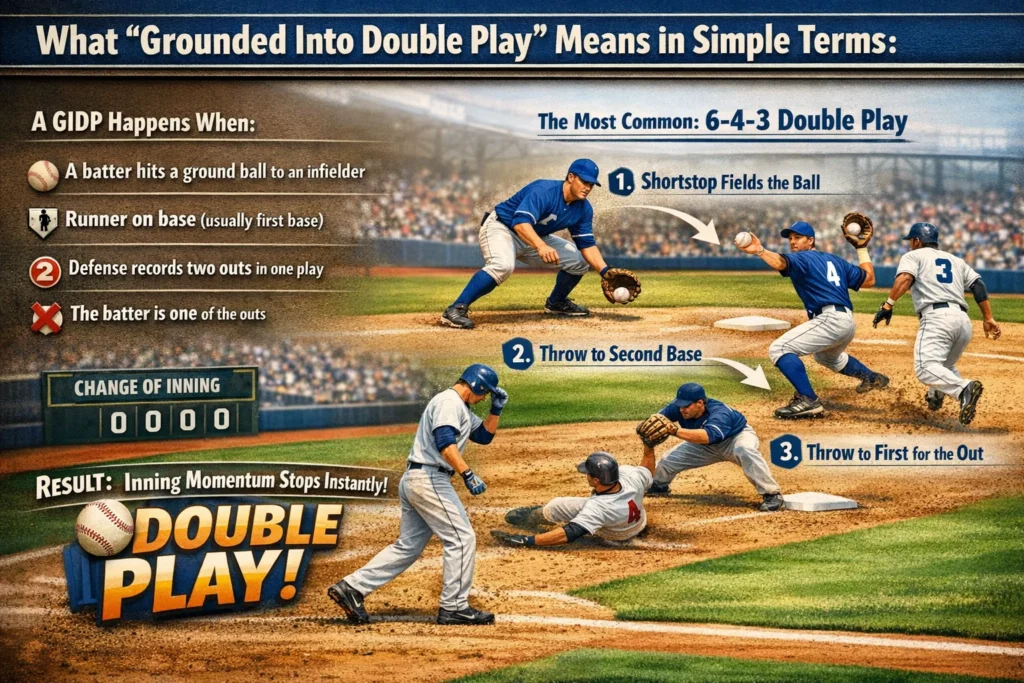
A GIDP happens when:
- A batter hits a ground ball to an infielder
- There is at least one runner on base (usually first base)
- The defense records two outs on the same continuous play
- The batter is one of the two outs
The most common version is the 6-4-3 double play:
- Shortstop fields the ball
- Throws to second base for the first out
- Second baseman throws to first base for the second out
Result: inning momentum stops instantly.
GIDP Meaning in Baseball
In baseball, GIDP stands for Grounded Into Double Play, a statistic used to track when a batter hits a ground ball that results in two outs on the same play.
This usually happens when there is at least one runner on base, most commonly on first base, and the defense quickly fields the ball, throws to second base for the first out, and then to first base for the second out. GIDP is often seen as a negative stat for hitters because it not only records an out but also removes a baserunner, reducing scoring opportunities.
Why GIDP Matters in Baseball
GIDPs are significant because they:
- End scoring opportunities quickly
- Penalize hitters who hit many ground balls
- Reward strong infield defense
- Affect player performance metrics
From a strategy perspective, a GIDP is one of the most efficient defensive outcomes possible.
GIDP Baseball:
In baseball, GIDP (Grounded Into Double Play) is a crucial moment that can quickly shift momentum in a game. It happens when a batter hits a ground ball that allows the defense to record two outs in one continuous play usually by forcing a runner out at second base and then throwing to first.
This situation often occurs when there’s a runner on first base with less than two outs, making it a key defensive opportunity. While it’s beneficial for the fielding team, a GIDP can be frustrating for hitters because it not only results in their own out but also removes a baserunner, killing scoring chances instantly.
Origin and Statistical Usage
The term “Grounded Into Double Play” developed alongside modern scorekeeping conventions in professional baseball. It became a standard stat in official records to track how often hitters produce rally-ending ground balls.
Today, GIDP is recorded across all levels of organized baseball and is prominently tracked in professional leagues such as Major League Baseball.
Statisticians and analysts use GIDP to evaluate:
- Hitter tendencies
- Situational hitting ability
- Team offensive efficiency
- Defensive coordination
How a GIDP Happens Step by Step
- Runner is on base, usually first base
- Batter hits a ground ball to an infielder
- Infielder throws to a base for one out
- Ball is relayed to another base for the second out
- Batter is retired as part of the play
Timing, positioning, and speed of runners all influence whether a double play is possible.
Common Game Situations Where GIDP Occurs
- Runner on first base with fewer than two outs
- Batter hits a sharply hit ground ball
- Defense is positioned for a double play
- Slow runner at bat
Power hitters who hit hard ground balls can still record many GIDPs if they lack speed.
Tone and Commentary Examples
Although GIDP is a technical statistic, commentators and fans discuss it in different tones.
Excited announcer tone
“That’s a textbook double play. The batter grounded into a GIDP and the inning is over.”
Neutral analytical tone
“The player leads the team in grounded into double plays this season.”
Frustrated fan tone
“Another rally killed by a GIDP.”
What Is GIDP in Baseball?
In baseball, GIDP stands for Grounded Into Double Play. It refers to a situation where a batter hits a ground ball that results in two outs on the same play, typically involving the batter and a baserunner (often from first base).
This usually happens when the defense quickly fields the ball, throws to second base for the first out, and then to first base to retire the batter. GIDP is considered a negative stat for hitters because it not only records an out but also removes a runner from base, reducing scoring opportunities.
Example Scenarios Table
| Situation | Runners on Base | Batted Ball | Defensive Result | Recorded Stat |
|---|---|---|---|---|
| Runner on first | Ground ball to shortstop | 6-4-3 double play | Two outs recorded | GIDP |
| Runners on first and second | Ground ball to third baseman | Force at third and first | Two outs recorded | GIDP |
| Runner on first | Fly ball to outfield | One out only | No double play | Not GIDP |
| Runner on first | Ground ball but only one out made | Single out | Not a double play | Not GIDP |
What Counts and What Does Not Count as GIDP
Counts as GIDP
- Batter hits a ground ball
- Defense records two outs
- Batter is one of the outs
Does Not Count
- Line drive double play
- Fly ball double play
- Double play where batter is safe
- Triple plays (recorded separately)
The key requirement is a ground ball leading directly to two outs involving the batter.
Comparison With Related Baseball Terms
| Term | Meaning | Key Difference From GIDP |
|---|---|---|
| Double Play (DP) | Two outs in one play | Not always caused by ground ball |
| Force Out | Runner must advance | May be part of GIDP |
| Fielder’s Choice | Defense chooses which runner to retire | May or may not produce two outs |
| Strikeout | Batter retired without ball in play | No baserunner involvement |
GIDP is a specific type of double play initiated by a ground ball from the batter.
Player Impact and Strategy Insights
For Hitters
- High GIDP totals can reduce offensive value
- Faster runners produce fewer GIDPs
- Line-drive hitters avoid them more often
For Defenses
- Strong infield coordination increases double-play success
- Strategic positioning improves efficiency
- Pitchers who induce ground balls benefit from GIDPs
Managers often call for defensive positioning specifically to increase double-play probability.
Professional or Analytical Alternatives
In statistical or analytical writing, GIDP may be described as:
- Ground ball double play
- Rally-ending ground out
- Double play opportunity converted
- Situational ground out
These alternatives appear in scouting reports and performance analysis.
Alternate Meanings
Outside baseball scoring, GIDP has no widely recognized alternate meaning. It is almost exclusively used in baseball statistics and commentary.
Practical Tips for Understanding Box Scores
When reviewing player statistics:
- A high GIDP number may reflect batting style
- Compare GIDP with on-base percentage and speed
- Context matters because opportunities vary by team lineup
A player batting behind frequent base runners will have more GIDP opportunities.
FAQs:
1. What does GIDP stand for in baseball stats?
Grounded Into Double Play.
2. Is every double play a GIDP?
No. Only ground-ball double plays involving the batter.
3. Does a GIDP count as an at-bat?
Yes, it counts as an official at-bat.
4. Why do some players have high GIDP totals?
Ground-ball hitting style and slower running speed increase likelihood.
5. Can a GIDP occur with multiple runners on base?
Yes, but only two outs are recorded in a standard double play.
6. Is GIDP considered a negative statistic?
Generally yes, because it ends scoring opportunities.
7. Do pitchers influence GIDP frequency?
Yes, ground-ball pitchers create more double-play chances.
8. Where can I see GIDP in official stats?
It appears in player batting statistics and game box scores.
Conclusion
GIDP, or Grounded Into Double Play, represents one of baseball’s most decisive momentum shifts. It happens when a batter hits a ground ball that results in two outs on the same play, typically erasing a scoring opportunity in seconds. While it is a routine part of the game, it carries meaningful strategic and statistical weight.
For hitters, avoiding GIDPs often comes down to contact type, speed, and situational awareness. For defenses, successfully turning a double play reflects coordination, positioning, and quick execution.
When you see GIDP in a box score, it tells a deeper story than just two outs. It signals a moment when the defense seized control and changed the direction of an inning.
Discover More Related Articles:
- PFP Mean in Text: Complete Guide for Social Media Users (2026)
- Shabbat Shalom Mean in English: Usage, and Significance in 2026

James Anderson is an experienced content writer and language researcher who focuses on explaining word meanings, definitions, slang terms, and modern expressions. He writes for WordNexy.com, where his articles are designed to provide accurate meanings, practical usage examples, and easy-to-understand explanations for readers worldwide.