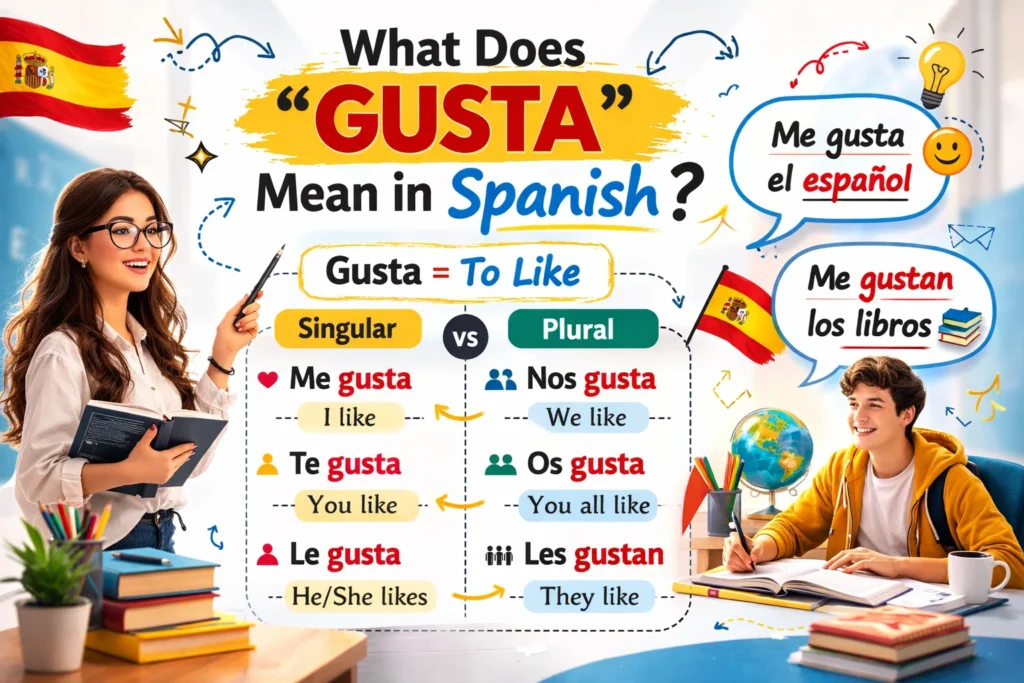
Definition:
“Gusta” is a form of the Spanish verb gustar, which means “to like.” It is used when talking about something that is liked, typically with singular nouns or infinitive verbs. For example, “Me gusta el café” means “I like coffee.”
Have you ever heard someone say “Me gusta” in a song, a movie, or during a Spanish lesson and wondered what it really means? At first glance, it seems simple “gusta” means “like.” But Spanish doesn’t use gustar the same way English uses “to like,” and that’s where things get interesting.
If you’re learning Spanish or just curious about the language, understanding what does gusta mean in Spanish will instantly boost your confidence. In this in-depth guide, we’ll break down its meaning, origin, grammar structure, tone, real-life usage, comparisons with similar words, and common mistakes plus practical examples and FAQs.
Let’s dive in.
What Does “Gusta” Mean in Spanish?
In Spanish, “gusta” is the third-person singular present tense form of the verb gustar.
It literally translates to:
👉 “(It) pleases”
But in natural English, we translate it as:
👉 “likes”
Why the Literal Meaning Matters
Spanish structures sentences differently than English. Instead of saying:
“I like pizza.”
Spanish says:
“Pizza pleases me.”
Me gusta la pizza.
That’s why understanding gustar requires a small mindset shift.
Origin of the Word “Gusta”
The verb gustar comes from Latin, specifically from the word gustare, meaning:
- To taste
- To enjoy
- To try
Over time, the meaning evolved into “to like” or “to be pleasing.” Today, gustar is one of the most commonly used verbs in Spanish across countries like:
- Spain
- Mexico
- Argentina
- Colombia
No matter the Spanish-speaking country, gusta is universally understood.
How “Gusta” Works Grammatically
This is where many learners get confused.
Basic Structure:
Indirect Object Pronoun + gusta + noun/verb
| Pronoun | Meaning | Example | Translation |
|---|---|---|---|
| Me | To me | Me gusta el café | I like coffee |
| Te | To you | Te gusta la música | You like music |
| Le | To him/her | Le gusta el cine | He/She likes movies |
| Nos | To us | Nos gusta viajar | We like traveling |
| Les | To them | Les gusta el fútbol | They like soccer |
Notice something?
The verb “gusta” stays singular because it agrees with the thing being liked not the person.
When to Use “Gusta”
Use gusta when talking about:
1️⃣ A Singular Noun
- Me gusta el libro.
- Te gusta la película.
2️⃣ An Infinitive Verb
- Me gusta correr. (I like running.)
- Nos gusta estudiar. (We like studying.)
When NOT to Use “Gusta”
Use “gustan” instead when talking about plural nouns.
Example:
- Me gustan los perros.
- Me gustan las flores.
Quick rule:
- Singular thing → gusta
- Plural thing → gustan
Real-Life Examples of “Gusta”
Understanding tone is important.
😊 Friendly / Casual Tone
- Me gusta tu camisa.
“I like your shirt.” - ¿Te gusta esta canción?
“Do you like this song?”
😐 Neutral Tone
- Le gusta trabajar aquí.
😏 Slightly Dismissive or Sarcastic Tone
- Ah, ¿te gusta ahora?
“Oh, now you like it?”
Tone depends more on voice and context than grammar.
Labeled Example Table
| Spanish Sentence | Literal Meaning | Natural English Meaning | Tone |
|---|---|---|---|
| Me gusta el chocolate | Chocolate pleases me | I like chocolate | Friendly |
| Te gusta estudiar | Studying pleases you | You like studying | Neutral |
| No me gusta eso | That does not please me | I don’t like that | Negative |
| ¿Te gusta? | Does it please you? | Do you like it? | Curious |
Popular Usage in Media & Culture
If you listen to Spanish music or watch Spanish shows, you’ll hear gusta frequently.
For example, in the famous song Despacito by Luis Fonsi, you’ll hear:
“Me gusta…”
Music has helped spread everyday Spanish phrases globally.
Comparison: “Gusta” vs Similar Spanish Words
Let’s compare gusta with related expressions.
| Word/Phrase | Meaning | Strength Level |
|---|---|---|
| Me gusta | I like | Moderate |
| Me encanta | I love | Strong |
| Me fascina | I’m fascinated by | Very strong |
| Me agrada | It pleases me | Polite/formal |
| Amo | I love deeply | Very strong/emotional |
Key Differences
- Me gusta → Standard “like”
- Me encanta → Much stronger than like
- Me agrada → More formal and polite
Example:
- Me gusta el café. ☕
- Me encanta el café. 😍
Big difference in enthusiasm!
Alternate Meanings of “Gusta”
There aren’t many alternate meanings for gusta, but depending on context, it can imply:
- Enjoyment
- Preference
- Attraction
- Approval
Example:
- Le gusta ella.
Could mean “He likes her” romantically.
Context is key.
Polite & Professional Alternatives
If you’re in a business or formal setting, you might prefer:
- Me agrada su propuesta. (Your proposal pleases me.)
- Nos parece interesante. (We find it interesting.)
- Es de nuestro interés. (It is of interest to us.)
These sound more professional than casual “me gusta.”
Common Mistakes Learners Make
❌ Saying: Yo gusto el café
This is incorrect.
✅ Correct: Me gusta el café
Why? Because gustar doesn’t work like normal verbs.
❌ Forgetting Plural Agreement
- Wrong: Me gusta los libros
- Correct: Me gustan los libros
❌ Using Subject Pronouns Unnecessarily
- Not needed: Yo me gusta
- Correct: Me gusta
Why “Gusta” Is So Popular
Search trends show that phrases like:
- what does gusta mean in spanish
- meaning of gusta
- me gusta translation
- gusta vs gustan
are extremely common among Spanish learners.
That’s because gustar is usually taught early in beginner courses, but fully understanding it takes time.
FAQs:
1. What does “gusta” mean literally?
It literally means “(it) pleases.”
2. Does gusta mean love?
No. It means “like.” “Love” would be me encanta or amo.
3. Why do we say “me gusta” instead of “yo gusta”?
Because gustar works differently. The object (thing liked) controls the verb form.
4. What is the difference between gusta and gustan?
- Gusta → singular
- Gustan → plural
5. Can gusta be romantic?
Yes, depending on context. Le gusta ella could mean romantic interest.
6. Is gusta formal or informal?
Neutral. It works in both casual and formal contexts.
7. How do you respond to “¿Te gusta?”
- Sí, me gusta.
- No, no me gusta.
8. Is gusta used in all Spanish-speaking countries?
Yes. It’s universal across the Spanish-speaking world.
Practical Tips to Remember “Gusta”
✔ Think: “It pleases me.”
✔ Check if the thing is singular or plural.
✔ Don’t use subject pronouns unnecessarily.
✔ Practice with real sentences daily.
✔ Listen to music or shows in Spanish for natural exposure.
Conclusion:
Understanding what does gusta mean in Spanish is more than memorizing a translation. It’s about understanding how Spanish structures emotion and preference differently from English.
Here’s what to remember:
- “Gusta” means “likes” or literally “pleases.”
- It’s used with singular nouns or infinitive verbs.
- The verb agrees with the thing liked not the person.
- It’s one of the most common and essential verbs in Spanish.
- Tone depends on context, not grammar.
- There are stronger and more formal alternatives.
Mastering gusta unlocks countless everyday conversations in Spanish. Once you get comfortable with it, you’ll find yourself naturally saying:
Me gusta aprender español. 😊
Discover More Related Articles:
- PFP Mean in Text: Complete Guide for Social Media Users (2026)
- Shabbat Shalom Mean in English: Usage, and Significance in 2026

James Anderson is an experienced content writer and language researcher who focuses on explaining word meanings, definitions, slang terms, and modern expressions. He writes for WordNexy.com, where his articles are designed to provide accurate meanings, practical usage examples, and easy-to-understand explanations for readers worldwide.