Definition
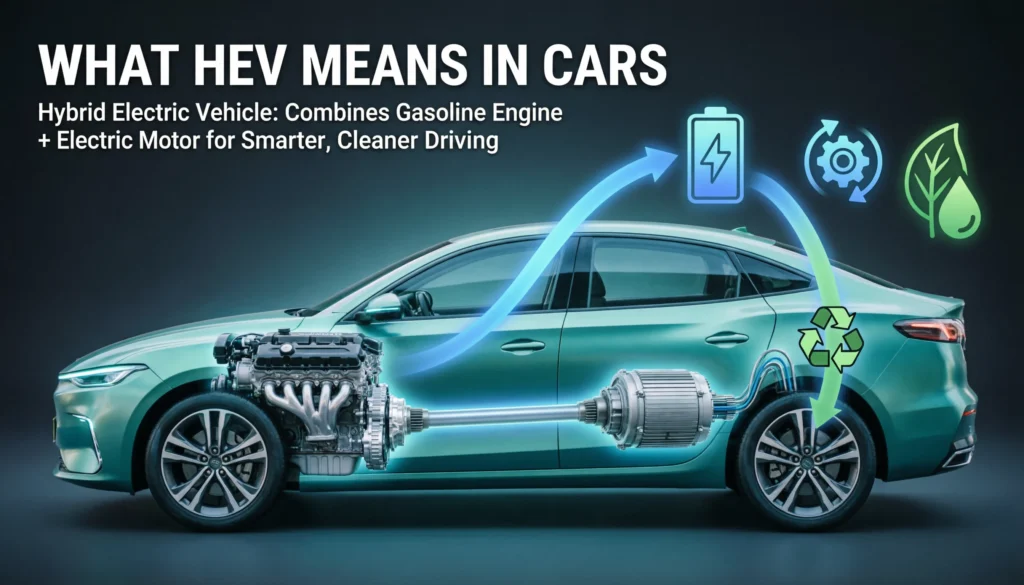
HEV in cars means Hybrid Electric Vehicle a vehicle that uses both an internal combustion engine and an electric motor to power the car, improving fuel efficiency and reducing emissions without requiring external charging.
Hybrid technology has become one of the biggest innovations in the modern automotive world. As fuel prices rise and environmental concerns grow, car manufacturers are developing smarter and cleaner ways to power vehicles. One abbreviation you may often see when researching eco-friendly vehicles is HEV.
If you’re browsing car specifications, comparing hybrid models, or simply curious about green vehicle technology, you might ask: What does HEV mean in cars?
Understanding this term helps you better evaluate modern vehicles and choose the right type of car for your lifestyle.
Origin and Meaning of HEV in Cars
What Does HEV Stand For?
HEV stands for Hybrid Electric Vehicle.
An HEV (Hybrid Electric Vehicle) is a type of car that uses both a gasoline engine and an electric motor to power the vehicle. These two systems work together to improve fuel efficiency, reduce emissions, and enhance overall performance.
Unlike fully electric vehicles, HEVs do not need to be plugged in to charge. Instead, they recharge their batteries through:
- Regenerative braking
- The gasoline engine
- Energy captured while driving
Because of this system, HEVs are considered one of the most convenient forms of hybrid technology.
Why the Term Became Popular
The term HEV gained popularity in the late 1990s and early 2000s when hybrid cars began entering the mainstream market. Automakers wanted to distinguish traditional hybrids from newer electric technologies.
Several factors contributed to the popularity of HEVs:
- Rising fuel prices
- Stricter emission regulations
- Increased environmental awareness
- Advances in battery technology
Today, many major automakers offer hybrid vehicles as part of their lineup.
How HEV Technology Works
The Hybrid Powertrain Explained
A Hybrid Electric Vehicle combines two power sources:
- Internal Combustion Engine (ICE) – Uses gasoline like traditional cars.
- Electric Motor – Runs on electricity stored in a battery.
These components work together depending on driving conditions.
Driving Modes in an HEV
Most hybrid vehicles switch automatically between power sources.
Common operating modes include:
- Electric-only mode – Used during low-speed driving.
- Gasoline engine mode – Used at higher speeds.
- Combined power mode – Both engine and motor work together for acceleration.
- Regenerative braking mode – Captures energy while braking.
This smart switching system is what makes HEVs highly efficient.
Regenerative Braking
One of the most important features of HEVs is regenerative braking.
When you brake, instead of wasting energy as heat, the system:
- Converts braking energy into electricity
- Stores it in the battery
- Reuses it later to power the electric motor
This process increases fuel efficiency and reduces energy waste.
Real-World Usage of HEV
Where You’ll See the Term HEV
The abbreviation HEV commonly appears in:
- Car specifications
- Auto reviews
- Manufacturer websites
- Vehicle badges
- Automotive news articles
For example, you might see:
- Model name: “Hybrid HEV version”
- Specification: “2.5L HEV powertrain”
- Dealership listing: “Available in petrol or HEV variant”
Example Sentences
Here are some common real-world examples:
Friendly tone
- “I’m thinking of buying an HEV because it saves fuel in city driving.”
Neutral tone
- “The HEV model offers better fuel efficiency than the standard gasoline version.”
Enthusiastic tone
- “This new HEV gets incredible mileage! 🚗⚡”
Slightly dismissive tone
- “I prefer a full EV instead of an HEV.”
Examples of Popular HEV Cars
Many well-known car models use hybrid technology.
Hybrid Vehicle Examples
| Car Model | Type | Fuel Efficiency Benefit | Key Feature |
|---|---|---|---|
| Toyota Prius | HEV | Extremely high | Pioneer hybrid model |
| Toyota Camry Hybrid | HEV | 40+ MPG | Smooth hybrid system |
| Honda Accord Hybrid | HEV | Excellent highway economy | Powerful hybrid engine |
| Hyundai Sonata Hybrid | HEV | Long range | Solar roof option |
| Kia Niro Hybrid | HEV | Compact crossover | Efficient urban driving |
These vehicles combine reliability with lower fuel consumption.
Advantages of HEV Vehicles
Hybrid Electric Vehicles offer several practical benefits.
Better Fuel Economy
HEVs consume significantly less fuel than conventional gasoline vehicles.
This is especially noticeable in:
- City traffic
- Stop-and-go driving
- Urban commuting
Lower Emissions
Because electric power assists the gasoline engine, HEVs produce:
- Less carbon dioxide
- Lower air pollution
- Reduced environmental impact
No Charging Required
Unlike plug-in hybrids or electric cars, HEVs do not require external charging.
This makes them convenient for drivers who:
- Don’t have home chargers
- Live in apartments
- Drive long distances
Smooth Driving Experience
Hybrid systems provide:
- Quiet acceleration
- Smooth transitions between power sources
- Instant torque from the electric motor
Disadvantages of HEV Vehicles
While HEVs are efficient, they do have some drawbacks.
Higher Purchase Price
Hybrid vehicles usually cost more upfront than gasoline models.
However, fuel savings can offset the cost over time.
Battery Replacement Costs
Hybrid batteries can be expensive if replacement becomes necessary, though they typically last many years.
Less Electric Range
Unlike plug-in hybrids or EVs, HEVs cannot drive long distances using electricity alone.
Comparison With Similar Vehicle Terms
Understanding HEV becomes easier when compared with other vehicle technologies.
Hybrid vs Electric Vehicle Types
| Term | Meaning | Charging Required | Power Source |
|---|---|---|---|
| HEV | Hybrid Electric Vehicle | No | Gas engine + electric motor |
| PHEV | Plug-in Hybrid Electric Vehicle | Yes | Larger battery + gasoline engine |
| EV | Electric Vehicle | Yes | Fully electric motor |
| MHEV | Mild Hybrid Electric Vehicle | No | Small electric assist |
Key Differences
Compare HEV vs PHEV
- HEV charges itself automatically
- PHEV requires plugging in for full benefits
Using HEV vs EV
- HEV still uses gasoline
- EV runs completely on electricity
Difference HEV vs MHEV
- MHEV only assists the engine
- HEV can drive short distances using electric power
Alternate Meanings of HEV
Although HEV usually refers to Hybrid Electric Vehicle, the abbreviation can occasionally mean other things depending on context.
Other Possible Meanings
| Industry | Meaning |
|---|---|
| Medicine | Hemorrhagic Enteritis Virus |
| Aviation | High-Explosive Vehicle |
| Engineering | High Energy Vehicle |
However, in the automotive world, HEV almost always means Hybrid Electric Vehicle.
Polite or Professional Alternatives
Instead of using the abbreviation HEV, you can also say:
- Hybrid vehicle
- Hybrid electric car
- Gas-electric hybrid
- Self-charging hybrid
- Hybrid powertrain vehicle
For example:
Instead of:
“I’m buying an HEV.”
You could say:
“I’m planning to buy a hybrid electric vehicle.”
Labeled Example Table: HEV Driving Scenarios
The table below shows how hybrid systems behave in different situations.
| Driving Situation | Power Source Used | Result |
|---|---|---|
| Starting the car | Electric motor | Quiet start |
| City traffic | Electric + gasoline | Maximum efficiency |
| Highway cruising | Gasoline engine | Consistent power |
| Hard acceleration | Engine + electric motor | Strong performance |
| Braking | Regenerative braking | Battery recharges |
This intelligent switching is what makes HEVs so efficient.
FAQs
What does HEV mean in cars?
HEV stands for Hybrid Electric Vehicle. It refers to a car that uses both a gasoline engine and an electric motor to power the vehicle, improving fuel efficiency and reducing emissions.
Is an HEV the same as a hybrid car?
Yes, an HEV is simply the technical abbreviation for a hybrid electric vehicle. Most standard hybrid cars you see on the road are classified as HEVs.
Do HEV cars need to be plugged in to charge?
No, HEV vehicles do not require external charging. Their batteries recharge automatically through regenerative braking and energy generated by the gasoline engine.
What is the difference between HEV and PHEV?
The main difference is charging. HEVs charge themselves automatically, while PHEVs (Plug-in Hybrid Electric Vehicles) can be plugged in to charge their larger batteries and can drive longer distances on electricity alone.
Are HEV cars fuel efficient?
Yes, HEVs are designed to improve fuel economy. Many hybrid vehicles consume significantly less fuel than traditional gasoline cars, especially during city driving.
Can HEV vehicles run only on electricity?
Yes, but only for short distances and low speeds. The electric motor usually assists the gasoline engine rather than replacing it completely.
How long do hybrid (HEV) batteries last?
Most HEV batteries last 8 to 15 years depending on the vehicle model, driving habits, and maintenance. Many manufacturers also provide long battery warranties.
Are HEV vehicles expensive to maintain?
Maintenance costs for HEVs are generally similar to regular gasoline cars. However, hybrid battery replacement can be expensive if needed after many years of use.
Conclusion
Understanding what HEV means in cars helps you better navigate the growing world of modern vehicle technology.
A Hybrid Electric Vehicle (HEV) combines the reliability of a gasoline engine with the efficiency of an electric motor. This smart combination allows drivers to enjoy:
- Better fuel economy
- Lower emissions
- Smooth and quiet driving
- No need for external charging
HEVs serve as a practical middle ground between traditional gasoline cars and fully electric vehicles. For many drivers, they offer the best balance of convenience, efficiency, and environmental responsibility.
If you’re considering a more fuel-efficient car but aren’t ready for a fully electric vehicle, an HEV might be the perfect option.
Discover More Related Articles:
- PFP Mean in Text: Complete Guide for Social Media Users (2026)
- Shabbat Shalom Mean in English: Usage, and Significance in 2026

James Anderson is an experienced content writer and language researcher who focuses on explaining word meanings, definitions, slang terms, and modern expressions. He writes for WordNexy.com, where his articles are designed to provide accurate meanings, practical usage examples, and easy-to-understand explanations for readers worldwide.