Definition:
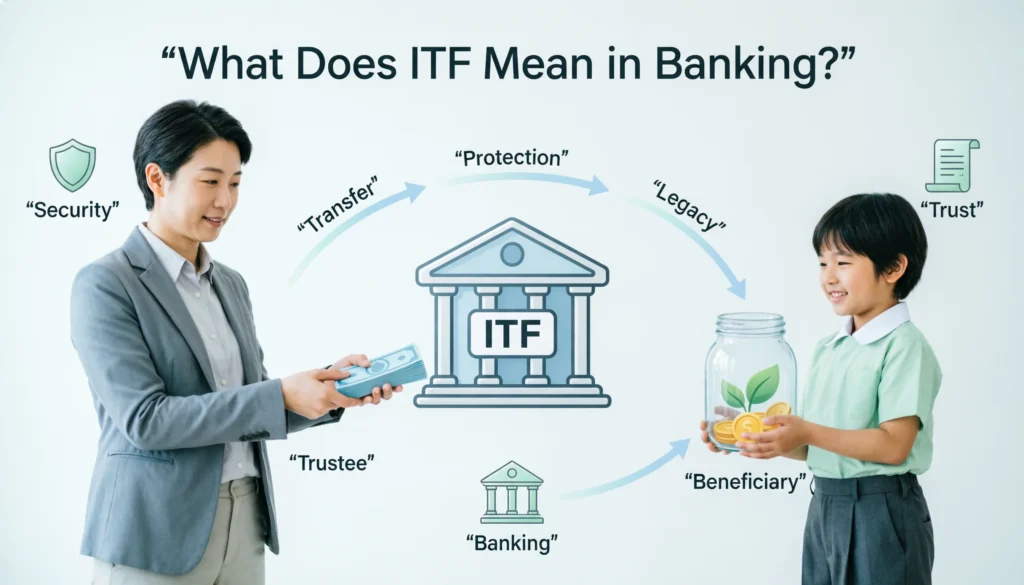
ITF in banking stands for “In Trust For.” It refers to a type of account where one person (the account holder) manages money on behalf of another person (the beneficiary).
The funds are legally owned by the beneficiary but controlled by the trustee until certain conditions are met, such as age or specific instructions.
If you’ve ever seen “ITF” next to a name on a bank account or statement, you might have wondered what it actually means. While it looks like just another banking abbreviation, ITF plays a crucial role in financial planning, inheritance, and money management.
From parents saving for their children to individuals planning their estate, ITF accounts are widely used across the banking world. In this guide, you’ll learn everything—from the meaning and origin to real-life examples, comparisons, and practical usage tips.
What Does ITF Mean in Banking?
In simple terms, an ITF (In Trust For) account is a financial account set up by one person (called the trustee) for the benefit of another person (called the beneficiary).
Key Components:
- Trustee (Account Holder): Controls the account
- Beneficiary: Person who receives the funds
- Bank/Financial Institution: Holds the account
How It Works:
- The trustee deposits money into the account
- The funds are managed on behalf of the beneficiary
- The beneficiary receives the funds when conditions are met (e.g., reaching adulthood)
👉 Think of it like this:
“Ali ITF Sara” = Ali manages money for Sara until she is eligible to access it.
Origin and Popularity of ITF Accounts
The concept of ITF accounts comes from trust law, which has existed for centuries. Traditionally, trusts were used by wealthy families to manage assets across generations. Over time, banks simplified this idea into accessible products like ITF accounts.
Why ITF Became Popular:
- Easy way to transfer wealth without complex legal procedures
- Avoids probate (in many cases)
- Ideal for parents saving for children
- Useful for estate planning
Today, ITF accounts are commonly used in countries like the U.S., Canada, and parts of Europe, though similar structures exist globally under different names.
Real-World Usage of ITF in Banking
ITF accounts are practical and widely used in everyday financial situations.
Common Use Cases:
- 👶 Saving for Children: Parents open ITF accounts for minors
- 🏡 Estate Planning: Ensures smooth transfer of funds after death
- 💰 Gift Management: Holding money for someone until a future date
- 🎓 Education Funds: Saving for tuition or future expenses
Examples of ITF in Context
Friendly Tone 😊
- “I opened an ITF account for my daughter so she can use it for college.”
Neutral Tone 📘
- “The account is registered as ITF, meaning the funds are held in trust for the beneficiary.”
Slightly Formal / Legal Tone ⚖️
- “The trustee maintains control over the ITF account until the beneficiary meets the specified conditions.”
ITF Account Example Table
| Scenario | Trustee | Beneficiary | Purpose |
|---|---|---|---|
| Parent saving money | Father | Child | Education fund |
| Gift holding | Uncle | Niece | Future financial support |
| Estate planning | Individual | Family member | Asset transfer after death |
| Long-term savings | Guardian | Minor | Financial security |
Key Features of ITF Accounts
Advantages:
- ✔ Simple setup
- ✔ Avoids probate (in many cases)
- ✔ Clear beneficiary designation
- ✔ Useful for minors
Limitations:
- ❌ Limited control once beneficiary is named
- ❌ Cannot always change beneficiary easily
- ❌ Rules vary by country and bank
ITF vs Other Banking Terms
Understanding ITF becomes easier when compared with similar financial terms.
Comparison Table
| Term | Meaning | Key Difference |
|---|---|---|
| ITF (In Trust For) | Account held for a beneficiary | Trustee controls funds |
| POA (Power of Attorney) | Authority to manage someone’s finances | No ownership transfer |
| Joint Account | Shared account between two people | Both have equal access |
| TOD (Transfer on Death) | Assets transfer after death | No control during lifetime |
Alternate Meanings of ITF
While ITF in banking means “In Trust For,” the abbreviation can have different meanings in other contexts:
- International Tennis Federation (Sports)
- International Transport Forum (Logistics)
- Intelligent Traffic Flow (Technology)
👉 Always rely on context—in banking, ITF almost always means “In Trust For.”
Professional and Polite Alternatives
If you want to avoid abbreviations in formal communication, you can use:
- “In Trust For account”
- “Trust account for beneficiary”
- “Custodial account”
- “Beneficiary-managed account”
These sound more professional in emails, documents, or financial discussions.
Practical Tips for Using ITF Accounts
- 📌 Clearly name the beneficiary
- 📌 Understand withdrawal rules
- 📌 Check local banking regulations
- 📌 Keep documentation updated
- 📌 Consult a financial advisor for large sums
FAQs:
1. What does ITF stand for in banking?
ITF stands for “In Trust For,” meaning funds are held by one person for another.
2. Who owns the money in an ITF account?
The beneficiary legally owns the money, but the trustee controls it.
3. Can an ITF account be changed?
It depends on the bank and local laws; some allow changes, others don’t.
4. Is an ITF account the same as a trust fund?
Not exactly. ITF is a simplified version of a trust, usually managed through a bank.
5. What happens to an ITF account after death?
The funds typically go directly to the beneficiary without probate.
6. Can minors have ITF accounts?
Yes, ITF accounts are commonly used for children.
7. Is ITF available in all countries?
Not always by the same name, but similar structures exist worldwide.
8. What is the difference between ITF and a joint account?
In ITF, only the trustee controls funds; in joint accounts, both parties have access.
Conclusion:
ITF, or “In Trust For,” is a simple yet powerful banking tool designed to manage money for someone else. Whether you’re saving for your child, planning your estate, or organizing future financial gifts, ITF accounts offer clarity and convenience.
Quick Recap:
- ITF = In Trust For
- Used for managing funds for a beneficiary
- Common in savings, estate planning, and gifting
- Offers simplicity but has some limitations
👉 Final Tip: Always check with your bank or financial advisor before opening an ITF account, as rules and benefits can vary.
Discover More Related Artices:

Sarah Williams is the passionate author behind WordNexy.com, dedicated to creating content that informs, inspires, and sparks curiosity. With a love for words and storytelling, she transforms ideas into meaningful articles that educate, entertain, and leave a lasting impression on every reader.