📌Definition
“-itis” is a medical suffix that means inflammation of a body part, organ, or tissue. It is commonly added to the name of a body structure to describe a condition involving swelling, pain, redness, or irritation.
If you’ve ever heard terms like arthritis, tonsillitis, or bronchitis, you’ve already encountered one of the most important suffixes in medical language: “-itis.”
Understanding what “-itis” means can instantly help you decode hundreds of medical terms even if you’re not a doctor. Whether you’re reading a prescription, researching symptoms online, or studying biology, this tiny suffix carries a big meaning.
In this guide, you’ll learn everything about what “-itis” means in medical terms, including its origin, real-life usage, examples, comparisons, and practical tips to recognize it easily.
What Does “-itis” Mean in Medical Terms?
At its core, “-itis” simply means inflammation.
Inflammation is your body’s natural response to injury, infection, or irritation. It usually involves:
- 🔴 Redness
- 🔥 Heat
- 💧 Swelling
- 😖 Pain
- ⚠️ Loss of function (in severe cases)
When you see a word ending in “-itis,” it tells you that something in the body is inflamed.
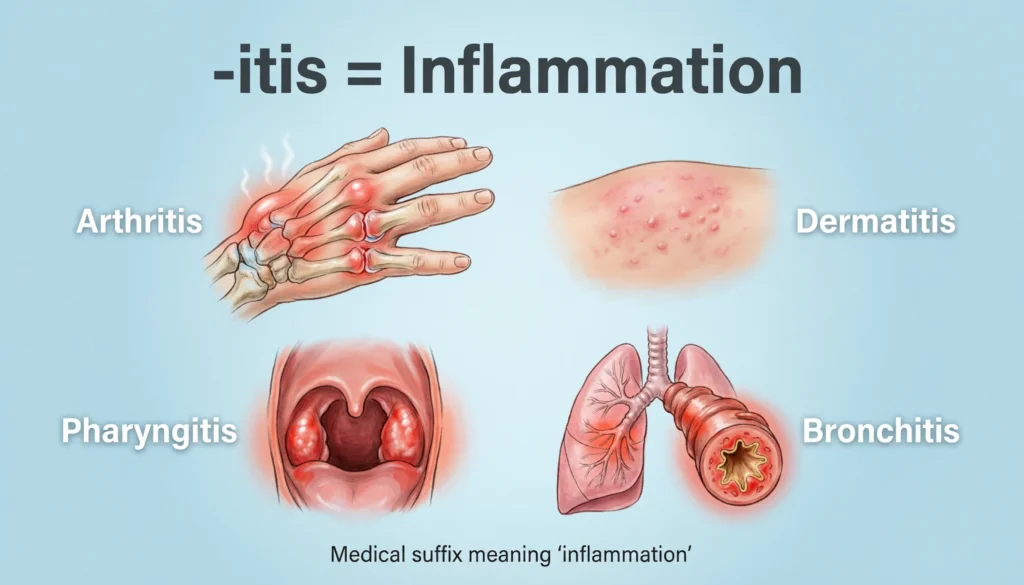
Visual Examples of Common “-itis” Conditions

These images represent how inflammation can affect different parts of the body from joints to skin to lungs.
Origin and History of “-itis”
The suffix “-itis” comes from Ancient Greek, specifically from the word “itis,” which means inflammation or disease affecting a specific part.
Key Points About Its Origin:
- 📚 Rooted in Greek medical terminology
- 🏥 Widely adopted in Latin-based medical language
- 📖 Still used globally in modern medicine
Over time, “-itis” became a universal medical suffix, making it easier for healthcare professionals worldwide to communicate clearly and consistently.
Why Is “-itis” So Common in Medicine?
There’s a simple reason: inflammation is one of the body’s most common responses to illness or injury.
Doctors frequently use “-itis” because it:
- Clearly identifies the problem (inflammation)
- Points to the location of the issue
- Helps in quick diagnosis and communication
Common Medical Terms Ending in “-itis”
Here are some of the most frequently used “-itis” terms:
| Medical Term | Meaning | Affected Area |
|---|---|---|
| Arthritis | Inflammation of joints | Joints |
| Tonsillitis | Inflammation of tonsils | Throat |
| Bronchitis | Inflammation of bronchial tubes | Lungs |
| Gastritis | Inflammation of stomach lining | Stomach |
| Dermatitis | Inflammation of the skin | Skin |
| Appendicitis | Inflammation of the appendix | Lower abdomen |
| Hepatitis | Inflammation of the liver | Liver |
| Sinusitis | Inflammation of sinuses | Face/head |
How to Understand Medical Terms with “-itis”
Learning to decode these words is easier than you think.
Simple Formula:
👉 Root Word (Body Part) + “-itis” = Inflammation of that part
Examples:
- Arthr (joint) + itis → Arthritis
- Derm (skin) + itis → Dermatitis
- Bronch (airways) + itis → Bronchitis
💡 Pro Tip: If you know the root, you can guess the meaning even if you’ve never seen the word before.
Real-World Usage of “-itis”
“–itis” is used in medical, educational, and everyday conversations.
🏥 Medical Setting (Formal Tone)
- “The patient has gastritis caused by bacterial infection.”
- “Symptoms suggest early-stage appendicitis.”
👩⚕️ Educational Context (Neutral Tone)
- “Dermatitis refers to inflammation of the skin.”
- “Hepatitis affects liver function.”
😄 Informal / Humorous Use
Sometimes people jokingly use “-itis”:
- “I’ve got texting-itis 📱😂”
- “He has lazy-itis today!”
⚠️ Note: These informal uses are not medically correct, but they show how popular the suffix has become in everyday language.
Types of Inflammation Associated with “-itis”
Not all “-itis” conditions are the same. Inflammation can vary:
- Acute → Short-term (e.g., appendicitis)
- Chronic → Long-lasting (e.g., arthritis)
- Infectious → Caused by bacteria/viruses
- Non-infectious → Caused by injury or autoimmune response
Comparison: “-itis” vs Other Medical Suffixes
Understanding “-itis” becomes easier when compared to similar suffixes:
| Suffix | Meaning | Example | Explanation |
|---|---|---|---|
| -itis | Inflammation | Arthritis | Swelling of joints |
| -algia | Pain | Neuralgia | Nerve pain |
| -oma | Tumor or growth | Lipoma | Fatty tumor |
| -osis | Condition (often abnormal) | Dermatosis | Skin condition (not always inflamed) |
| -ectomy | Surgical removal | Appendectomy | Removal of appendix |
Alternate Meanings of “-itis”
While “-itis” is mainly medical, it can have informal meanings:
Informal Use:
- Used humorously to describe an obsession or habit
- “Shopping-itis” 🛍️
- “Travel-itis” ✈️
Important Note:
👉 These uses are figurative and not used in professional healthcare.
Polite or Professional Alternatives
Instead of always using technical terms, doctors or communicators may simplify:
| Medical Term | Simple Alternative |
|---|---|
| Tonsillitis | Inflamed tonsils |
| Dermatitis | Skin inflammation |
| Gastritis | Stomach irritation/inflammation |
💬 This helps patients better understand their condition without confusion.
Labeled Example Table: Symptoms of Common “-itis” Conditions
| Condition | Common Symptoms | Severity Level |
|---|---|---|
| Arthritis | Joint pain, stiffness, swelling | Moderate–Severe |
| Bronchitis | Cough, mucus, chest discomfort | Mild–Moderate |
| Dermatitis | Itching, redness, rash | Mild–Moderate |
| Appendicitis | Sharp abdominal pain, fever, nausea | Severe ⚠️ |
| Sinusitis | Facial pressure, headache, congestion | Mild–Moderate |
Tips to Easily Recognize “-itis” Words
- ✅ Look for the “-itis” ending
- ✅ Identify the root word (body part)
- ✅ Think “inflammation” immediately
- ✅ Use context clues (symptoms, location)
FAQs
1. What does “-itis” literally mean?
It literally means inflammation of a body part or tissue.
2. Is every “-itis” condition serious?
No. Some are mild (like dermatitis), while others can be serious (like appendicitis).
3. Can “-itis” be caused by infections?
Yes. Many cases are caused by bacteria, viruses, or fungi.
4. What is the difference between “-itis” and “-osis”?
“-itis” means inflammation, while “-osis” refers to a condition (not always inflammatory).
5. Is arthritis always due to aging?
Not always. It can also result from autoimmune diseases or injuries.
6. Can “-itis” go away on its own?
Some mild cases do, but others require medical treatment.
7. Why do doctors use “-itis” so often?
Because it clearly indicates inflammation and helps standardize medical language.
8. Is “-itis” used outside medicine?
Yes, informally for humor or exaggeration (e.g., “phone-itis”), but not medically.
Conclusion
In simple terms, “-itis” means inflammation, and it’s one of the easiest ways to understand medical terminology quickly. Once you recognize this suffix, you can break down complex words and identify what part of the body is affected.
From everyday conditions like dermatitis to more serious ones like appendicitis, the suffix “-itis” helps doctors communicate clearly and efficiently. For you, it’s a powerful shortcut to better understanding symptoms, diagnoses, and health information.
From arthritis to bronchitis, this small suffix plays a major role in medicine and now you can recognize it with confidence.
Discover More Related Articles:

James Anderson is an experienced content writer and language researcher who focuses on explaining word meanings, definitions, slang terms, and modern expressions. He writes for WordNexy.com, where his articles are designed to provide accurate meanings, practical usage examples, and easy-to-understand explanations for readers worldwide.