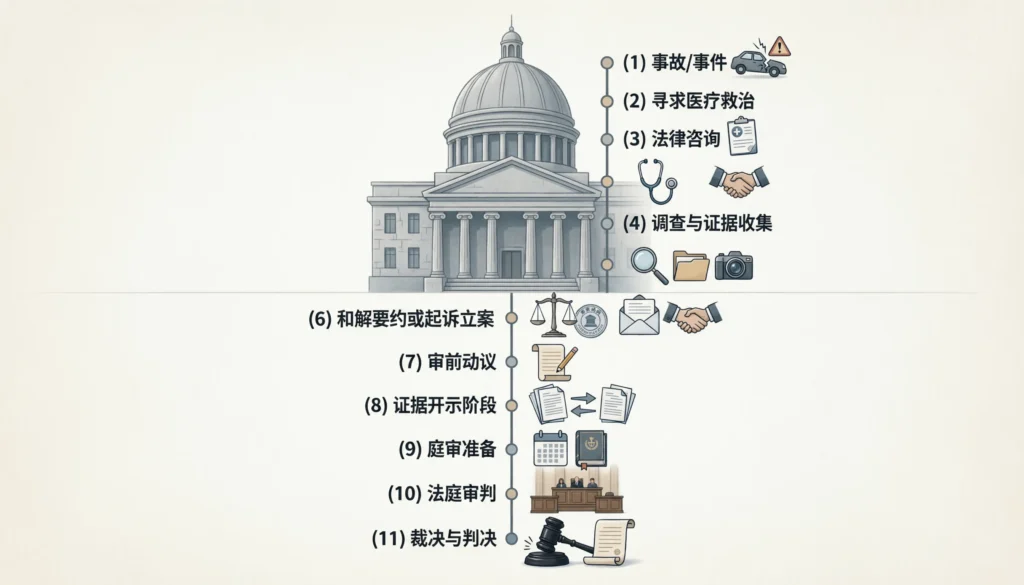
Litigation in a personal injury case is the formal legal process of resolving an injury-related dispute through the court system. It begins when a lawsuit is filed and can include discovery, motions, settlement negotiations, trial, and possible appeal.
If you’ve ever heard someone say, “This case is going to litigation,” it can sound intimidating like things just got serious (because they did). But litigation isn’t automatically a courtroom battle. It’s a structured process designed to determine responsibility and compensation when negotiations stall.
Understanding what litigation means in a personal injury case helps you know what to expect, what your rights are, and how cases actually move from claim to resolution.
Below, you’ll find a clear, friendly, and comprehensive guide that explains litigation step-by-step, why it happens, how it differs from settlement, and what it means for injured individuals in the real world.
What Is Litigation in a Personal Injury Case?
In personal injury law, litigation refers to pursuing compensation through the civil court system after an injury caused by negligence, recklessness, or intentional harm. It’s the legal pathway used when informal resolution like insurance negotiations fails to produce a fair outcome.
Key idea: Litigation is not just a trial. It’s the entire court-driven process from filing a lawsuit to final judgment or settlement.
Core components of litigation
- Filing a complaint (lawsuit)
- Serving legal papers to the defendant
- Discovery (evidence exchange)
- Pretrial motions and hearings
- Settlement discussions
- Trial (if necessary)
- Judgment and possible appeal
Why Litigation Happens in Personal Injury Cases
Most personal injury claims begin with an insurance claim. Litigation becomes necessary when there’s a breakdown in agreement. Common triggers include:
- Disputed liability: The defendant denies fault.
- Low settlement offers: Compensation doesn’t reflect medical costs, lost wages, or pain and suffering.
- Severe injuries: High-value claims often require formal legal review.
- Insurance delays or denial: Insurers may challenge coverage or causation.
- Complex evidence: Expert testimony or extensive documentation is needed.
In short, litigation is the mechanism that moves a disagreement from negotiation into a structured legal decision-making process.
Origin and Evolution of Litigation
The concept of litigation comes from the Latin word litigare, meaning “to dispute” or “to carry on a lawsuit.” Historically, civil litigation developed as societies needed formal systems to resolve private disputes fairly and consistently.
Why litigation remains central today
- It ensures due process and impartial review.
- It creates binding decisions enforceable by law.
- It encourages settlement fairness (because both sides know a trial is possible).
- It establishes legal precedents that shape future cases.
In personal injury law, litigation has grown alongside modern insurance systems, medical documentation, and consumer protections making it a cornerstone of how injury claims are resolved.
Step-by-Step: How Litigation Works in a Personal Injury Case
Litigation follows a structured path. While timelines vary, the phases below are typical.
1) Filing the Complaint
The plaintiff files a formal legal document outlining:
- The facts of the incident
- The legal basis for liability
- The damages requested
2) Service of Process
The defendant is officially notified and given time to respond.
3) Defendant’s Answer
The defendant admits or denies allegations and may raise defenses.
4) Discovery Phase
Both sides gather and exchange evidence:
- Depositions (sworn testimony)
- Medical records and bills
- Accident reports
- Expert opinions
- Interrogatories (written questions)
This phase often determines the strength of each side’s case.
5) Pretrial Motions
Attorneys may ask the court to:
- Dismiss parts of the case
- Exclude certain evidence
- Decide legal issues before trial
6) Settlement Negotiations
Many cases settle during or after discovery when facts are clearer.
7) Trial
If no settlement occurs, the case proceeds to trial where a judge or jury determines liability and damages.
8) Judgment and Appeal
A final decision is issued. Either side may appeal under certain circumstances.
Litigation vs. Settlement: What’s the Difference?
Understanding this comparison helps clarify when litigation is used and why.
| Aspect | Litigation | Settlement |
|---|---|---|
| Decision-maker | Judge or jury | Parties agree voluntarily |
| Process | Formal court procedure | Negotiated resolution |
| Timeframe | Often longer | Typically faster |
| Cost | Higher legal expenses | Lower costs overall |
| Outcome certainty | Unpredictable | More predictable |
| Public record | Yes | Usually private |
| Pressure level | High stakes ⚖️ | Collaborative tone 🤝 |
Important: Filing a lawsuit doesn’t eliminate settlement. Many litigated cases still settle before trial.
Real-World Examples of Litigation in Personal Injury
Friendly/neutral tone example 🙂
A driver runs a red light and causes a serious collision. The injured person files an insurance claim. The insurer disputes the severity of injuries and offers minimal compensation. The injured party files a lawsuit. During discovery, medical experts confirm long-term impairment. The case settles before trial.
Professional tone example
A construction worker sustains injuries due to defective equipment. Liability is contested. After expert analysis and depositions, the court denies a dismissal motion. The parties reach a structured settlement.
Negative/dismissive tone example 😬
“Take it to court if you want we’re not paying.”
When negotiations stall like this, litigation becomes the only viable path forward.
Types of Personal Injury Cases That Commonly Go to Litigation
- Motor vehicle accidents
- Medical negligence
- Product liability claims
- Workplace injury disputes
- Slip and fall incidents
- Wrongful death claims
Cases involving catastrophic injuries or permanent disability are especially likely to enter litigation due to higher damages and contested liability.
Key Legal Terms Related to Litigation
| Term | Meaning | How It Relates |
|---|---|---|
| Plaintiff | Injured party filing suit | Initiates litigation |
| Defendant | Party accused of causing harm | Responds to claim |
| Damages | Monetary compensation | Central objective |
| Liability | Legal responsibility | Must be proven |
| Discovery | Evidence exchange phase | Builds the case |
| Deposition | Sworn testimony | Used as evidence |
| Motion | Formal court request | Shapes proceedings |
| Verdict | Trial decision | Final determination |
Litigation vs. Related Legal Concepts
Difference Litigation vs. Claim
- Claim: Initial request for compensation (often through insurance)
- Litigation: Formal court process when a claim isn’t resolved
Using Litigation vs. Lawsuit
- Lawsuit: The specific case filed in court
- Litigation: The broader process that follows
Comparing Litigation vs. Arbitration
- Litigation: Public court process with judge/jury
- Arbitration: Private decision by a neutral arbitrator
Litigation vs. Mediation
- Litigation: Binding court decision
- Mediation: Facilitated negotiation without imposed outcome
Tone and Usage in Everyday Language
You’ll hear the word “litigation” used in different contexts. Here’s how tone can change meaning:
- Neutral: “The case is currently in litigation.”
- Professional: “Litigation was initiated after negotiations failed.”
- Serious/urgent: “If they won’t settle, we’ll proceed to litigation.”
- Dismissive: “Go ahead and litigate it won’t change anything.”
The word often signals escalation from negotiation to formal legal action.
Practical Tips If Your Case Enters Litigation
- Stay organized: Keep medical records, receipts, and communications.
- Follow treatment plans: Medical consistency supports your claim.
- Be truthful and consistent: Credibility matters in depositions and testimony.
- Understand timelines: Litigation can take months or years.
- Consider settlement carefully: Trial isn’t always the best outcome.
Alternate Meanings of “Litigation”
Outside personal injury law, litigation simply refers to any legal dispute resolved through courts, including:
- Contract disputes
- Employment conflicts
- Business lawsuits
- Property disagreements
The core idea remains the same: formal dispute resolution through the judicial system.
Professional or Polite Alternatives to the Word “Litigation”
Depending on context, you might use:
- “Legal proceedings”
- “Court action”
- “Formal legal process”
- “Civil lawsuit process”
- “Judicial resolution”
These alternatives can soften tone in professional communication.
Common Myths About Litigation in Personal Injury Cases
Myth 1: Litigation always means a trial.
Reality: Many litigated cases settle before reaching a courtroom.
Myth 2: Litigation guarantees higher compensation.
Reality: Outcomes vary; trials carry risk.
Myth 3: Litigation is only for major injuries.
Reality: It depends on disputes, not just severity.
Myth 4: Filing a lawsuit is aggressive.
Reality: It’s a standard legal tool to resolve disputes.
FAQs
1. Does litigation mean going to court?
Not necessarily. Litigation means your case is in the court system, but it can still settle anytime before reaching trial.
2. How long does litigation take in a personal injury case?
It varies. Some cases take a few months, while complex cases can take several years, depending on the evidence and court schedules.
3. Is litigation expensive?
It can cost more than a simple settlement, but many personal injury lawyers work on contingency fees, meaning you only pay if you win.
4. What happens after a lawsuit is filed?
The case moves into discovery, pretrial motions, and possible settlement discussions before it might go to trial.
5. Can a case settle after litigation begins?
Yes. Many cases actually settle during litigation once all the evidence is reviewed.
6. What is the difference between litigation and suing someone?
Suing someone is the act of filing the lawsuit. Litigation is the entire legal process that follows the filing.
7. Who decides the outcome in litigation?
If the case goes to trial, a judge or jury determines who is liable and what compensation is awarded.
8. Do all personal injury cases require litigation?
No. Many personal injury claims are resolved through insurance negotiations without ever filing a lawsuit.
Conclusion:
Litigation in a personal injury case is the structured legal pathway used when informal resolution fails. It transforms a dispute into a formal process governed by evidence, procedure, and judicial oversight. While the word can sound intimidating, it simply represents a method for reaching a fair, enforceable outcome.
If negotiations hit a wall, litigation isn’t the end of the road it’s the legal system stepping in to provide clarity, accountability, and resolution.
Discover More Related Articles:
- Understanding FIP in Baseball: Definition, Formula, and Uses (2026)
- TW in Jewelry Meaning: What It Really Stands For (2026)

Amanda Lewis is a professional content writer and word-meaning researcher who specializes in explaining definitions, slang, abbreviations, and modern language terms. She writes for WordNexy.com, where she creates clear, accurate, and reader-friendly articles to help users understand word meanings and proper usage. Her work is especially useful for students, writers, and online readers seeking quick and reliable explanations.