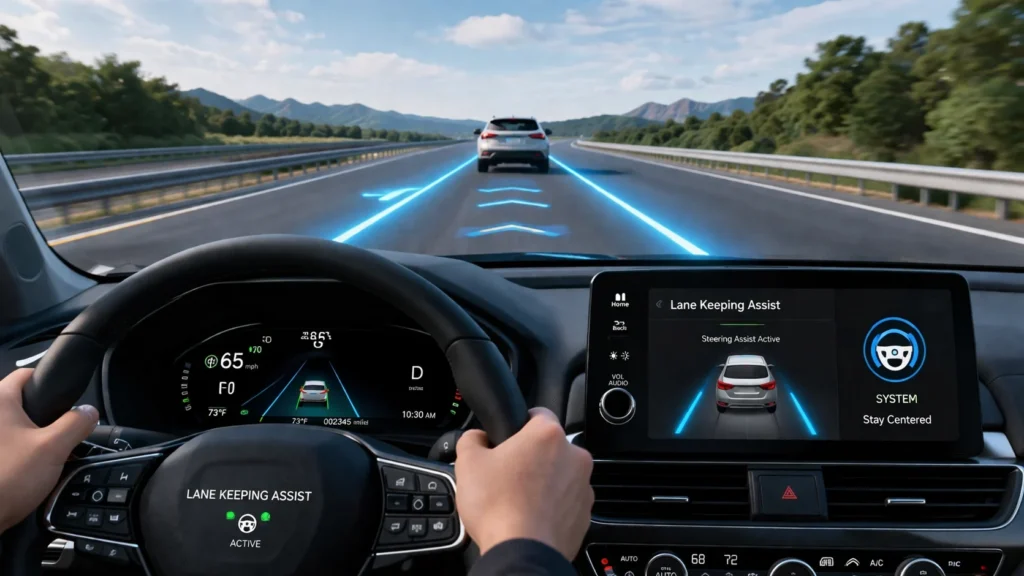
Definition:
LKAS (Lane Keeping Assist System) is an advanced driver-assistance feature in modern cars that helps keep the vehicle centered within its lane by automatically making small steering adjustments when it detects unintentional drifting.
Imagine driving on a long highway, your hands on the wheel, but the car subtly helps you stay perfectly centered in your lane. Sounds futuristic? It’s already here and it’s called LKAS.
As vehicles become smarter and safer, features like Lane Keeping Assist System (LKAS) are quickly becoming standard. Whether you’re buying a new car, researching safety features, or simply curious about dashboard alerts, understanding what LKAS means in a car can make you a more informed and confident driver.
In this guide, you’ll learn everything about LKAS from how it works to when you should trust it (and when you shouldn’t).
What Is LKAS in a Car?
LKAS (Lane Keeping Assist System) is part of a vehicle’s Advanced Driver Assistance Systems (ADAS). It uses cameras and sensors to monitor lane markings on the road and gently steer the vehicle to keep it centered.
Key Functions of LKAS:
- Detects lane markings using front-facing cameras
- Alerts the driver if the car drifts unintentionally
- Automatically applies small steering corrections
- Works best on highways and well-marked roads
👉 Think of LKAS as a co-pilot it assists you but doesn’t replace you.
Origin and Evolution of LKAS
The concept of LKAS comes from the broader field of automotive safety innovation.
Timeline:
- Early 2000s: Basic lane departure warning systems introduced
- Mid-2000s: LKAS added with active steering correction
- Today: Integrated with semi-autonomous driving systems
Car manufacturers like Honda, Toyota, and Hyundai popularized LKAS by including it in everyday vehicles not just luxury models.
Why It Became Popular:
- Increased focus on road safety
- Reduction in accidents caused by lane drifting
- Growing demand for smart driving technology
How Does LKAS Work?
LKAS relies on a combination of technology:
Components:
- Front Camera: Mounted near the windshield
- Sensors: Track vehicle position and movement
- Control System: Processes data and decides when to intervene
Step-by-Step Process:
- The camera scans road lane markings
- The system detects if the car is drifting
- LKAS sends a warning (visual, sound, or vibration)
- If needed, it gently adjusts the steering
⚠️ Important: LKAS works best when lane markings are clearly visible.
Real-World Usage of LKAS
LKAS is especially useful in everyday driving situations:
Common Scenarios:
- Long highway drives
- Traffic congestion
- Driver fatigue situations
Example Situations:
| Scenario | What LKAS Does | Tone |
|---|---|---|
| You drift slightly while distracted | Steering gently corrects direction | Friendly 😊 |
| You change lanes without signaling | Warning alert triggers | Neutral ⚠️ |
| You ignore repeated alerts | System may disengage | Slightly strict ❗ |
👉 LKAS is helpful but it expects you to stay alert and in control.
Examples of LKAS in Action
Friendly Tone 😊
You’re cruising on a highway, and your car gently nudges you back into your lane. Smooth and helpful!
Neutral Tone ⚠️
You drift slightly without signaling. The system gives a beep and a dashboard alert.
Negative/Dismissive Tone ❗
You repeatedly ignore alerts. The system may deactivate and require manual control.
Benefits of LKAS
Safety Advantages:
- Reduces unintentional lane departures
- Helps prevent accidents
- Supports tired or distracted drivers
Convenience Benefits:
- Makes long drives less stressful
- Improves driving confidence
- Works seamlessly in modern vehicles
Limitations of LKAS
Despite its advantages, LKAS isn’t perfect:
- ❌ Doesn’t work well on faded or unclear lane markings
- ❌ May struggle in bad weather (rain, fog, snow)
- ❌ Not a substitute for driver attention
- ❌ Can be less effective on sharp curves
👉 Always keep your hands on the wheel and stay focused.
LKAS vs Similar Car Features
Understanding similar terms can help avoid confusion:
| Feature | Full Form | Function | Key Difference |
|---|---|---|---|
| LKAS | Lane Keeping Assist System | Actively steers car | Corrects direction |
| LDW | Lane Departure Warning | Alerts only | No steering help |
| LKA | Lane Keep Assist | Similar to LKAS | Naming varies by brand |
| Autopilot | Semi-autonomous system | Handles multiple tasks | More advanced |
Alternate Meanings of LKAS
While rare, LKAS may have other meanings in different contexts:
- In technology forums: Could refer to system abbreviations
- In informal use: Not commonly used outside automotive context
👉 However, in cars, LKAS almost always means Lane Keeping Assist System.
Polite or Professional Alternatives
If you’re writing or speaking professionally, you can say:
- Lane Keeping Assist System
- Lane Assist Feature
- Driver Assistance Technology
- Lane Centering System
Usage Tips for Drivers
How to Use LKAS Safely:
- Always keep hands on the steering wheel
- Use it mainly on highways
- Pay attention to alerts and warnings
- Keep windshield and sensors clean
Pro Tip:
Combine LKAS with adaptive cruise control for a smoother driving experience 🚘
FAQs
1. What does LKAS mean on a car dashboard?
It indicates that the Lane Keeping Assist System is active or ready to assist.
2. Is LKAS the same as autopilot?
No. LKAS only helps with steering, while autopilot systems handle multiple driving tasks.
3. Can I turn LKAS off?
Yes, most cars allow you to disable it via settings or a dashboard button.
4. Does LKAS work at all speeds?
Usually, it works best at moderate to high speeds, especially on highways.
5. Is LKAS safe to rely on completely?
No. It’s an assist feature not a replacement for the driver.
6. Why does LKAS stop working sometimes?
Poor lane visibility, bad weather, or sharp curves can affect performance.
7. Does LKAS drain battery or fuel?
No significant impact it uses minimal power.
8. Which cars have LKAS?
Many modern vehicles from brands like Honda, Toyota, Hyundai, and others include LKAS.
Conclusion:
LKAS is one of the most practical and helpful safety features in modern vehicles. It acts like a silent partner keeping you centered, alert, and safer on the road.
The Lane Keeping Assist System (LKAS) is a smart, practical safety feature designed to help drivers stay centered in their lane. It reduces the risk of unintentional drifting, especially on highways, and adds an extra layer of confidence for long drives.
Discover More Related Articles:

Amanda Lewis is a professional content writer and word-meaning researcher who specializes in explaining definitions, slang, abbreviations, and modern language terms. She writes for WordNexy.com, where she creates clear, accurate, and reader-friendly articles to help users understand word meanings and proper usage. Her work is especially useful for students, writers, and online readers seeking quick and reliable explanations.