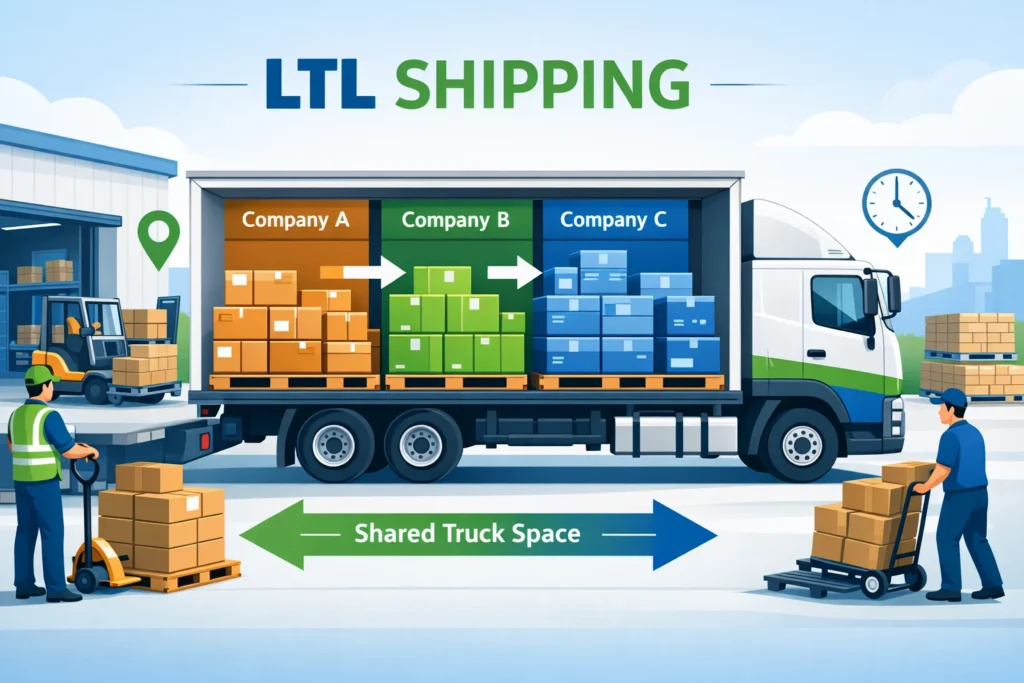
Definition
LTL (Less Than Truckload) shipping is a freight transportation method used to move relatively small shipments that do not require a full truck. Multiple shippers share space on the same truck, making it a cost-effective option for businesses shipping between 150 and 15,000 pounds.
Imagine you run a small business and need to ship products across the country—but you don’t have enough goods to fill an entire truck. Paying for a full truckload would be wasteful, right?
That’s exactly where LTL shipping comes in.
In today’s fast-paced logistics world, efficiency and cost savings are everything. Whether you’re an eCommerce seller, a manufacturer, or a distributor, understanding what LTL means in shipping can help you save money, optimize delivery, and scale your operations smarter.
Let’s break it down in a clear, simple, and practical way.
📦 What Does LTL Mean in Shipping?
LTL stands for Less Than Truckload. It refers to shipping freight that doesn’t fill an entire truck, so it’s combined with shipments from other businesses.
Key Characteristics of LTL Shipping:
- 📏 Shipment size: Typically 150–15,000 lbs
- 🚛 Shared truck space with multiple shipments
- 💰 Lower cost compared to full truckload (FTL)
- 📍 Multiple stops for pickups and deliveries
- 📦 Ideal for pallets or boxed freight
👉 In simple terms:
You pay only for the portion of the truck space you use.
🕰️ Origin and Evolution of LTL Shipping
LTL shipping has its roots in the early days of trucking in the 20th century, when logistics companies realized they could maximize profits by combining smaller shipments into one truck.
How It Evolved:
- Early 1900s: Small freight carriers begin consolidating loads
- Mid-century: Expansion of highway systems boosts LTL growth
- 1980s (Deregulation): Increased competition and lower prices
- Modern era: Advanced tracking, automation, and logistics software
Today, LTL is a core part of supply chain management, especially for small and mid-sized businesses.
📊 How LTL Shipping Works

Understanding the process helps you use LTL more effectively:
- Pickup
Your shipment is collected from your warehouse or location. - Consolidation
It’s taken to a terminal where it’s combined with other shipments. - Linehaul Transport
The truck travels long distances with multiple shipments onboard. - Deconsolidation
At destination terminals, shipments are sorted again. - Final Delivery
Your goods are delivered to the receiver.
📦 Real-World Examples of LTL Shipping
Here are some practical scenarios where LTL is commonly used:
Example Table: LTL Shipping in Action
| Scenario | Shipment Type | Why LTL is Used |
|---|---|---|
| Small furniture business | 5 pallets of chairs | Not enough to fill a full truck |
| Online retailer | Mixed product boxes | Cost savings and flexibility |
| Manufacturer | Spare parts shipment | Urgent but small load |
| Wholesale supplier | Partial inventory restock | Frequent small shipments |
🗣️ LTL Usage in Different Contexts
While LTL is mostly a professional logistics term, how it’s used can vary slightly depending on context:
✅ Neutral/Professional Tone
- “We’ll ship this order via LTL to reduce costs.”
- “LTL freight is ideal for mid-sized shipments.”
😊 Friendly/Conversational Tone
- “No need to book a full truck—just go LTL and save money!”
⚠️ Slightly Negative/Frustrated Tone
- “LTL deliveries can take longer because of multiple stops.”
⚖️ LTL vs Other Shipping Methods
Understanding how LTL compares to similar terms helps avoid confusion.
Comparison Table: LTL vs FTL vs Parcel
| Feature | LTL (Less Than Truckload) | FTL (Full Truckload) | Parcel Shipping |
|---|---|---|---|
| Shipment Size | Medium (150–15,000 lbs) | Large (full truck) | Small packages |
| Cost | Shared cost | Higher (full truck) | Low per package |
| Speed | Moderate | Fast | Fast |
| Handling | Multiple touchpoints | Minimal handling | High automation |
| Best For | Small businesses, partial loads | Large shipments | eCommerce small items |
🔄 Related Terms You Should Know
- FTL (Full Truckload): Entire truck used by one shipper
- Freight Class: Pricing category based on density, value, etc.
- Bill of Lading (BOL): Shipping document with details
- 3PL (Third-Party Logistics): Outsourced logistics services
- Cross-docking: Transfer of goods without storage
🌍 Why LTL Shipping Is So Popular
LTL shipping has become a go-to solution for many businesses due to its flexibility.
Key Benefits:
- 💰 Cost Efficiency: Pay only for space used
- 🌱 Eco-Friendly: Fewer trucks on the road
- 📦 Flexible Shipping Sizes
- 📍 Wide Coverage Networks
Drawbacks:
- ⏱️ Longer delivery times
- 📦 Higher risk of handling damage
- 📍 More complex tracking (multiple stops)
💡 Practical Tips for Using LTL Shipping
If you plan to use LTL, here are some smart tips:
- ✔️ Package properly (use pallets, shrink wrap)
- ✔️ Label clearly (avoid misrouting)
- ✔️ Choose the right freight class
- ✔️ Compare carriers for best rates
- ✔️ Schedule pickups in advance
🔤 Alternate Meanings of LTL
While “Less Than Truckload” is the most common meaning in logistics, LTL can occasionally stand for:
- “Long-Term Liability” (finance/accounting)
- “Living the Life” (casual slang)
👉 However, in shipping and logistics, it almost always means Less Than Truckload.
🤝 Polite or Professional Alternatives
Instead of saying “LTL,” you might use:
- “Partial truckload shipping”
- “Shared freight shipping”
- “Consolidated freight service”
These alternatives can be useful when explaining to beginners or clients unfamiliar with industry terms.
❓ FAQs
1. What does LTL mean in shipping terms?
LTL means Less Than Truckload, referring to shipments that share truck space with other shipments.
2. What weight qualifies for LTL shipping?
Typically between 150 and 15,000 pounds.
3. Is LTL cheaper than FTL?
Yes, because you only pay for the portion of the truck you use.
4. How long does LTL shipping take?
It usually takes longer than FTL due to multiple stops and transfers.
5. What types of goods are shipped via LTL?
Palletized goods, boxes, furniture, machinery parts, and retail products.
6. Is LTL shipping safe?
Yes, but it involves more handling, so proper packaging is important.
7. Can individuals use LTL shipping?
Yes, but it’s more commonly used by businesses.
8. What is the difference between LTL and partial truckload?
Partial truckload typically involves fewer stops and larger shipments than LTL.
🧾 Conclusion:
LTL (Less Than Truckload) shipping is a smart, cost-effective solution for businesses that don’t need an entire truck for their freight. By sharing space with other shipments, companies can reduce costs while still moving goods efficiently across long distances.
While LTL may involve slightly longer transit times and more handling, its flexibility, affordability, and wide availability make it a go-to choice for small and medium-sized shipments.
👉 Whether you’re a small business owner or just exploring logistics, LTL shipping offers a practical, budget-friendly solution for moving goods efficiently.
Discover More Related Articles:
- PFP Mean in Text: Complete Guide for Social Media Users (2026)
- Shabbat Shalom Mean in English: Usage, and Significance in 2026

James Anderson is an experienced content writer and language researcher who focuses on explaining word meanings, definitions, slang terms, and modern expressions. He writes for WordNexy.com, where his articles are designed to provide accurate meanings, practical usage examples, and easy-to-understand explanations for readers worldwide.