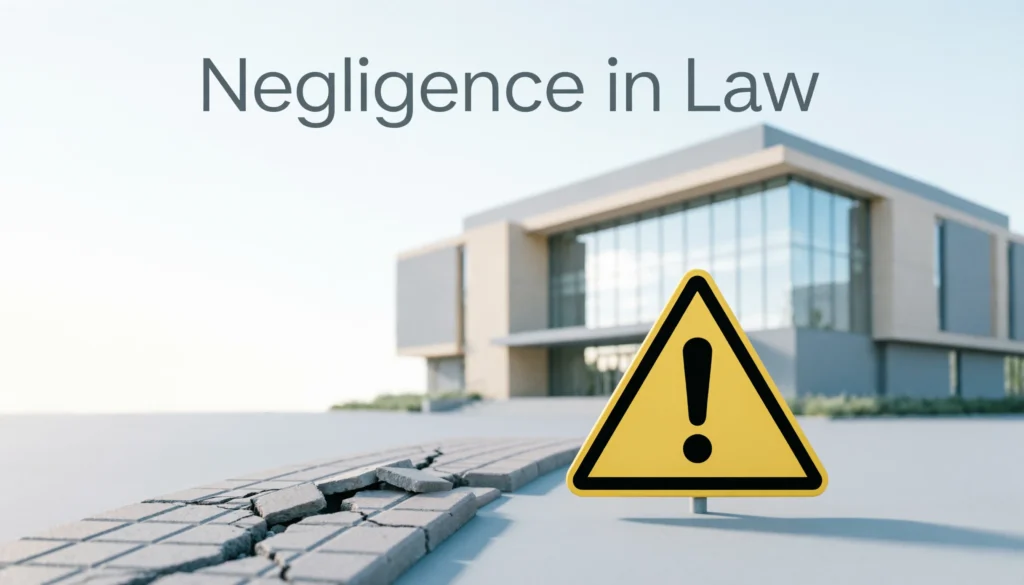
Negligence in law means failing to use reasonable care, resulting in harm or damage to another person.
To prove negligence, a party must show a duty of care existed, that duty was breached, harm occurred, and the breach caused the harm.
Most legal disputes don’t start with bad intentions they start with carelessness. When someone fails to act with reasonable care and another person gets hurt, the law calls that negligence. This concept is one of the foundations of personal injury law, civil liability, and everyday legal responsibility.
Why Negligence Matters in the Legal System
Negligence determines responsibility when harm happens without intent. It answers a key legal question:
👉 Who is legally responsible when someone is careless?
Courts apply negligence principles to situations involving:
- Car accidents
- Medical mistakes
- Unsafe property conditions
- Workplace injuries
- Consumer product defects
This concept helps balance individual freedom with responsibility for others’ safety.
Origin and Development of Negligence Law
The modern legal idea of negligence developed through English common law and evolved into a structured doctrine used worldwide.
Historical Background
Early courts focused mainly on intentional wrongdoing. Over time, judges recognized that carelessness can cause just as much harm as intentional acts. Legal systems gradually developed rules defining when careless behavior becomes legally actionable.
Today, negligence is a central concept in civil law, particularly in personal injury cases and liability disputes.
The Four Essential Elements of Negligence
To succeed in a negligence claim, a plaintiff must prove four legal elements. If any element is missing, negligence is not established.
1. Duty of Care
A legal obligation to act reasonably to avoid harming others.
Examples:
- Drivers must follow traffic laws.
- Doctors must provide competent treatment.
- Property owners must maintain safe premises.
2. Breach of Duty
Failure to meet the required standard of care.
Examples:
- Running a red light
- Ignoring safety warnings
- Failing to repair a dangerous condition
3. Causation
The breach must directly cause the harm.
Two parts of causation:
- Actual cause (the harm would not have happened otherwise)
- Proximate cause (the harm was reasonably foreseeable)
4. Damages
Actual harm must occur, such as:
- Physical injury
- Property damage
- Financial loss
- Emotional distress
Example Scenarios Table
| Situation | Duty of Care | Breach | Result | Negligence Likely? |
|---|---|---|---|---|
| Driver texting while driving | Drive safely | Distracted driving | Crash injury | Yes |
| Store ignores spill on floor | Maintain safe premises | Failure to clean hazard | Customer falls | Yes |
| Doctor follows standard procedure | Provide competent care | No breach | Patient recovers | No |
| Homeowner fixes broken steps promptly | Keep property safe | Duty fulfilled | No injury | No |
Real-World Usage of Negligence
Negligence appears frequently in court decisions, legal news, and civil lawsuits. Courts at all levels apply negligence standards when determining liability, including the Supreme Court of the United States when addressing broader legal principles.
Common Legal Statements
- “The defendant was negligent.”
- “The court found no negligence.”
- “Negligence caused the injury.”
The term is widely used because most personal injury cases rely on proving negligence rather than intentional harm.
Examples of Negligence in Context
Friendly Explanation
“The driver wasn’t paying attention and caused an accident that’s negligence.”
Neutral Legal Explanation
“The court found the defendant breached the duty of care, resulting in injury.”
Critical or Negative Tone
“The company’s negligence led to preventable harm.”
Everyday Understanding
“Someone failed to be careful when they should have been.”
Types of Negligence in Law
Negligence can appear in different legal forms depending on severity and context.
Ordinary Negligence
Failure to act with reasonable care.
Example: Forgetting to check blind spots while driving.
Gross Negligence
Extreme carelessness showing disregard for safety.
Example: Driving at high speed through a crowded area.
Comparative Negligence
Both parties share responsibility for harm.
Example: Two drivers both contribute to an accident.
Contributory Negligence
The injured party’s own carelessness contributes to the harm, sometimes limiting recovery.
Comparison With Related Legal Terms
Understanding similar terms helps clarify negligence.
| Term | Meaning | Difference From Negligence |
|---|---|---|
| Liability | Legal responsibility | Negligence is one way liability arises |
| Recklessness | Conscious disregard of risk | More severe than negligence |
| Intentional harm | Deliberate wrongdoing | Opposite of accidental carelessness |
| Duty of care | Legal obligation | One element of negligence |
| Malpractice | Professional negligence | Specific to licensed professionals |
Key Insight
Negligence involves carelessness, not intent.
Alternate Meanings of Negligence
Outside law, negligence simply means:
- Carelessness
- Inattention
- Failure to act responsibly
However, legal negligence has a precise definition requiring proof of duty, breach, causation, and damages.
Professional Alternatives to “Negligence”
Depending on context, professionals may use:
- Failure to exercise reasonable care
- Breach of duty
- Lack of due care
- Careless conduct
- Civil wrongdoing
These phrases often appear in legal writing and court opinions.
Why Courts Use Negligence Standards
Negligence law serves several purposes:
- Encourages responsible behavior
- Compensates injured parties
- Promotes public safety
- Provides fair rules for liability
It creates a structured method to evaluate everyday risks and responsibilities.
How Negligence Is Proven in Court
A negligence claim typically involves:
- Evidence of duty
- Proof of careless behavior
- Connection between behavior and harm
- Documentation of damages
Evidence may include:
- Witness testimony
- Expert opinions
- Medical records
- Photographs
- Accident reports
If all elements are proven, the court may award compensation.
FAQs
What does negligence mean in law?
It means failing to use reasonable care, resulting in harm to another person.
What are the four elements of negligence?
Duty of care, breach of duty, causation, and damages.
Is negligence intentional wrongdoing?
No. It involves carelessness, not deliberate harm.
What is an example of negligence?
A driver running a red light and causing an accident.
Can both parties be negligent?
Yes. Some cases involve shared responsibility.
What is gross negligence?
Serious carelessness showing extreme disregard for safety.
What happens if negligence is proven?
The responsible party may be required to pay compensation.
Is negligence a crime or a civil issue?
Usually civil, but extreme negligence can lead to criminal charges in some situations.
Conclusion
Negligence is one of the most important concepts in modern law because it defines responsibility for careless behavior that causes harm. Whether in traffic accidents, professional services, or property safety, the principle remains the same: people must act with reasonable care toward others.
Understanding negligence helps you interpret legal decisions, evaluate responsibility, and recognize how the law protects individuals from avoidable harm.
When courts find negligence, they are not saying someone intended harm. They are saying:
👉 A legal duty existed, reasonable care was not used, and harm resulted.
Discover More Related Articles:
- The Color Yellow Mean in the Bible: Light, Glory, and Faith in 2026
- Concubine Mean in the Bible: History and Insights for 2026

Sarah Williams is the passionate author behind WordNexy.com, dedicated to creating content that informs, inspires, and sparks curiosity. With a love for words and storytelling, she transforms ideas into meaningful articles that educate, entertain, and leave a lasting impression on every reader.