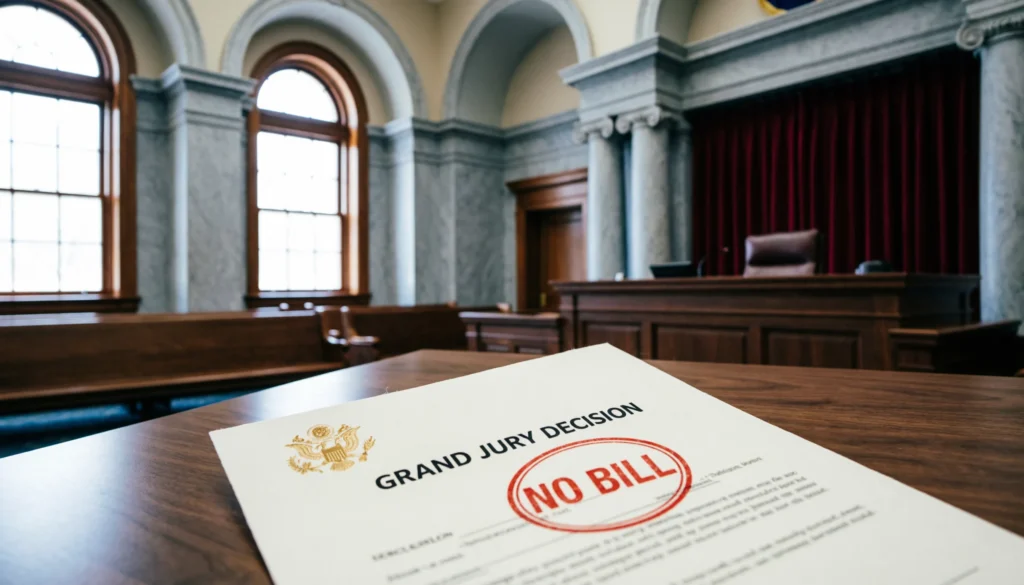
A no bill in court means a grand jury reviewed the prosecutor’s evidence and decided not to issue an indictment.
In simple terms, the jury found insufficient evidence to formally charge the accused with a crime, so the case does not proceed to trial at that time.
Imagine being investigated for a serious offense and waiting to learn whether charges will be filed. Then you hear, “The grand jury returned a no bill.” That phrase can sound confusing or intimidating, but its meaning is straightforward and legally important.
Understanding what a no bill means helps you see how criminal cases move forward or stop before trial.
This guide explains the meaning, origin, real-world use, tone, comparisons with related legal terms, and practical implications. Whether you are researching for knowledge, writing, or general curiosity, you will walk away with a clear understanding.
What Happens When a No Bill Is Issued?
A no bill occurs during the grand jury phase of criminal proceedings. Before certain serious criminal charges can be filed, prosecutors present evidence to a grand jury, a group of citizens tasked with deciding whether there is probable cause to charge someone.
If the grand jury votes not to indict:
- The case is dismissed at the charging stage
- The accused is not formally charged
- There is no criminal trial based on that presentation of evidence
- Prosecutors may revisit the case later if new evidence emerges
Think of it as a legal checkpoint. The prosecution did not meet the required threshold for charges.
Origin of the Term “No Bill”
The phrase dates back centuries to early common law traditions. Grand juries historically wrote their decision directly on the proposed indictment document:
- “True Bill” meant charges were approved
- “No Bill” meant charges were rejected
That notation became standard courtroom language and continues to be used today in criminal procedure.
Why Grand Juries Issue a No Bill
A grand jury does not determine guilt or innocence. Its role is narrower. It decides whether there is probable cause to charge someone.
A no bill usually results from one or more of these factors:
1. Insufficient Evidence
The prosecution did not present enough credible evidence linking the accused to the alleged crime.
2. Weak or Unreliable Witnesses
Witness testimony may be inconsistent, unclear, or legally inadmissible.
3. Legal Issues with Evidence
Evidence might have been obtained improperly, weakening the case.
4. Lack of Probable Cause
Even if wrongdoing seems possible, the threshold for formal charges was not met.
5. Credibility Concerns
Jurors may doubt the reliability of investigative methods or reports.
A no bill does not declare someone innocent. It simply means the evidence was not strong enough to support charges.
Real-World Usage of “No Bill”
You will typically see the term used in:
- Criminal case updates
- News reporting
- Court records
- Legal commentary
- Attorney statements
Tone and Context
The phrase itself is neutral, but surrounding context shapes its tone.
Neutral / Informational
“The grand jury returned a no bill after reviewing the evidence.”
Positive / Relief
“He expressed relief when the grand jury issued a no bill.”
Negative / Disappointed
“The victim’s family was disappointed by the no bill decision.”
Example
| Scenario | Context | Meaning | Tone |
|---|---|---|---|
| News Report | Grand jury returns no bill in investigation | Charges not approved | Neutral |
| Attorney Statement | We are pleased the grand jury issued a no bill | Defense success | Positive |
| Victim Statement | We are disappointed by the no bill | Charges rejected | Negative |
| Legal Record | Indictment status: No Bill | Case halted at charging stage | Formal |
Step by Step: How a No Bill Decision Happens
- Investigation occurs
Law enforcement gathers evidence. - Prosecutor presents evidence
The case is submitted to a grand jury. - Grand jury deliberates privately
Proceedings are confidential. - Vote is taken
A required number of jurors must agree to indict. - Decision recorded
True bill means charges filed.
No bill means no indictment.
No Bill vs Similar Legal Terms
Understanding related terminology helps prevent confusion.
Comparison Table
| Term | Meaning | Who Decides | Stage |
|---|---|---|---|
| No Bill | No indictment issued | Grand jury | Before trial |
| True Bill | Indictment approved | Grand jury | Before trial |
| Dismissed | Case terminated after filing | Judge | Various stages |
| Acquitted | Not guilty verdict | Trial jury | After trial |
| Declined to Prosecute | Charges never pursued | Prosecutor | Before grand jury |
Key Differences
- No bill vs dismissal
A dismissal usually occurs after charges are filed. A no bill prevents charges from being filed. - No bill vs acquittal
An acquittal occurs after a trial. A no bill happens before trial begins. - No bill vs declined prosecution
Sometimes prosecutors choose not to pursue charges at all. A no bill means the grand jury made that decision after reviewing evidence.
Can a Case Be Reopened After a No Bill?
Yes. A no bill does not permanently end a case.
Prosecutors may:
- Present new evidence to another grand jury
- Continue investigating
- File different charges based on new facts
Reopening a case usually depends on whether meaningful new evidence emerges.
Legal Impact on the Accused
A no bill carries important consequences.
Immediate Effects
- No criminal charges filed
- No criminal trial
- Release from custody if detained solely for that case
Long Term Considerations
- Investigation may remain open
- Public perception may vary
- Records of investigation may still exist
In everyday conversation, people often treat a no bill as legal relief, though it is not a declaration of innocence.
Tone and Communication Tips
When discussing a no bill professionally, wording matters.
Professional Alternatives
- The grand jury declined to indict
- No charges were authorized
- The case did not proceed to indictment
- Insufficient evidence for charges
Sensitive Communication
When addressing affected individuals:
- Use neutral language
- Avoid implying guilt or innocence
- Focus on procedure rather than opinion
Example:
“The grand jury determined there was insufficient evidence to file charges at this time.”
Alternate Meanings of “No Bill”
Outside criminal law, the phrase may occasionally appear in other contexts.
Legislative Context
A proposal or measure that was not approved.
Informal Usage
Rarely used figuratively to mean rejected or not approved.
Common Misconceptions
Myth: A no bill means the person is innocent
Reality: It means insufficient evidence for charges.
Myth: A no bill permanently closes the case
Reality: Cases can be revisited if new evidence appears.
Why the Concept Matters
Understanding what a no bill means helps you:
- Interpret criminal case news accurately
- Understand legal procedure
- Avoid confusing it with acquittal or dismissal
- Recognize how evidence thresholds work
It is an important safeguard that prevents charges without adequate proof.
FAQs
- What does no bill mean in court?
It means the grand jury decided not to issue an indictment because the evidence did not meet the standard of probable cause. - Is a no bill the same as not guilty?
No. A not guilty verdict happens after a trial, while a no bill occurs before any trial begins. - Can prosecutors try again after a no bill?
Yes. If new or stronger evidence emerges, the case may be presented to the grand jury again. - Does a no bill clear someone’s record?
Not completely. A no bill prevents formal charges but does not erase records of the investigation. - Who decides whether to issue a no bill?
The grand jury makes this decision not a judge or prosecutor. - How common are no bill decisions?
They are less common than indictments and usually happen when evidence is weak or incomplete. - What happens after a no bill?
The accused is not charged, and the case does not proceed to trial, though the investigation may remain open. - What is the opposite of a no bill?
A true bill, which means the grand jury approved charges and an indictment is issued.
Conclusion
Understanding what no bill means in court comes down to one core idea. The grand jury determined there was not enough evidence to formally charge the accused. It is not a verdict, not a dismissal after trial, and not proof of innocence. It is a procedural safeguard that stops a case before it advances.
When you see the term in legal news or court records, you now know exactly what it signals. The legal system paused the case because the evidence did not meet the required standard for charges.
Discover More Related Articles:
- RSVP Meaning in English: Complete Guide with Origin and Examples (2026)
- What Does LOI Stand For in Business Transactions? (2026)

Sarah Williams is the passionate author behind WordNexy.com, dedicated to creating content that informs, inspires, and sparks curiosity. With a love for words and storytelling, she transforms ideas into meaningful articles that educate, entertain, and leave a lasting impression on every reader.