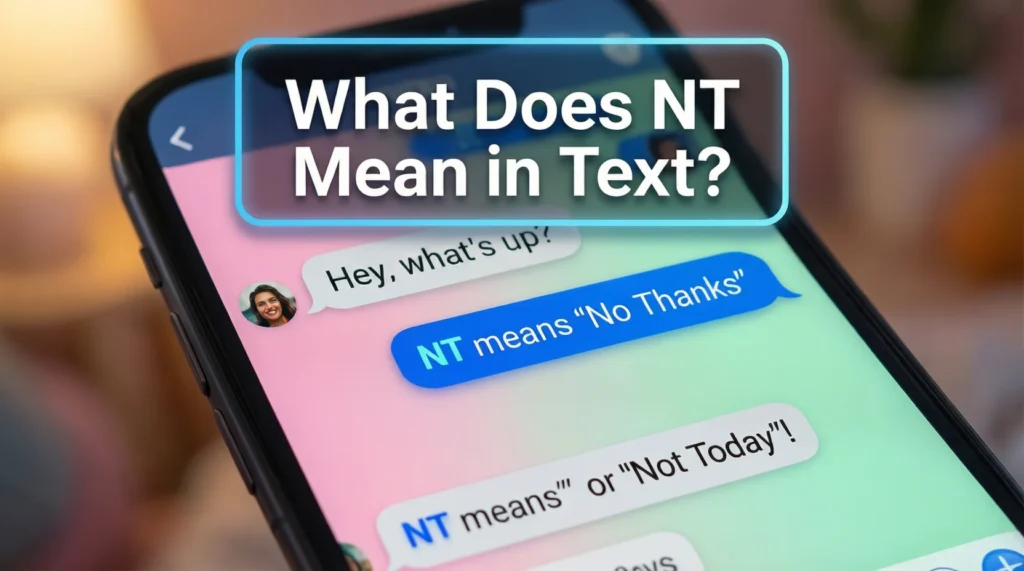
NT in text stands for “No Thanks,” indicating polite refusal or declining something in a chat or online conversation.
In the world of texting, acronyms and shorthand are everywhere. One of the abbreviations you might have come across is “NT Mean in Text”. But what does it actually mean?
Whether you’ve seen it in a chat with friends, on social media, or in an online forum, understanding “NT” can save you from confusion and help you communicate more effectively.
In this article, we’ll break down what NT means in text, its origin, real-world usage, examples, comparisons with related terms, and alternative meanings. By the end, you’ll be able to spot and use NT like a pro.
It can sometimes also mean “Nice Try” in gaming contexts, but its primary usage in texting is as a concise, polite way to say no.
Origin of NT in Texting
Texting shorthand became popular as mobile phones spread in the late 1990s and early 2000s. Limited character counts and slower typing speeds encouraged people to use abbreviations.
- Early shorthand: Abbreviations like “LOL” (Laugh Out Loud) and “BRB” (Be Right Back) paved the way.
- NT adoption: NT likely evolved as a quick way to say “No Thanks” without typing a full sentence.
- Popularity: Today, it’s widely recognized across messaging apps, social media, and online forums.
How NT is Used in Texts
NT is mainly used in casual digital communication to indicate refusal, decline, or disinterest. Its tone is usually polite, neutral, and concise.
Example contexts:
- Invitations:
Friend: “Do you want to come to the movie tonight?”
You: “NT, maybe next time.” - Sales or promotions:
Online chat: “Would you like to try our premium subscription?”
You: “NT, thanks.” - Group chats:
Someone proposes an idea: “Let’s play a game!”
You: “NT, busy today.”
NT is especially handy when you want to respond quickly without sounding rude.
NT Usage in Different Tones
| Tone | Example | Explanation |
|---|---|---|
| Friendly | “NT, but I’ll join next time 😊” | Polite and casual refusal |
| Neutral | “NT, thanks” | Straightforward and minimal emotion |
| Dismissive | “NT” | Can sound blunt if used alone |
| Professional | “NT, I appreciate the offer” | Maintains politeness in formal contexts |
Tip: Tone matters. Using NT alone can sometimes come across as curt, so adding “thanks” or an emoji softens it.
Comparison with Related Abbreviations
| Abbreviation | Meaning | Difference from NT |
|---|---|---|
| NVM | Never Mind | Cancels a previous message, not a refusal |
| LOL | Laugh Out Loud | Expresses amusement, unrelated to refusal |
| BRB | Be Right Back | Temporarily leaving a conversation, not declining |
| TY / THX | Thank You | Polite acknowledgment, does not indicate decline |
| No TY / NTY | No Thank You | Similar to NT, slightly longer and clearer |
Alternate Meanings of NT
While “No Thanks” is the most common interpretation in texting, NT can also mean different things in other contexts:
- Gaming: NT = Nice Try, used to acknowledge an attempt
- Technical/Professional: NT = Network Time, New Technology, Non-Transferable
- Medical: NT = Nuchal Translucency, used in pregnancy scans
Context is key. The meaning changes depending on the conversation or field.
Examples
| Context | Example | Interpretation |
|---|---|---|
| Casual chat | “NT, I’m good for now” | Polite decline |
| Social media comment | “NT, maybe later” | Saying no politely |
| Gaming | “You lost the round” → “NT!” | Nice Try, acknowledging effort |
| Professional email | “NT, I appreciate your offer” | Polite refusal |
| Family chat | “Want some snacks?” → “NT, thanks” | Friendly decline |
Tips for Using NT in Texting
- Add a polite word or emoji to avoid sounding blunt.
- Use in casual contexts like chats with friends or family.
- Be mindful in professional settings; pair NT with polite language.
- Combine with other shorthand: “NT, TY!” shows both refusal and gratitude.
- Observe the conversation tone; NT alone can sometimes seem abrupt.
FAQs
- What does NT stand for in texting?
NT usually stands for “No Thanks,” used to politely decline something. - Can NT mean something else?
Yes, it can mean “Nice Try,” “No Typing,” “Network Time,” or other field-specific terms. - Is NT rude?
NT alone can seem blunt; adding “thanks” or an emoji makes it polite. - How do I use NT in a professional chat?
Pair it with a polite phrase: “NT, I appreciate the offer.” - Is NT common in social media?
Yes, it is widely used in casual platforms like WhatsApp, Instagram, and Discord. - Can NT replace ‘No Thank You’?
Yes, NT is a shortened version of “No Thank You.” - What’s the difference between NT and NVM?
NT declines or refuses; NVM cancels or retracts a previous message. - Can NT be used in gaming?
Yes, NT often means “Nice Try” in gaming contexts.
Conclusion:
Understanding NT in texting is simple once you know the context. Most of the time, it means No Thanks, offering a polite and concise way to decline. In gaming, it can mean Nice Try, while in technical or professional contexts, it may have other meanings.
By mastering NT, you’ll text more efficiently, avoid confusion, and communicate politely in digital conversations.
Search More Related Articles :
- RSVP Meaning in English: Complete Guide with Origin and Examples (2026)
- What Does LOI Stand For in Business Transactions? (2026)

Sarah Williams is the passionate author behind WordNexy.com, dedicated to creating content that informs, inspires, and sparks curiosity. With a love for words and storytelling, she transforms ideas into meaningful articles that educate, entertain, and leave a lasting impression on every reader.