Definition:
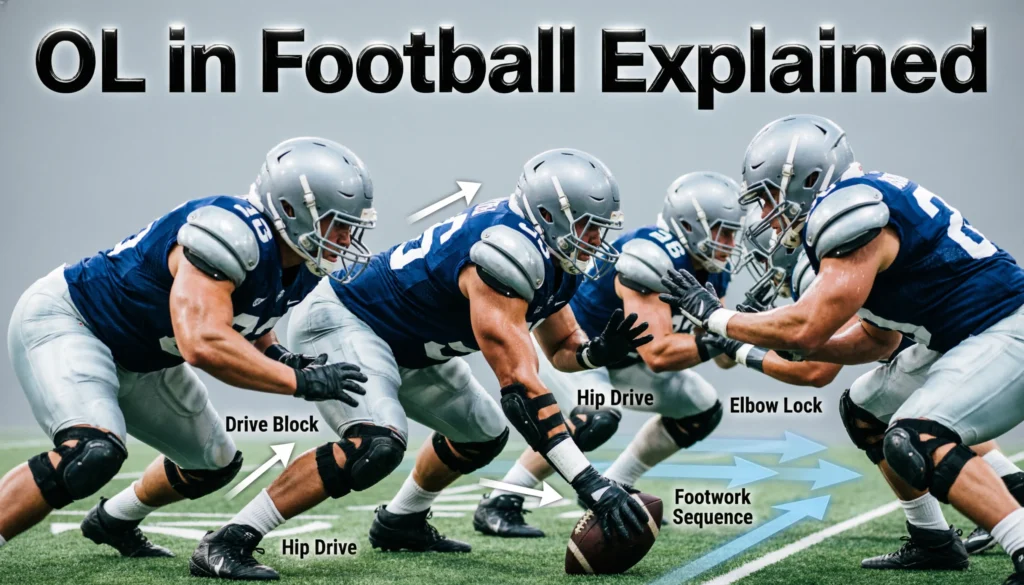
OL in football stands for Offensive Line, the group of players whose primary job is to block defenders, protect the quarterback, and create running lanes for ball carriers.
If you have watched a football game and heard commentators mention “the OL did a great job,” they are talking about the unit that quietly controls the game’s physical battle at the line of scrimmage. They may not score touchdowns, but they make most offensive success possible.
This guide explains what OL means in football, where the term comes from, how it is used in real games, and how it compares with related football positions and abbreviations.
What “OL” Means in Plain English
In football, OL refers to the Offensive Line, which typically includes five players positioned at the front of the offense.
These players are:
- Center
- Left Guard
- Right Guard
- Left Tackle
- Right Tackle
Their main responsibilities are:
- Protecting the quarterback during passing plays
- Blocking defenders for running plays
- Preventing defensive penetration
- Controlling the line of scrimmage
In simple terms, the OL is the offense’s protection and power unit.
Origin and Popularity of the Term
The abbreviation OL developed as football strategy and media coverage became more technical. Coaches, commentators, and analysts began using shorthand position labels to simplify communication.
Today, OL is widely used across:
- Professional football
- College football
- High school football
- Sports media
- Fantasy football analysis
You will frequently hear the term in coverage of the National Football League, where offensive line performance is considered one of the most important factors in team success.
How the Offensive Line Functions During a Play
Understanding OL requires seeing how each player works together.
Before the Snap
- The line sets formation
- The center prepares to snap the ball
- Players identify defensive threats
During a Passing Play
- Tackles block edge rushers
- Guards block interior defenders
- The center anchors the middle
- The unit forms a protective pocket
During a Running Play
- Linemen push defenders backward
- They open running lanes
- They execute coordinated blocking schemes
The OL must function as a synchronized unit. One breakdown can collapse the entire play.
Real-World Usage in Football Conversations
Friendly Fan Conversation
“Our OL dominated today. The quarterback had so much time to throw.”
Neutral Broadcast Analysis
“The offensive line allowed zero sacks and controlled the defensive front.”
Critical or Negative Tone
“The OL struggled all game and couldn’t protect the quarterback.”
Even casual fans quickly learn that OL performance often determines game outcomes.
Offensive Line Positions Explained
| Position | Location | Primary Role |
|---|---|---|
| Center | Middle of line | Snaps ball and blocks interior defenders |
| Guard | Next to center | Blocks defensive tackles and blitzers |
| Tackle | Outer edges | Protects quarterback from edge rushers |
Each position requires a combination of strength, technique, awareness, and coordination.
Why the OL Is Crucial to Team Success
The offensive line influences nearly every offensive statistic.
Impact on Passing Game
- Provides time for routes to develop
- Prevents sacks and quarterback hits
- Enables deep passing plays
Impact on Running Game
- Creates rushing lanes
- Controls defensive front movement
- Determines rushing efficiency
Strategic Impact
- Dictates tempo of offense
- Reduces turnovers caused by pressure
- Enables play-action effectiveness
A strong OL makes the entire offense more efficient.
Comparison With Related Football Terms
Understanding OL is easier when compared with similar abbreviations.
| Term | Meaning | Side of Ball | Role |
|---|---|---|---|
| OL | Offensive Line | Offense | Blocks and protects |
| DL | Defensive Line | Defense | Attacks and pressures |
| QB | Quarterback | Offense | Leads offense and passes |
| RB | Running Back | Offense | Carries the ball |
| TE | Tight End | Offense | Blocks and receives passes |
The OL directly opposes the defensive line on every play.
Common Football Phrases Involving OL
You will often hear OL used in phrases such as:
- Strong offensive line play
- OL protection breakdown
- Elite OL unit
- Offensive line depth
- Dominant trench battle
These phrases highlight how central the offensive line is to football strategy.
Alternate Meanings of OL
Outside football, OL can mean different things depending on context, including:
- Online
- Offensive Lineman singular
- Organizational Leader in business settings
However, in sports discussions, OL almost always refers to the offensive line.
Professional and Analytical Alternatives
In formal football analysis, OL may be replaced with:
- Offensive line unit
- Offensive front
- Blocking unit
- Protection unit
These alternatives are common in coaching reports and sports journalism.
When Analysts Emphasize the OL Most
Experts typically highlight the offensive line when:
- A quarterback is frequently pressured
- A team has a strong running attack
- Injuries affect protection performance
- A game is won in physical matchups
- Evaluating championship contenders
Football strategy often begins with line play.
Practical Tips for Understanding OL in Games
If you want to evaluate offensive line performance while watching football:
- Watch how long the quarterback has before pressure
- Observe running lanes on rushing plays
- Notice penalties like holding or false start
- Look for defenders breaking through quickly
- Listen to commentators discussing protection
Once you focus on the OL, you will notice how often they determine success.
Example Game Situations Table
| Situation | OL Performance | Result |
|---|---|---|
| Clean pocket | Strong blocking | Successful pass play |
| Defensive pressure | Protection breakdown | Sack or incomplete pass |
| Wide running lane | Effective run blocking | Long rushing gain |
| Penalty on OL | Mistimed movement | Loss of yardage |
| Goal line stand | Physical dominance | Touchdown or stop |
FAQs:
1. What does OL stand for in football positions?
OL stands for Offensive Line.
2. How many players are on the offensive line?
There are typically five players.
3. Is an offensive lineman allowed to carry the ball?
Usually no, unless a special play design allows it.
4. Why is the offensive line important?
They protect the quarterback and create running opportunities.
5. What is the difference between OL and DL?
OL blocks defenders, while the defensive line attacks the offense.
6. Do offensive linemen score touchdowns?
Rarely, but it can happen in special situations.
7. What skills do offensive linemen need?
Strength, coordination, awareness, and technique.
8. Is OL used in fantasy football analysis?
Yes, analysts evaluate OL strength when predicting player performance.
Conclusion
Understanding what OL means in football gives you a deeper appreciation of how the game really works. The offensive line is the foundation of every successful offense. These players protect the quarterback, open running lanes, and control the physical battle at the line of scrimmage on every play.
While they may not score points or receive the spotlight, their performance often determines whether an offense thrives or struggles. Strong offensive line play leads to better passing protection, more effective rushing attacks, and fewer mistakes caused by defensive pressure.
For fans, recognizing the role of the OL transforms how you watch the game.
Discover More Related Articles:
- Shabbat Shalom Mean in English: Usage, and Significance in 2026
- PFP Mean in Text: Complete Guide for Social Media Users (2026)

James Anderson is an experienced content writer and language researcher who focuses on explaining word meanings, definitions, slang terms, and modern expressions. He writes for WordNexy.com, where his articles are designed to provide accurate meanings, practical usage examples, and easy-to-understand explanations for readers worldwide.