Definition :
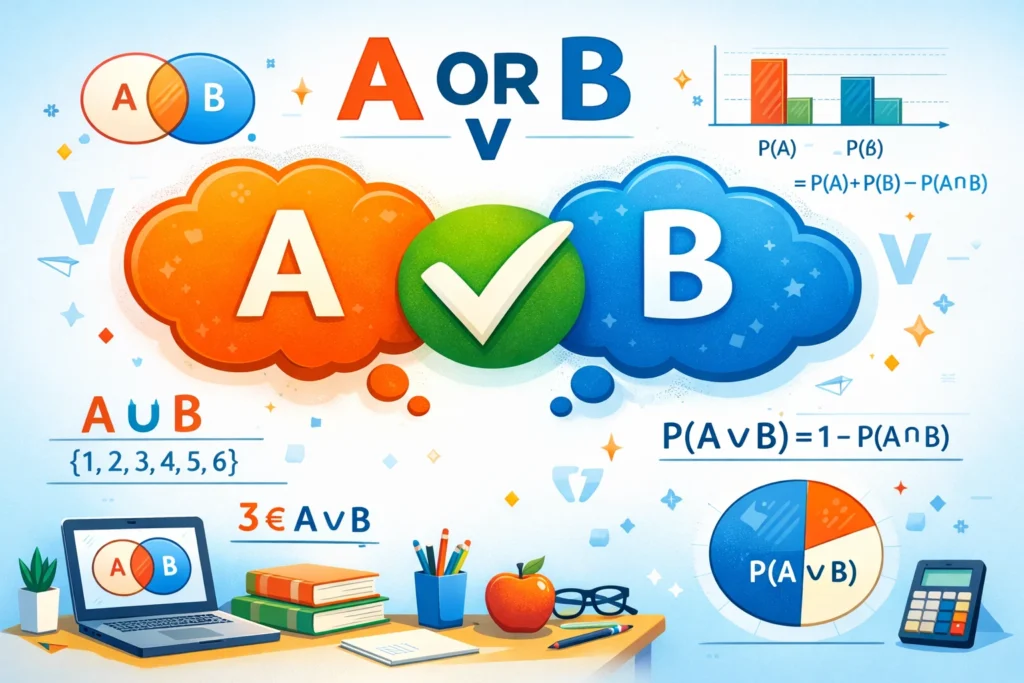
In math, “OR” is a logical operator used to connect two or more statements, where the result is true if at least one of the statements is true.
It is a fundamental concept in logic, set theory, probability, and computer science, often represented by the symbol ∨.
Origin of “OR” in Math
The word “OR” comes from everyday English, meaning a choice between options. In mathematics, it was adopted as part of formal logic in the 19th century. Logicians like George Boole (1815–1864) formalized the concept in what we now call Boolean algebra, which uses “AND,” “OR,” and “NOT” to describe logical relationships.
Boole’s work allowed mathematicians and computer scientists to translate human reasoning into symbolic statements, which are essential in programming, circuit design, and probability theory. The popularity of “OR” has grown alongside technology, as it forms the backbone of decision-making in computers and algorithms.
How “OR” is Used in Math
The OR operator appears in several branches of mathematics:
- Logic:
- Combines statements or propositions.
- True if at least one statement is true.
- Example:
- Statement A: “It is raining.”
- Statement B: “It is snowing.”
- A OR B is true if either it is raining, or it is snowing, or both.
- Set Theory:
- OR corresponds to the union of sets.
- Symbolically: A∪B includes all elements in A, B, or both.
- Probability:
- OR is used to calculate the probability that at least one of multiple events occurs.
- Formula (for mutually exclusive events): P(A OR B)=P(A)+P(B)
- For events that can occur simultaneously: P(A OR B)=P(A)+P(B)−P(A AND B)
- Computer Science & Programming:
- OR is a key operator in programming languages like Python, Java, and C.
- Written as
||in many languages ororin Python. - Example in Python: if is_raining or is_snowing:
print(“Take an umbrella!”)
Examples of OR in Math
Here are clear examples that show how OR works in different contexts:
| Context | Statement A | Statement B | A OR B Result | Explanation |
|---|---|---|---|---|
| Logic | It is raining | It is sunny | True | One of the statements is true (raining) |
| Set Theory | {1,2,3} | {3,4,5} | {1,2,3,4,5} | Union of the sets contains all elements |
| Probability | Rolling a 2 | Rolling a 4 | 2/6 + 1/6 = 1/3 | At least one favorable outcome occurs |
| Computer Programming | x > 5 | y < 10 | True | Either condition being true satisfies the OR |
Tone Examples with OR
- Friendly tone:
“Think of OR as saying ‘either one or the other or both!’ 😊 It’s very flexible!” - Neutral tone:
“The OR operator evaluates statements such that the outcome is true if at least one component is true.” - Negative/dismissive tone:
“You might think OR is confusing, but it’s really just the opposite of AND it only needs one statement to be true.”
Comparison With Related Terms
| Term | Meaning | How It Differs From OR |
|---|---|---|
| AND | True only if both statements are true | Requires all conditions to be true |
| NOT | Reverses the truth value of a statement | OR does not negate; it combines truth values |
| XOR (Exclusive OR) | True only if exactly one statement is true | OR allows both to be true, XOR does not |
Example of XOR vs OR:
- A = True, B = True
- A OR B = True
- A XOR B = False
Alternate Meanings of OR in Math
While “OR” is primarily a logical operator, in some contexts it may refer to:
- Odds Ratio (OR) in statistics, measuring the association between events.
- Occasionally, casual use in word problems may simply mean “either one or the other”.
It’s always important to check context to avoid confusion.
Professional Alternatives to OR
In academic or technical writing, you can use:
- Logical disjunction (formal term in logic)
- Union (set theory context)
- Inclusive choice (informal but precise in educational contexts)
FAQs
- What does OR mean in algebra?
OR in algebra typically refers to logical operations, especially when dealing with inequalities or set operations. - Is OR the same as + in math?
Not exactly. While OR may resemble addition in probability for mutually exclusive events, it is fundamentally a logical operator, not arithmetic. - How do you write OR in math symbols?
Usually as ∨. For example, A∨B means A OR B. - Can OR be used with more than two statements?
Yes! OR can combine any number of statements. The result is true if at least one statement is true. - What is the difference between OR and XOR?
OR is inclusive (true if one or both statements are true), whereas XOR is exclusive (true only if exactly one statement is true). - How does OR work in probability?
OR calculates the likelihood that at least one of several events occurs. If events are not mutually exclusive, subtract the intersection. - Is OR only used in math?
No, OR is widely used in computer programming, statistics, logic puzzles, and daily decision-making. - Can OR ever be false?
Yes, OR is false only when all connected statements are false.
Practical Tips for Using OR in Math
- Remember OR is inclusive: it allows both conditions to be true.
- In probability, watch out for overlaps and use the formula: P(A OR B)=P(A)+P(B)−P(A AND B)
- In programming, always check syntax, as OR may differ (
||,or) across languages. - Use truth tables to visualize complex OR statements.
Conclusion
The OR operator is simple but powerful. It allows mathematicians, programmers, and students to evaluate statements flexibly, understand probabilities, and model real-world choices. From logic and set theory to probability and programming, OR helps us handle situations where one option or multiple options can be true.
By understanding OR, its alternatives, and its proper usage, you can confidently tackle math problems, write precise code, and even make everyday decisions more logically.
Discover More Related Articles:
- Understanding FIP in Baseball: Definition, Formula, and Uses (2026)
- TW in Jewelry Meaning: What It Really Stands For (2026)

Amanda Lewis is a professional content writer and word-meaning researcher who specializes in explaining definitions, slang, abbreviations, and modern language terms. She writes for WordNexy.com, where she creates clear, accurate, and reader-friendly articles to help users understand word meanings and proper usage. Her work is especially useful for students, writers, and online readers seeking quick and reliable explanations.