✅ Definition:
PPM stands for “parts per million.” In water, it measures the concentration of a substance dissolved in water meaning how many parts of a contaminant or mineral exist per one million parts of water.
For example:
If water contains 10 ppm of chlorine, that means there are 10 parts of chlorine in 1,000,000 parts of water.
In simple terms:
👉 The higher the PPM, the more of that substance is present in the water.
Ever looked at a water test report and seen a tiny number followed by “ppm” and wondered what it actually means? You’re not alone.
Whether you’re checking drinking water quality, testing your aquarium, maintaining a swimming pool, or reviewing a lab report, understanding PPM in water is essential. That small abbreviation plays a big role in determining whether your water is safe, clean, or potentially harmful.
Why Understanding PPM in Water Matters
Water might look crystal clear, but it can still contain dissolved substances such as:
- Minerals (calcium, magnesium)
- Chemicals (chlorine, fluoride)
- Metals (lead, iron)
- Salts
- Fertilizers (nitrates)
- Contaminants
PPM helps measure how much of these substances are present even in tiny amounts.
And here’s the important part:
Some substances are safe at low PPM levels but dangerous at high levels.
Origin of the Term “PPM”
The term parts per million (PPM) comes from scientific measurement systems used in chemistry and environmental science.
Scientists needed a way to measure:
- Very small concentrations
- Dissolved substances
- Trace chemicals in water, air, and soil
Because many contaminants exist in extremely tiny amounts, percentages were too large a unit. So instead of saying 0.0001%, scientists used 1 ppm which is much easier to understand and communicate.
Today, PPM is widely used in:
- Environmental testing
- Water treatment
- Laboratory analysis
- Agriculture
- Aquariums
- Swimming pool maintenance
How PPM Works in Water
Think of PPM like this:
Imagine:
- 1 million drops of water in a large container
- 1 drop of ink added
That equals 1 ppm of ink.
Now imagine:
- 10 drops of ink added
That equals 10 ppm.
💡 In Water Measurements:
For water specifically:
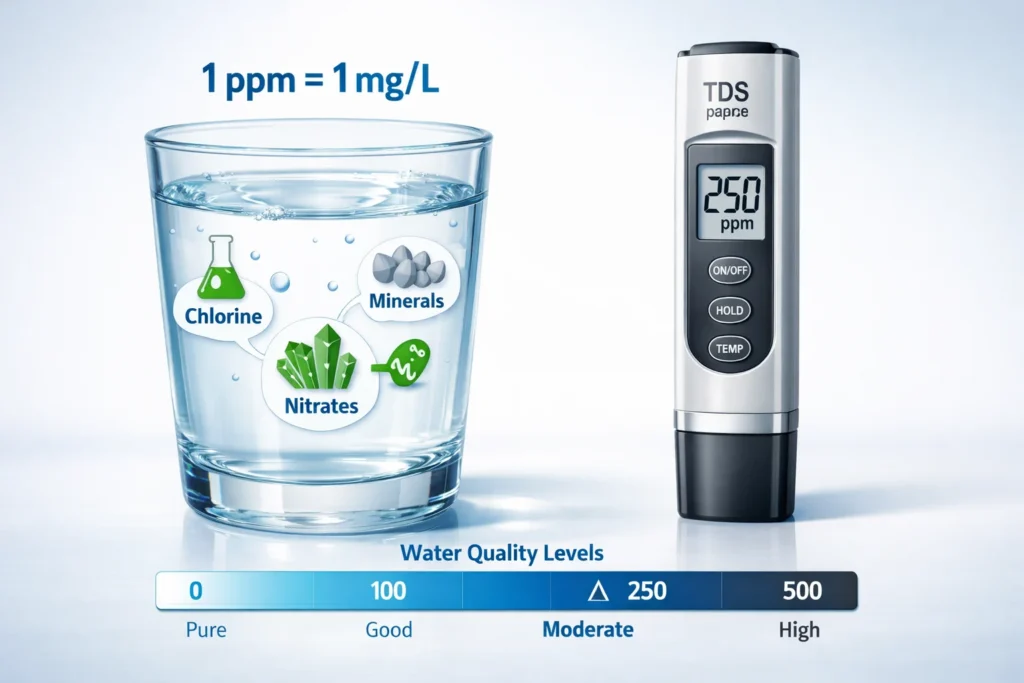
1 ppm ≈ 1 milligram per liter (mg/L)
Since 1 liter of water weighs about 1 kilogram, this conversion works well in water testing.
Common Substances Measured in PPM
Here are some typical water components measured in PPM:
| Substance | What It Affects | Safe Range (Drinking Water) |
|---|---|---|
| Total Dissolved Solids (TDS) | Taste & hardness | Below 500 ppm (recommended) |
| Chlorine | Disinfection | 1–4 ppm (pools) |
| Fluoride | Dental health | Around 0.7 ppm |
| Nitrates | Health risk | Below 10 ppm |
| Iron | Taste & staining | Below 0.3 ppm |
| Lead | Toxic metal | 0 ppm (ideally none) |
⚠️ Even small numbers can matter significantly.
Real-World Usage of PPM in Water
1️⃣ Drinking Water Testing
Water quality reports often list contaminants in ppm. Regulatory bodies like the Environmental Protection Agency (EPA) set safe drinking water limits in ppm.
For example:
- Nitrates above 10 ppm may pose health risks.
- Lead should ideally be 0 ppm.
2️⃣ Aquariums 🐠
Fish are highly sensitive to chemical changes.
Aquarium owners monitor:
- Ammonia (0 ppm is ideal)
- Nitrite (0 ppm is ideal)
- Nitrate (under 40 ppm preferred)
Even small increases can stress fish.
3️⃣ Swimming Pools 🏊
Pool chlorine levels are measured in ppm:
- Ideal chlorine: 1–4 ppm
- Too low? Water may grow bacteria.
- Too high? Eye and skin irritation 😖
4️⃣ Agriculture
Farmers test irrigation water for:
- Salt levels
- Mineral buildup
- Fertilizer concentration
High PPM salt can damage crops.
5️⃣ Industrial Water Systems
Manufacturing plants monitor dissolved solids to prevent:
- Corrosion
- Scale buildup
- Equipment damage
What Is TDS in PPM?
TDS stands for Total Dissolved Solids.
It measures the total amount of dissolved substances in water including minerals, salts, and metals.
General TDS Guidelines:
| TDS (ppm) | Water Quality |
|---|---|
| 0–50 | Very pure |
| 50–150 | Excellent |
| 150–250 | Good |
| 250–500 | Fair |
| 500+ | Poor |
Keep in mind:
Low TDS doesn’t always mean “healthy” and high TDS doesn’t always mean “dangerous.” It depends on what substances are present.
PPM vs Other Measurement Units (Comparison)
Understanding PPM is easier when compared to related terms.
| Unit | Meaning | When Used |
|---|---|---|
| PPM | Parts per million | Water, soil, air |
| PPB | Parts per billion | Very tiny concentrations |
| mg/L | Milligrams per liter | Water testing |
| % | Percent | Larger concentrations |
Key Differences:
- 1 ppm = 1 mg/L (in water)
- 1 ppm = 1,000 ppb
- Percent (%) is much larger than ppm
Example:
- 1% = 10,000 ppm
Is High PPM in Water Bad?
It depends on what the PPM is measuring.
🔹 High Mineral PPM (Hard Water)
- Causes scale buildup
- Leaves white residue
- Not usually dangerous
🔹 High Contaminant PPM
- Lead? Dangerous.
- Nitrates? Risky for infants.
- Chlorine? Irritating at high levels.
So the substance matters more than the number alone.
Friendly, Neutral & Concerned Usage Examples
Here’s how PPM might appear in everyday situations:
Friendly:
“Your pool chlorine is at 3 ppm perfect! 👍”
Neutral:
“The lab report shows iron at 0.2 ppm.”
Concerned:
“Lead levels are 15 ppm this requires immediate attention.”
Tone depends on context and safety standards.
Alternate Meanings of PPM
While in water testing PPM means “parts per million,” it can also mean:
- Pages per minute (printing)
- Pulse position modulation (electronics)
- Project portfolio management (business)
But in water quality discussions, it almost always means concentration measurement.
How to Measure PPM in Water
You can measure PPM using:
- TDS meters
- Digital water testers
- Chemical test strips
- Laboratory analysis
A handheld TDS meter gives quick readings in seconds.
Steps:
- Turn on the meter
- Insert into water sample
- Wait for digital ppm reading
Simple and fast!
When Should You Worry About PPM?
You should investigate further if:
- TDS exceeds 500 ppm in drinking water
- Nitrates exceed 10 ppm
- Lead is detected at any level
- Chlorine in pools exceeds 5 ppm
Always compare readings with official safety standards.
FAQs
1. What does ppm mean in water testing?
PPM means parts per million. It measures how much of a substance is dissolved in water.
2. Is 500 ppm safe for drinking water?
Generally, yes. The Environmental Protection Agency recommends TDS below 500 ppm for palatability.
3. What is a good ppm for pool water?
Chlorine levels should stay between 1–4 ppm for safe swimming.
4. Does higher ppm mean dirtier water?
Not necessarily. It depends on what is dissolved. High mineral content may not be harmful.
5. How do I lower ppm in water?
You can use:
- Reverse osmosis systems
- Distillation
- Deionization filters
6. Is 0 ppm possible?
Yes distilled water can measure 0 ppm, meaning nearly no dissolved solids.
7. What is the difference between ppm and mg/L?
In water, they are practically equal: 1 ppm ≈ 1 mg/L.
8. What ppm level is dangerous?
It depends on the substance. For example:
- Lead: any detectable level is concerning
- Nitrates: above 10 ppm may be unsafe
Practical Tips for Interpreting PPM
✔ Always check what substance is being measured
✔ Compare readings with official safety standards
✔ Use calibrated testing tools
✔ Don’t panic over TDS alone
✔ Retest if results seem unusual
Conclusion:
PPM in water stands for parts per million, a unit used to measure how much of a substance is dissolved in water.
It helps us:
- Ensure drinking water safety
- Maintain healthy aquariums
- Keep swimming pools clean
- Monitor environmental quality
The key takeaway?
👉 PPM tells you concentration but context tells you whether it’s safe.
Understanding PPM empowers you to make smarter decisions about water quality, health, and maintenance.
Small numbers can make a big difference.
Discover More Related Articles:
- PFP Mean in Text: Complete Guide for Social Media Users (2026)
- Shabbat Shalom Mean in English: Usage, and Significance in 2026

James Anderson is an experienced content writer and language researcher who focuses on explaining word meanings, definitions, slang terms, and modern expressions. He writes for WordNexy.com, where his articles are designed to provide accurate meanings, practical usage examples, and easy-to-understand explanations for readers worldwide.