In the Bible, praise refers to the act of expressing admiration, honor, and gratitude toward God for His character, deeds, and blessings.
It involves both verbal acknowledgment and heartfelt worship, recognizing God’s greatness, power, and mercy.
Praise is not just about singing or speaking; it is a full response of reverence, joy, and devotion that aligns the believer’s heart and actions with God’s glory.
Understanding the Origin of Praise in the Bible
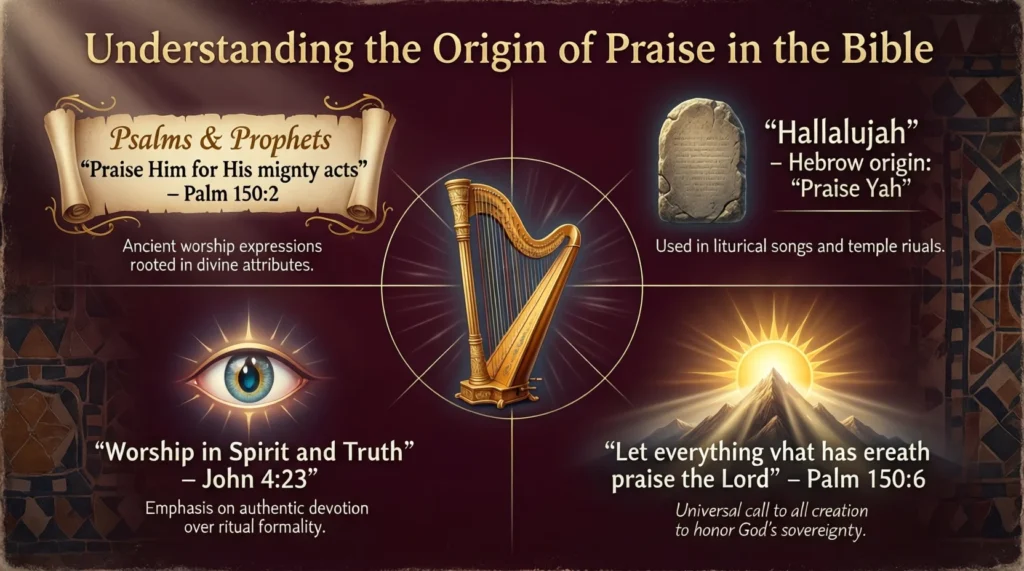
The concept of praise in Scripture is deeply rooted in Hebrew and Greek terms that appear throughout the Old and New Testaments.
- Hebrew (Old Testament): The word tehillah (תְּהִלָּה) translates to “praise” or “song of praise.” It is often used to describe songs or expressions that honor God’s name, such as in the Psalms.
- Greek (New Testament): The term aineo (αἰνέω) signifies “to praise” or “to celebrate” and frequently refers to worship, giving thanks, or public acknowledgment of God’s goodness.
Historically, praise in biblical culture was an outward expression of inner devotion. It often accompanied music, singing, clapping, and dancing (Psalm 150:4–6). Praise was a communal and personal act, connecting believers to God and to one another in worship.
Why Praise is Important in the Bible

Praise is a vital component of a believer’s spiritual life for several reasons:
- Acknowledgment of God’s Glory: Praise recognizes God’s supreme authority and majesty (Psalm 145:3).
- Spiritual Strength: Praise strengthens faith and brings joy even in challenging circumstances (Habakkuk 3:17–18).
- Encouragement for Others: When shared publicly, praise inspires and encourages fellow believers (Hebrews 13:15).
- Spiritual Warfare: Praise can act as a spiritual weapon, demonstrating trust in God’s power over adversities (2 Chronicles 20:22).
How Praise is Expressed in the Bible
Biblical praise is multifaceted, encompassing words, actions, and attitudes:
| Mode of PraiseBiblical ExamplePurpose / Meaning | ||
|---|---|---|
| Singing | Psalm 95:1–2 | Express joy and worship through music |
| Verbal Acknowledgment | Psalm 100:4 | Declare God’s goodness and faithfulness |
| Dancing / Physical Expression | 2 Samuel 6:14 | Celebrate God’s presence with the body |
| Offering / Sacrifice | Psalm 50:14 | Show devotion through acts of obedience |
| Prayer | Daniel 2:23 | Recognize God’s wisdom and provision |
Practical Tip: Modern believers can incorporate praise through worship music, spoken gratitude, journaling blessings, and sharing testimonies.
Real-World Usage and Popularity of Praise
Praise is not confined to church settings. It permeates daily life for people of faith:
- In Personal Devotion: Individuals use praise to start and end their day with gratitude.
- In Public Worship: Congregational singing, reading Psalms, and collective prayer.
- In Social Media: Many Christians share verses, testimonies, or worship playlists as a form of digital praise.
- Cross-Cultural Influence: Praise has inspired music genres like gospel, contemporary Christian music, and hymns worldwide.
Tip: Praise does not always require elaborate rituals; even simple acknowledgments of God’s blessings count.
Examples of Praise in the Bible
Here are a few contexts where praise appears, showing varied tones and situations:
- Friendly / Joyful Tone:
- Psalm 150:1–2: “Praise the Lord! Praise God in his sanctuary; praise him in his mighty heavens!”
- Here, praise is celebratory and full of joy.
- Neutral / Reverent Tone:
- Psalm 145:1–2: “I will exalt you, my God the King; I will praise your name forever and ever.”
- Respectful acknowledgment of God’s authority.
- Praise in Adversity:
- Habakkuk 3:17–18: Even in hardship, believers are encouraged to rejoice and praise God.
- Demonstrates praise as faith and trust rather than emotion-driven only.
Praise vs. Related Biblical Terms
Understanding praise in context is easier when compared with similar terms:
| Term | Meaning | Difference from Praise |
|---|---|---|
| Worship | Deep reverence expressed through devotion | Praise is part of worship, often verbal or musical |
| Thanksgiving | Gratitude for specific blessings | Praise is broader; includes admiration of God’s character |
| Extol / Glorify | To honor highly or magnify | Praise emphasizes ongoing acknowledgment, not just one-time glorification |
| Adoration | Loving devotion | Praise may include adoration but is not limited to affection; it’s also acknowledgment |
Alternate Meanings and Contexts
While “praise” in the Bible primarily refers to honoring God, in secular contexts it can also mean:
- Expressing approval or admiration for people or achievements (“The teacher praised the student’s essay”).
- Recognition of good deeds or quality, not necessarily spiritual.
Pro Tip: When using “praise” in a biblical study or devotional context, clarify that it pertains to God to avoid ambiguity.
Polite and Professional Alternatives to Praise
In scholarly or formal writing about faith, consider these alternatives:
- Exalt – Highlighting God’s supreme position.
- Glorify – Recognizing God’s greatness in words or actions.
- Magnify – Emphasizing God’s qualities or deeds.
- Give thanks – Specific expression of gratitude within praise.
FAQs
1. What does it mean to praise God in the Bible?
It means acknowledging God’s greatness, expressing gratitude, and exalting His name through words, actions, or worship.
2. How is praise different from worship?
Praise is a component of worship, often verbal or musical, while worship is broader, including lifestyle, obedience, and devotion.
3. Can I praise God in difficult times?
Yes! Biblical examples, such as Habakkuk 3:17–18, show that praise can strengthen faith during trials.
4. What are the Hebrew and Greek words for praise?
- Hebrew: Tehillah – praise or song of praise
- Greek: Aineo – to celebrate or honor
5. Are there specific Psalms dedicated to praise?
Yes, many Psalms, like Psalms 100, 150, and 145, focus entirely on praising God.
6. Can praise be non-verbal?
Absolutely! Dancing, clapping, and offering acts of service are forms of praise.
7. How often should a Christian praise God?
Ideally, praise should be a daily practice, both privately and publicly, as an expression of continual gratitude and devotion.
8. Is praise only for good times?
No. Praise is appropriate in both joyous and challenging circumstances, demonstrating trust in God’s sovereignty.
Conclusion
Praise in the Bible is more than words it is a lifestyle of acknowledging, glorifying, and trusting God. Whether through song, prayer, or actions, it connects believers to God’s presence, strengthens faith, and inspires others.
By understanding biblical praise, practicing it daily, and using it creatively in modern life, we can experience deeper joy, spiritual growth, and communal encouragement.
Search More Related Articles :

James Anderson is an experienced content writer and language researcher who focuses on explaining word meanings, definitions, slang terms, and modern expressions. He writes for WordNexy.com, where his articles are designed to provide accurate meanings, practical usage examples, and easy-to-understand explanations for readers worldwide.