Definition:
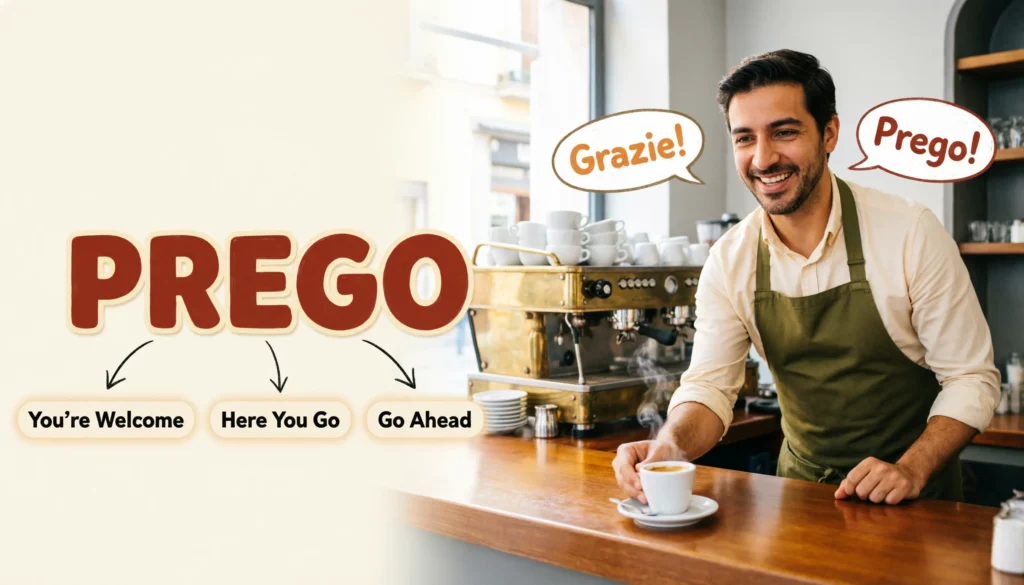
Prego is an Italian word that most commonly means “you’re welcome” in English, but it can also mean “please,” “go ahead,” “after you,” or “here you are,” depending on context. It is used as a polite response after someone says thank you or when offering something to another person.
If you’ve ever heard someone say “prego!” in a movie, restaurant, or while traveling in Italy, you might wonder what it actually means in English. At first glance it seems like a simple word, but “prego” is one of the most versatile and commonly used words in the Italian language.
It can mean “you’re welcome,” “here you go,” “please go ahead,” or even “after you.” The exact meaning depends on the situation and tone.
Understanding this single word can instantly make conversations with Italian speakers feel more natural and polite.
Origin of the Word “Prego”
The word prego comes from the Italian verb pregare, which means “to pray” or “to request politely.”
Historically, the term developed as a polite way to say:
- “I pray that you accept”
- “I request that you go ahead”
- “Please allow me”
Over time, the meaning evolved into a general-purpose polite expression used in everyday interactions.
In modern Italian conversations, “prego” is a social courtesy word, similar to how English speakers use phrases like:
- “You’re welcome”
- “No problem”
- “Go ahead”
- “Sure”
Because of its flexibility, prego is one of the first Italian words travelers learn.
Most Common Meanings of “Prego” in English
Here are the primary meanings of “prego” depending on the situation.
| Situation | Meaning in English | Example |
|---|---|---|
| Responding to thanks | You’re welcome | “Grazie!” → “Prego!” |
| Offering something | Here you go | Giving someone food or an item |
| Allowing someone to go first | After you | Holding a door open |
| Inviting someone to speak | Go ahead | When someone wants to ask a question |
| Customer service | How can I help? | Used by waiters or clerks |
Because of this versatility, tone and context are important when translating “prego.”
How “Prego” Is Used in Real Conversations
Let’s look at real-life examples where the meaning changes depending on context.
1. Responding to “Thank You”
This is the most common usage.
Italian Conversation
Person A: Grazie!
Person B: Prego!
English Translation
Person A: Thank you!
Person B: You’re welcome!
This is the standard polite response in Italian.
2. Giving Someone Something
When handing someone an object, Italians often say “prego.”
Example:
Waiter: Ecco il vostro caffè. Prego.
Translation: Here is your coffee. Here you go.
Tone: Friendly and polite.
3. Letting Someone Go First
When opening a door or stepping aside.
Example:
Person A: Prego.
Translation: After you.
Tone: Courteous and respectful.
4. Inviting Someone to Speak
Sometimes “prego” means “go ahead” when someone wants to ask a question.
Example:
Student: Posso fare una domanda?
Teacher: Prego.
Translation:
Student: Can I ask a question?
Teacher: Go ahead.
Tone: Encouraging and polite.
Example Sentences with Tone
Below are different contexts and tones for using “prego.”
| Sentence | Meaning | Tone |
|---|---|---|
| Grazie mille! — Prego! | Thank you very much — You’re welcome! | Friendly |
| Prego, si accomodi. | Please, go ahead. | Polite |
| Ecco il menu. Prego. | Here is the menu. | Professional |
| Prego, entri pure. | Please come in. | Welcoming |
| Prego! 😊 | You’re welcome! | Warm and casual |
Why “Prego” Is So Popular
There are several reasons prego is used frequently in Italian conversation.
1. It Is Extremely Versatile
Unlike English phrases that require different expressions, prego covers many polite situations.
2. It Shows Courtesy
Italian culture places strong emphasis on politeness and hospitality, and “prego” helps maintain a respectful tone.
3. It Works in Formal and Informal Settings
You can use it:
- With friends
- With strangers
- In restaurants
- In business settings
This flexibility makes it a core vocabulary word for learners.
Common Situations Where You Will Hear “Prego”
You’re likely to hear “prego” in these situations:
Restaurants
Waiter: Prego, il vostro tavolo è pronto.
Translation: Your table is ready.
Stores
Clerk: Prego, posso aiutarti?
Translation: May I help you?
Everyday Politeness
Someone says thank you → Prego
Comparison With Similar Italian Words
To understand “prego” better, it helps to compare it with other Italian courtesy expressions.
| Word | Meaning | When Used |
|---|---|---|
| Prego | You’re welcome / Go ahead | General polite response |
| Grazie | Thank you | Expressing gratitude |
| Per favore | Please | Making a request |
| Figurati | No problem | Casual response |
| Di niente | It’s nothing | Humble response to thanks |
Key Difference
- Prego = standard polite response
- Figurati = casual among friends
- Di niente = humble or modest
Alternate Meanings of “Prego”
Although prego usually means “you’re welcome,” there are a few lesser-known meanings.
1. In Formal Contexts
It can mean “please proceed.”
Example:
Prego, continui.
Translation: Please continue.
2. Customer Service Context
Staff may use it to mean:
- “Yes?”
- “How can I help?”
Example:
Customer: Scusi!
Clerk: Prego?
Translation:
Customer: Excuse me!
Clerk: Yes, how can I help?
3. As a Polite Invitation
Example:
Prego, si sieda.
Translation: Please, sit down.
Polite English Alternatives to “Prego”
If you want to translate prego naturally into English, you might use:
Formal Alternatives
- You’re welcome
- My pleasure
- Certainly
- Please go ahead
Casual Alternatives
- No problem
- Anytime
- Sure
- Of course
The best choice depends on context and tone.
Common Mistakes When Using “Prego”
Language learners sometimes misuse the word. Here are a few common mistakes.
1. Using It Instead of “Please”
“Prego” is not usually used when asking for something.
Incorrect:
Prego, give me water.
Correct:
Per favore (please) give me water.
2. Thinking It Only Means “You’re Welcome”
While that’s the most common meaning, remember it can also mean:
- Go ahead
- Here you go
- After you
Context determines meaning.
Cultural Insight: Why Italians Love Polite Expressions
Italian communication style emphasizes warmth and courtesy.
Words like:
- Grazie (thank you)
- Prego (you’re welcome)
- Per favore (please)
help maintain friendly social interactions.
You’ll often hear them used multiple times in a short conversation.
Example:
Customer: Grazie!
Waiter: Prego!
Customer: Grazie ancora!
Waiter: Prego, buona giornata!
Translation:
Customer: Thank you!
Waiter: You’re welcome!
Customer: Thanks again!
Waiter: You’re welcome, have a nice day!
Practical Tips for Using “Prego”
If you’re learning Italian or traveling, here are some tips.
Use “Prego” When Someone Says Thank You
This is the safest and most common usage.
Pair It With Friendly Body Language
A smile makes the response feel natural.
Listen to Context
It may mean go ahead or here you go, depending on the situation.
FAQs:
- What does prego mean in English?
Prego most commonly means “you’re welcome,” “please,” or “go ahead” depending on the context in Italian conversation. - Is prego the same as “you’re welcome”?
Yes, prego is the standard Italian response to “grazie” (thank you), making it equivalent to “you’re welcome.” - Can prego mean “please”?
Yes. When offering something or inviting someone to act, prego can mean “please” or “go ahead.” For example: “Prego, entri.” means “Please, come in.” - Do Italians say prego often?
Yes. Prego is extremely common in everyday Italian speech, especially in polite interactions. - What is the difference between “prego” and “figurati”?
“Prego” is polite and neutral, while “figurati” is informal and friendly. - Can prego mean “sorry”?
No. Prego does not mean sorry. The Italian word for sorry is “mi dispiace.” - Why do waiters say prego in restaurants?
In restaurants, prego usually means “how can I help you?” or “go ahead.” - Is prego formal or informal?
Prego works in both formal and informal situations, making it one of the most versatile Italian words.
Conclusion
The Italian word “prego” may look simple, but it plays a big role in everyday conversation.
At its core, it means “you’re welcome.” However, depending on the situation it can also mean:
- Here you go
- Go ahead
- After you
- Please proceed
Its versatility, politeness, and cultural significance make it one of the most useful Italian words to learn.
If you ever visit Italy or interact with Italian speakers, remembering this simple word will help your conversations feel more natural and respectful.
Discover More Related Articles:

Sarah Williams is the passionate author behind WordNexy.com, dedicated to creating content that informs, inspires, and sparks curiosity. With a love for words and storytelling, she transforms ideas into meaningful articles that educate, entertain, and leave a lasting impression on every reader.