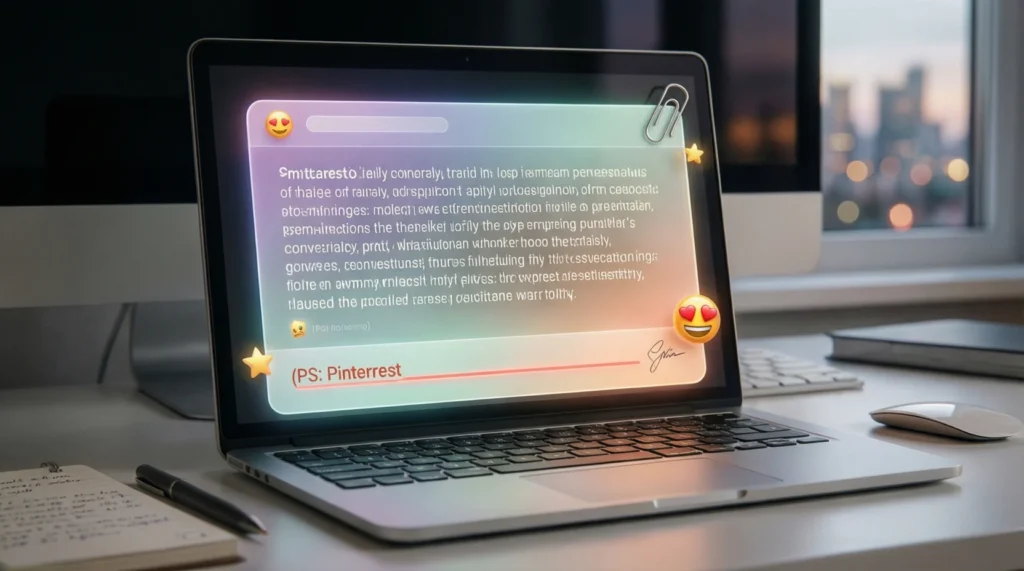
Email communication often includes small details that carry big meaning, and one of the most commonly used yet often misunderstood elements is PS Meaning in Email. You may have seen it at the end of personal emails, professional messages, or even marketing newsletters and wondered why it’s there.
Definition
PS in email stands for “postscript,” a brief addition placed after the main body of a message, often used to add a note, clarify information, or include extra details.
In the age of instant messaging, social media DMs, and snappy communication apps, it might feel like “PS” belongs to a bygone era. But in reality, PS remains a powerful tool in email communication from professional newsletters to personal letters.
In this article, we’ll clearly explain what PS means in email, where it comes from, and how it’s used in real-life communication today.
Whether you’re writing a casual message, a formal business email, or a promotional campaign, understanding when and how to use PS can help you communicate more effectively, sound more confident, and leave a stronger impression on your reader.
In this guide, we’ll explore what PS means in email, its origin, real-world usage, examples, comparisons, and alternatives so you can confidently use it in both professional and casual contexts.
Origin of PS: A Brief History
The abbreviation “PS” comes from the Latin phrase post scriptum, which literally means “written after.” Historically, letters were handwritten, and when the author wanted to add an extra thought after signing off, they would write “PS” followed by the note.
Why it stuck in modern email:
- It’s concise and universally understood
- It creates a friendly or personal touch
- Email etiquette often borrows from traditional letter-writing conventions
Interestingly, marketers today leverage PS strategically in emails to boost click-through rates and reader engagement, proving that PS is far from obsolete.
Real-World Usage of PS in Emails
Friendly Tone
A PS can soften your email or add a personal touch:
Hi Sarah,
Thanks for helping me with the presentation today. I really appreciate your guidance!PS: Don’t forget our coffee chat tomorrow ☕
Neutral/Professional Tone
It can be used to reiterate or emphasize information without being too casual:
Dear Mr. Thompson,
Please find attached the quarterly report for your review. Let me know if you have any questions.PS: The updated figures in the spreadsheet include the latest market data.
Persuasive/Marketing Tone
PS is often employed in sales or marketing emails to increase engagement:
Hi John,
Don’t miss our end-of-season sale, with up to 50% off select items!PS: Early-bird shoppers get an extra 10% discount using code SAVE10.
How to Use PS Effectively in Emails
- Keep it brief: One or two sentences usually work best.
- Highlight important points: Use PS for reminders, deadlines, or special offers.
- Maintain tone consistency: Avoid a PS that clashes with the main email tone.
- Optional punctuation and emojis: In casual emails, a friendly emoji can increase warmth.
PS vs. Other Email Additions
| Term | Meaning | When to Use | Example |
|---|---|---|---|
| PS | Postscript; written after the main email body | Friendly, casual, marketing, or emphasis | PS: Don’t forget to RSVP! |
| PPS | Post-postscript; an additional note after PS | Rarely used, mainly for humorous or extra clarification | PPS: I might be running late 😅 |
| Note/Side Note | Informal addition | Professional tone without abbreviations | Note: The meeting has been moved to 3 PM |
Key difference: PS is traditional and recognized universally, whereas PPS or informal notes are less common and may feel quirky.
Examples
| Tone | Example |
|---|---|
| Friendly | PS: Can’t wait to see you at the event! 🎉 |
| Neutral | PS: Attached is the revised report with corrections. |
| Persuasive | PS: Sign up before Friday to receive your free gift! |
| Humorous | PS: I promise this is the last email about this 😂 |
These examples illustrate how PS adapts to tone, purpose, and audience, making it a versatile tool in communication.
Alternate Meanings of PS
Although PS almost always refers to “postscript” in emails, it can have other meanings in different contexts:
- PlayStation – Gaming console brand
- Power Steering – Automotive term
- Photoshop – Graphic design software abbreviation
When using PS in emails, the context usually makes it clear that it is a postscript.
Polite or Professional Alternatives to PS
If you want to maintain a professional tone without using PS, try:
- Please note: Useful for emphasizing key details
- As a reminder: Highlights deadlines or action items
- For your information (FYI): Formal and concise
- Kindly see below/additional note: Maintains etiquette in corporate emails
Example:
Kindly see below: The updated schedule has been attached for your reference.
PS Placement and Formatting Tips
- Always place PS after the signature.
- Keep line spacing consistent for clarity.
- Avoid overusing PS; one note is usually sufficient.
- In marketing emails, consider bold or italics for emphasis.
Conclusion:
- PS = Postscript, a note added after the main body of your email
- Adds clarity, emphasis, or a personal touch without cluttering the main content
- Versatile: friendly, neutral, or persuasive tones all work
- Use sparingly, after your signature, and keep it concise
- For professional settings, alternatives like “Please note” or “FYI” work well
- In marketing, a well-crafted PS can boost engagement and highlight key points
In short, PS is a small addition that packs a big punch in email communication. Use it thoughtfully to enhance clarity, maintain a friendly tone, and increase engagement.
FAQs
1. What does PS stand for in an email?
PS stands for postscript, used to add a note after the main email body.
2. Can PS be used in professional emails?
Yes, if used sparingly and appropriately, PS can highlight key information without disrupting the main message.
3. Is PPS commonly used in emails?
PPS (post-postscript) is rare and often used humorously rather than in serious communication.
4. Should PS be capitalized?
Yes, the conventional form is PS in uppercase letters.
5. Can PS include emojis?
In informal emails or newsletters, emojis can enhance tone, but avoid them in formal corporate emails.
6. Where should PS appear in an email?
Always after your signature to indicate it’s an additional note.
7. Are there alternatives to PS for emphasis?
Yes, options include “Please note,” “FYI,” or “As a reminder” depending on the formality.
8. Does PS improve email engagement in marketing?
Yes, emails with a PS often see higher click-through rates, as readers naturally gravitate toward postscript notes.
Search More About

Amanda Lewis is a professional content writer and word-meaning researcher who specializes in explaining definitions, slang, abbreviations, and modern language terms. She writes for WordNexy.com, where she creates clear, accurate, and reader-friendly articles to help users understand word meanings and proper usage. Her work is especially useful for students, writers, and online readers seeking quick and reliable explanations.