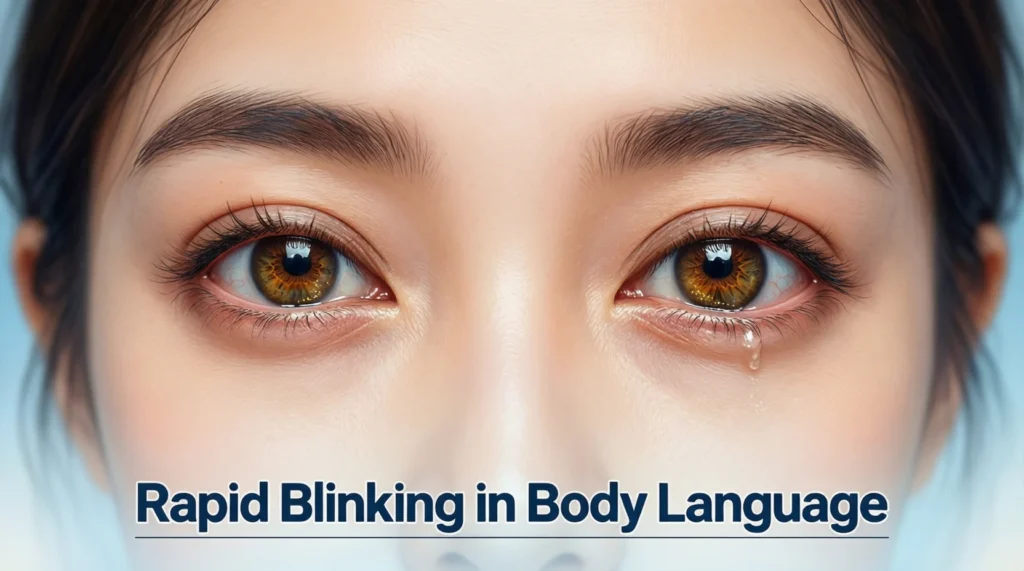
Rapid blinking in body language often refers to a noticeable increase in how frequently a person blinks compared to their normal rate. While Rapid Blinking Meaning in Body Language and Human Behavioris a natural and automatic function, sudden or excessive blinking can be a nonverbal cue that reveals what someone may be feeling internally.
In many cases, rapid blinking is linked to stress, nervousness, anxiety, excitement, or cognitive overload. It can appear during uncomfortable conversations, high-pressure situations, or moments when a person is processing intense emotions or information.
Definition:
Rapid blinking in body language refers to a fast, repeated closing and opening of the eyelids. It is often an unconscious signal that can indicate nervousness, stress, excitement, surprise, discomfort, or even deceit depending on the context
Understanding rapid blinking is essential for interpreting nonverbal cues accurately in personal, professional, and social interactions.
From a body language and psychology perspective, rapid blinking acts as a subtle signal of the brain responding to stimulation or emotional arousal. It may indicate that a person feels overwhelmed, defensive, uncertain, or even attracted, depending on the context.
What Is Rapid Blinking?
Blinking is a natural reflex that helps protect and lubricate the eyes. On average, humans blink 15–20 times per minute. However, when blinking occurs more rapidly than usual, it can be a form of nonverbal communication.
Rapid blinking is usually subtle, but it can reveal a lot about a person’s emotional state. Unlike deliberate gestures, this action is often involuntary, making it a useful clue in body language analysis.
Origin and Popularity of Rapid Blinking in Body Language Studies
The study of rapid blinking and other subtle eye movements originates from nonverbal communication research and psychology. Pioneers like Paul Ekman explored how microexpressions and involuntary facial cues reveal emotions. Rapid blinking gained attention because it is one of the few involuntary cues that reliably reflect inner feelings.
Over time, rapid blinking has become widely discussed in:
- Psychology and therapy sessions for assessing anxiety or stress
- Corporate environments for understanding colleagues’ reactions in meetings
- Interpersonal relationships for detecting discomfort, interest, or deception
- Media and pop culture where it is often exaggerated for dramatic effect
Common Meanings of Rapid Blinking
The meaning of rapid blinking can vary depending on context, tone, and other body language signals. Here’s a quick guide:
| Context | Possible Meaning | Example |
| Nervousness or Anxiety 😰 | The person is stressed or uneasy | A student rapidly blinks before giving a speech |
| Discomfort or Disbelief 😳 | Signals doubt or awkwardness | During a heated discussion, someone blinks rapidly when challenged |
| Excitement or Surprise 😮 | Shows heightened alertness or enthusiasm | Seeing a favorite celebrity in person may trigger rapid blinking |
| Lying or Concealing 🤥 | May indicate dishonesty or withholding info | A person avoiding eye contact while giving a story might blink faster |
| Fatigue or Eye Irritation 😴 | Physical reason rather than emotional | Working long hours may cause rapid blinking to refresh eyes |
Examples
Understanding rapid blinking becomes easier with real-world examples. Let’s break it down by tone:
Friendly or Positive Tone
- You meet a new coworker who is excited to talk about a shared project. Their eyes light up, and they blink rapidly in anticipation.
- Interpretation: Excitement or enthusiasm; a positive nonverbal cue.
Neutral or Observational Tone
- In a classroom, a student blinks rapidly while trying to follow a complex explanation.
- Interpretation: Focus, concentration, or mild stress.
Negative or Dismissive Tone
- During a tense negotiation, someone rapidly blinks while responding vaguely.
- Interpretation: Nervousness, doubt, or subtle avoidance.
Emoji Tip: Using emojis when analyzing rapid blinking in informal writing helps convey tone😰 for nervous, 😮 for surprised, 🤥 for deception.
Comparison With Related Terms
Rapid blinking is often discussed alongside other eye-related body language cues:
| Term | Definition | Difference from Rapid Blinking |
| Slow Blinking | Prolonged eye closure, often signaling relaxation | Opposite of rapid blinking, usually calm |
| Eye Darting | Quick lateral eye movement | Focuses on scanning or avoidance rather than blinking speed |
| Winking | Intentional single-eye closure | Conscious and deliberate; rapid blinking is usually involuntary |
| Eye Contact Avoidance | Looking away frequently | Could accompany rapid blinking when nervous or lying |
Alternate Meanings of Rapid Blinking
While rapid blinking is commonly an emotional or psychological signal, it can also have physical causes:
- Medical conditions: Dry eyes, allergies, eye strain, or neurological disorders
- Medication side effects: Some drugs may increase blink rate
- Environmental factors: Bright lights, dust, or screen glare
Always consider the context emotional interpretation is less reliable if there is an obvious physical cause.
Polite and Professional Alternatives
When interpreting rapid blinking in professional or social settings, it’s best to remain polite and neutral:
- Instead of assuming nervousness: “It seems they might be processing a lot of information.”
- Instead of assuming dishonesty: “They may need more time to respond.”
- In therapy or coaching contexts: Ask open-ended questions rather than pointing out blinking patterns.
This approach ensures nonjudgmental communication while still noticing subtle cues.
Example
| Situation | Likely Meaning | Suggested Action |
| Job interview | Nervousness or stress | Maintain supportive tone; give time to answer |
| Casual conversation | Excitement | Mirror enthusiasm subtly |
| Conflict discussion | Discomfort or disbelief | Clarify statements; avoid confrontation |
| Long screen work | Eye strain | Offer a break or adjust lighting |
Conclusion
Rapid blinking is a subtle but powerful part of body language that can reveal emotions like nervousness, excitement, discomfort, or even deceit. However, context is key, and physical causes like eye strain should not be overlooked.
By observing other cues, practicing empathy, and responding professionally, you can better interpret rapid blinking and use it to enhance communication, understanding, and connection in daily interactions.
FAQs
- What does rapid blinking indicate in body language?
Rapid blinking often indicates stress, nervousness, excitement, or surprise, depending on the context. - Can rapid blinking mean someone is lying?
Sometimes, rapid blinking accompanies deception, but it’s not a definitive sign. Other cues must be considered. - Is rapid blinking always emotional?
No. Physical causes like eye strain, allergies, or fatigue can also trigger rapid blinking. - How can I tell if rapid blinking is stress or excitement?
Look at other signals like posture, facial expressions, and tone of voice. - Does rapid blinking happen more in men or women?
There’s no significant gender difference; it’s more influenced by emotional and physical factors. - Can rapid blinking be controlled?
People can consciously slow their blinking, but involuntary rapid blinking usually reflects subconscious feelings. - Is rapid blinking a sign of attraction?
It can be, especially when combined with dilated pupils, smiling, and leaning in but context is key. - How to respond when someone blinks rapidly in conversation?
Stay calm, maintain a neutral tone, and avoid assuming their emotional state outright.
Search More Related Articles :

Amanda Lewis is a professional content writer and word-meaning researcher who specializes in explaining definitions, slang, abbreviations, and modern language terms. She writes for WordNexy.com, where she creates clear, accurate, and reader-friendly articles to help users understand word meanings and proper usage. Her work is especially useful for students, writers, and online readers seeking quick and reliable explanations.